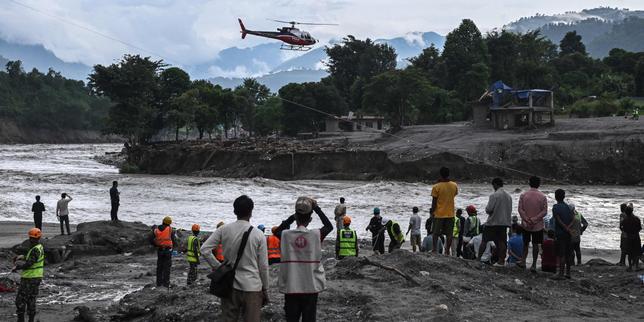
When a massive ice-rock avalanche collapsed down the northern face of Langtang Lirung, triggering a catastrophic debris torrent through the Bhotekoshi river basin, the official death toll quickly climbed past one thousand souls, with thousands more left missing in the Himalayan mud. For years, Kathmandu has warned that the roof of the world is turning into a hazard zone of melting glaciers and unstable slopes. Yet, the response from industrial superpowers and international financial institutions has been reduced to hollow diplomatic platitudes and bureaucratic foot-dragging.
Nepal’s government is demanding roughly $5 billion to rebuild what has been washed away. That figure represents nearly ten percent of the nation's entire economy. To cover these staggering expenses, Kathmandu has formally bypassed traditional aid requests, aiming its diplomatic artillery directly at major historic emitters like the United States, China, and India. This is no longer framed as a plea for charitable handouts. It is a calculated demand for legal and moral liability.
The mechanics of this crisis expose a glaring design flaw in how the world handles climate disaster recovery. When the United Nations Fund for Responding to Loss and Damage was established after years of grueling negotiations at successive climate summits, vulnerable nations were promised a lifeline. The reality on the ground looks entirely different. Wealthy nations have slow-walked contributions, leaving the fund with a paltry $820 million in total pledges. Under its current operational constraints, individual project payouts are capped at a meager $20 million.
Handing a $20 million check to a country facing a $5 billion catastrophe is not just inadequate. It is an insult.
The Trap of Single-Event Attribution
Skeptics in capital cities across the globe love to hide behind legalistic red tape, arguing that individual weather events or geological failures cannot be cleanly tied to global carbon emissions. Scientists note that the initial trigger in the Himalayas was a physical slope failure, a mountain destabilized by complex tectonic and geological factors.
This creates a convenient bureaucratic shield for industrial giants. If an avalanche starts with a crumbling rock face, polluting nations can shrug off responsibility, ignoring the atmospheric heating that turns glaciers into thawing butter.
The scientific reality is far more integrated. A warming atmosphere acts as a continuous threat multiplier. It alters precipitation cycles, melts permafrost, and hyper-accelerates the vulnerability of high-altitude ecosystems. Treating a mountain collapse as a purely isolated geological incident ignores the thermodynamic reality of a planet overloaded with greenhouse gases.
Geopolitical Friction in the Himalayas
Nepal finds itself trapped between two regional heavyweights that happen to be among the world's largest carbon emitters. While Kathmandu has publicly called out India, China, and the United States for their cumulative historical emissions, the diplomatic maneuvering is fraught with tension. Trade dependencies complicate matters immensely. Two-thirds of Nepal's trade flows through India, while major infrastructure projects like transboundary trade ports have historically altered local valley dynamics.
Placing the blame squarely on major emitters satisfies domestic political necessity, but it risks triggering a defensive diplomatic freeze. Major industrial powers have historically treated compensation claims as dangerous precedents that could open the floodgates to trillions of dollars in liability lawsuits. Consequently, rather than stepping up with substantial reparation packages, donor nations prefer to stick to emergency humanitarian aid rations. Aid keeps the recipient dependent. Compensation implies justice.
The Empty Vaults of International Finance
The international architecture designed to handle climate shocks is functionally bankrupt before it even begins to scale. Wealthy governments routinely make grandiose pledges at annual summits, only to watch funding stall in domestic legislative bodies. The United States has historically fought to keep liability and compensation clauses out of global climate agreements, fearing open-ended financial exposure. Other major economies have similarly dragged their feet, treating climate finance as an optional foreign policy line item rather than an existential debt.
When developing nations look to multilateral banks as an alternative, they run into another wall of debt. Loans do not solve structural devastation. Forcing a country like Nepal to borrow billions of dollars at commercial or semi-commercial rates to recover from a disaster it did not cause is economic violence masquerading as development assistance.
The Wider Regional Fallout
The destruction of the Bhotekoshi basin is a warning sign for the entire South Asian subcontinent. Over two billion people depend directly on the river systems fed by Himalayan ice fields. When these mountain systems fail, the downstream consequences ripple across international borders, threatening agriculture, drinking water supplies, and regional stability.
If the international community refuses to honor the concept of climate liability now, the upcoming decades will feature a repeating cycle of neglected catastrophes. Mountain communities will continue to bear the fatal costs of industrial emissions originating thousands of miles away, left to scavenge for scraps from underfunded UN accounts while global carbon output continues to break records.
The money exists. The moral obligation is unambiguous. What remains missing is the political courage in Western and Asian capitals to admit that ecological destruction demands a reckoning, not another round of empty promises.