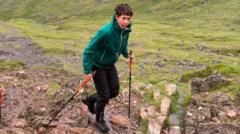
Trish Patterson has broken the female world record for the National Three Peaks Challenge on foot, finishing the grueling 425-mile journey across Scotland, England, and Wales in 5 days, 21 hours, and 0 minutes. This achievement slashes more than eight hours off the previous record set by Imo Boddy in 2024, and marks the second-fastest time ever recorded for the route by any runner, male or female. Patterson completed the run on July 5, 2026, summiting Ben Nevis, Scafell Pike, and Yr Wyddfa while running the vast road distances connecting them.
While conventional weekend warriors complete the Three Peaks by driving between the mountains within 24 hours, the on-foot variation demands an entirely different tier of human endurance. It requires covering over 70 miles a day on hard asphalt, battling severe sleep deprivation, and climbing a total ascent of over 7,700 meters. Don't forget to check out our earlier coverage on this related article.
The Math Behind Ultra Endurance Longevity
Endurance records like the Three Peaks on foot are not merely tests of aerobic capacity. They are exercises in managing acute physical decay. To sustain an average pace of four to five miles per hour across nearly six days, an athlete must maintain a highly calculated caloric intake and manage systemic inflammation.
Patterson survived on less than 90 minutes of sleep each night. This level of sleep deprivation forces the human brain into micro-sleep states while the body is still moving. The physical toll on the human musculoskeletal system during a 425-mile continuous road run is extreme. When running downhill on tarmac after summiting a mountain like Ben Nevis, the impact forces on the knee joints can reach up to several times the runner's body weight. To read more about the history of this, The Athletic provides an in-depth summary.
The physiological barrier here is not the lungs; it is the gut and the feet. The body struggling to digest thousands of calories while diverting blood flow to working muscles is a constant battle. Runners often face severe gastrointestinal distress, forcing them to rely on liquid nutrition, soft foods, or in Patterson's case, a precise mix of caffeine, targeted meals, and sheer willpower managed by a dedicated support crew in a tracking van.
The Evolution of a Forty Seven Year Struggle
The history of running the Three Peaks entirely on foot shows just how historic Patterson's run is. For decades, the benchmark for women was set by the pioneering long-distance race walker Ann Sayer, who clocked 7 days, 0 hours, and 31 minutes back in 1979. Sayer’s record stood untouched for 45 years, a testament to the sheer intimidation factor of the route.
When Imo Boddy broke that legendary record in May 2024 with a time of 6 days, 5 hours, and 43 minutes, many believed the new standard would stand for another generation. Boddy had run an average of 100 kilometers a day, fighting through intense heat waves and acute knee inflammation. Yet, just over two years later, Patterson has re-written the record books entirely.
The logistics of these attempts require flawless execution. A support vehicle must shadow the runner along busy A-roads, managing navigation, kit changes, podiatry care, and immediate nutritional needs. A single wrong turn or an unmanaged blister can end the record attempt instantly. Patterson herself recounted reaching a point on her final morning where she could not physically rise from the floor of her support van, requiring an intense mental reset and immediate fuel to keep moving forward.
Beyond Physical Adaptation
Patterson, a 41-year-old mother of twins from Hythe and a member of the Hadley Runners, was driven by a deep personal motivation. She ran to raise funds for the mental health charity Mind Over Mountains in memory of her close friend, Dave Cumins. This psychological backing often explains why ultra-endurance athletes can push past what sports scientists consider absolute physical limits.
When central governor theory dictates that the brain will shut down muscle activation to protect the heart and organs from damage, a profound emotional purpose can override these protective neurological signals. Patterson noted that quitting was never an option because of the honor of her friend, illustrating how psychological resilience can expand physical output.
The finish line at Caernarfon in Wales marked the end of an extraordinary chapter in British ultra-running. By lowering the record to under six days, Patterson has set a benchmark that moves the challenge out of the realm of traditional ultra-marathons and into the territory of elite, multi-day speed records. The physical cost was immense, but the record now stands as a monument to what the human frame can endure when pushed to its absolute limit.