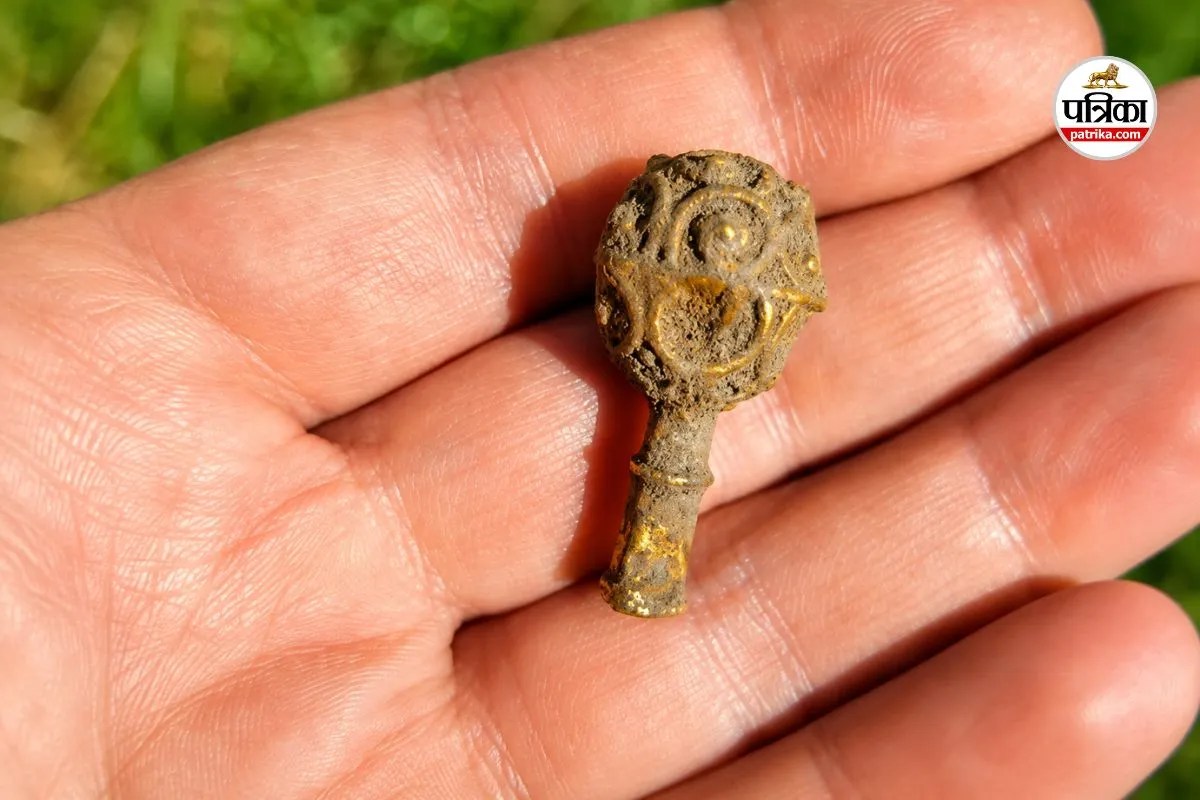
An undergraduate student digging near an ancient Roman road in Northumberland unearthed a rare ninth-century gold artifact just ninety minutes into her first field excavation. Yara Souza, a twenty-year-old international student at Newcastle University originally from Orlando, Florida, discovered a small, ornate piece measuring approximately four centimeters long with a decorative finial. This object dates back to the early medieval period, an era often erroneously dismissed by casual observers as a stagnant dark age devoid of sophisticated material culture. Instead of a simple stroke of beginner's luck, this discovery opens up severe academic debates about the geopolitical stability, elite transit routes, and religious geography of early medieval Britain.
The Myth of the Dark Ages and Ninth-Century Wealth
Popular culture loves a narrative of total collapse. When the Roman legions withdrew from Britain in the early fifth century, popular myth suggests the island plunged immediately into mud, ignorance, and absolute poverty. The physical evidence tells a much more complicated story. Gold during the ninth century was not a casual commodity. It was an exclusive marker of supreme political authority and ecclesiastical power. Ordinary farmers, tradespeople, and low-ranking soldiers did not carry or lose gold pins.
When an object of this material value surfaces outside of a known royal burial mound or a formal church treasury, it forces historians to re-evaluate how wealth moved across the landscape. The artifact discovered by Souza closely mirrors a round-headed pin found nearby by a metal detectorist named Alan Grey in 2021. Two high-status gold objects recovered from the exact same micro-region suggest that wealth circulation in ninth-century Northumbria was far more active than static administrative records imply.
Geography of Power Along Dere Street
To understand why this gold was buried in Redesdale, you must look at the geography of movement. The excavation took place near Dere Street, a primary paved artery engineered by Roman soldiers between 79 and 81 C.E. to cement their conquest of northern territories. Textbooks often treat Roman roads as abandoned ruins once the empire dissolved. Archaeology consistently proves otherwise.
Dere Street remained a vital corridor centuries after imperial administrative structures vanished. It connected major medieval religious centers, specifically the power seats at Jedburgh and Hexham. During the seventh, eighth, and ninth centuries, bishops and Northumbrian nobility used these older pathways to project religious authority and collect tithes across dangerous, fragmented territories.
Professor James Gerrard, a specialist in Roman and medieval archaeology at Newcastle University, points out that the survival of these objects along a known transit route implies intentional deposition. These were not casual losses from a torn pocket. Gold items of this magnitude were likely hidden deliberately during times of violent local raiding or deposited as part of a high-status ritual practice. Viking incursions were intensifying across Britain during the ninth century. Monasteries and wealthy travelers along Northumbrian roads faced immediate, existential threats from sea-borne raiders moving inland.
The Mechanics of Modern Field Archaeology
Media coverage heavily romanticizes the ninety-minute discovery window, framing field archaeology as a treasure hunt where amateurs strike oil with a trowel. Real academic excavation is a grueling, methodical destruction of context. Every centimeter of soil removed must be documented, mapped, and cataloged. If a student lifts an artifact without recording its three-dimensional stratigraphic coordinates, the historical value of that object drops exponentially because its relationship to the surrounding earth is lost forever.
The collaboration between Newcastle University students, professional museum staff, and local metal detectorists operates under strict regulatory frameworks like the United Kingdom's Portable Antiquities Scheme. Without this systematic cooperation, finds like the Redesdale gold pin would vanish into private collections, stripping the public record of crucial data points. The student’s find validates the importance of targeted follow-up digs. When Alan Grey recovered the initial gold piece in 2021, it could have been written off as an isolated anomaly. Returning to the exact zone with an academic team transformed a localized curiosity into a structured research project about elite medieval mobility.
Preservation Realities and Museum Futures
Physical objects recovered from damp British soil do not emerge pristine. Centuries of acidic peat and shifting ground pressure test the structural integrity of thin medieval gold alloys. Once extraction occurs, stabilization protocols begin immediately to prevent rapid oxidation or structural fracturing.
The gold fragment and its 2021 counterpart are slated for extended laboratory analysis before finding a permanent home in institutions like the Great North Museum: Hancock. Yet, display cases hide the harsher operational realities facing regional museums. Funding cuts, staffing shortages, and security overheads strain local institutions tasked with housing nationally significant material heritage. Discoveries generated by student digs inject vital public interest into university programs, but they also highlight the precarious funding models supporting archaeological preservation in the modern United Kingdom.
The small knob of ninth-century gold found in a muddy Northumbrian trench does more than satisfy a headline about beginner's luck. It forces a confrontation with the gaps in written histories, proving that the pathways carved by Roman legions continued to serve as the elite veins of early medieval power long after the emperors in Rome became a distant memory.
student finds rare ninth-century gold 'within the first 90 minutes' of her first excavation
This video provides a direct visual breakdown and historical context of the archaeological excavation in Northumberland where the rare medieval gold artifact was unearthed.