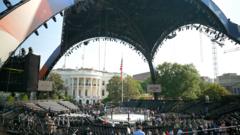
A massive steel structure resembling a cross between an industrial crane and a mechanical claw now blankets the South Lawn of the White House. Beneath it sits an eight-sided cage. On Sunday, June 14, 2026, professional mixed martial arts will take over the most exclusive real estate in global politics for UFC Freedom 250.
While television broadcasts will frame this as a historic celebration of America’s 250th anniversary, the reality is a raw display of political leverage, corporate muscle, and an unprecedented blurring of state power and sports entertainment. It is the ultimate manifestation of a decades-long alliance between UFC CEO Dana White and Donald Trump, executed at a staggering scale.
The 92-foot-high outdoor arena, nicknamed "The Claw," covers the very grass where Marine One typically lands. The National Park Service disclosed in a court filing that the temporary stadium cost upward of $60 million to erect. Seven federal agencies, including the Department of Homeland Security and the Federal Aviation Administration, have spent weeks coordinating manpower to secure a 4,300-seat amphitheater on a heavily fortified lawn.
To understand how a once-banned blood sport secured the ultimate venue, one must look past the patriotic branding. This is not just a fight card. It is a highly calculated, multi-million-dollar corporate merger of brand equity.
The Cost of Compliance
Building a sports arena on the executive mansion’s lawn requires more than just money. It requires rewriting the rules of Washington bureaucracy. The National Park Service is currently battling a lawsuit aiming to block the spectacle, but construction has proceeded regardless.
The logistical footprint is immense. The 600-ton steel apparatus was shipped from Europe, assembled in Pennsylvania, and trucked into the capital via a fleet of flatbeds. When the fights conclude, the entire apparatus will be dismantled, driven back to Pennsylvania, and packed into containers bound for the Netherlands.
For the UFC, the financial risk is largely absorbed by the sheer marketing value of the spectacle. Fighters will literally walk out from the Oval Office, step past power-washed colonnades, and enter a cage backdropped by the Truman Balcony.
Yet, the event is fracturing the carefully curated image the UFC likes to present to its corporate partners. The promotion originally planned a nonpartisan concert series around the event to broaden its appeal. A-list musical acts quickly backed out after discovering the deep ties to the administration and the fact that the fight night perfectly coincides with Trump’s 80th birthday. The concert series was quietly canceled altogether.
A Monopoly Staging a Monarchy
Dana White has built his empire on the premise that the UFC can go anywhere and conquer any market. The promotion survived the pandemic by hosting fights on a private island in Abu Dhabi. Taking over the White House is the logical conclusion of that borderless, rule-bending ambition.
But the corporate optics remain messy. The event will stream exclusively on Paramount+, bypassing a traditional CBS broadcast after network executives balked at the intense political undertones of the evening.
The public will be kept at a distance. General admission tickets do not exist for the South Lawn. Instead, a highly vetted crowd of 4,300 people—mostly active-duty military personnel, dignitaries, and 300 of Dana White’s personal celebrity guests—will sit ringside.
To placate the broader fanbase, the organization is staging a free viewing area at the Ellipse. Massive screens and stages are being erected to accommodate an estimated 100,000 lottery winners. It is bread and circuses on a grand scale, designed to project populist appeal while maintaining an ultra-exclusive VIP core inside the gates.
Blood on the South Lawn
The sports world has seen plenty of odd venues, from basketball games on aircraft carriers to tennis matches on helipads. Those were exhibitions. UFC Freedom 250 features real, high-stakes violence.
The main event features Ilia Topuria defending his lightweight title against Justin Gaethje. Alex Pereira will face Ciryl Gane for the interim heavyweight title. These are brutal, uncompromising matchups where athletes will suffer concussions, broken bones, and deep lacerations.
The contrast will be jarring. Swirling red, white, and blue spotlights will illuminate the cage while fighters trade heavy blows within spitting distance of the executive residence. Blood will inevitably stain the canvas just yards from where historic treaties have been signed.
The UFC is banking on this shock value to cement its status as the most culturally dominant force in combat sports. The promotion has traveled a long way from the late 1990s, when politicians labeled it "human cockfighting" and banned it from cable television. By conquering the White House, the UFC is sending a definitive message to its critics and competitors. It is no longer knocking on the door of the establishment. It has taken over the house.
The heavy machinery on the South Lawn will eventually fall silent, the steel beams will be packed away to Europe, and the grass will be reseeded. But the precedent has been set. The highest office in the United States has been transformed into a pay-per-view backdrop, proving that with enough capital and the right political alignment, any venue in the world is up for sale.