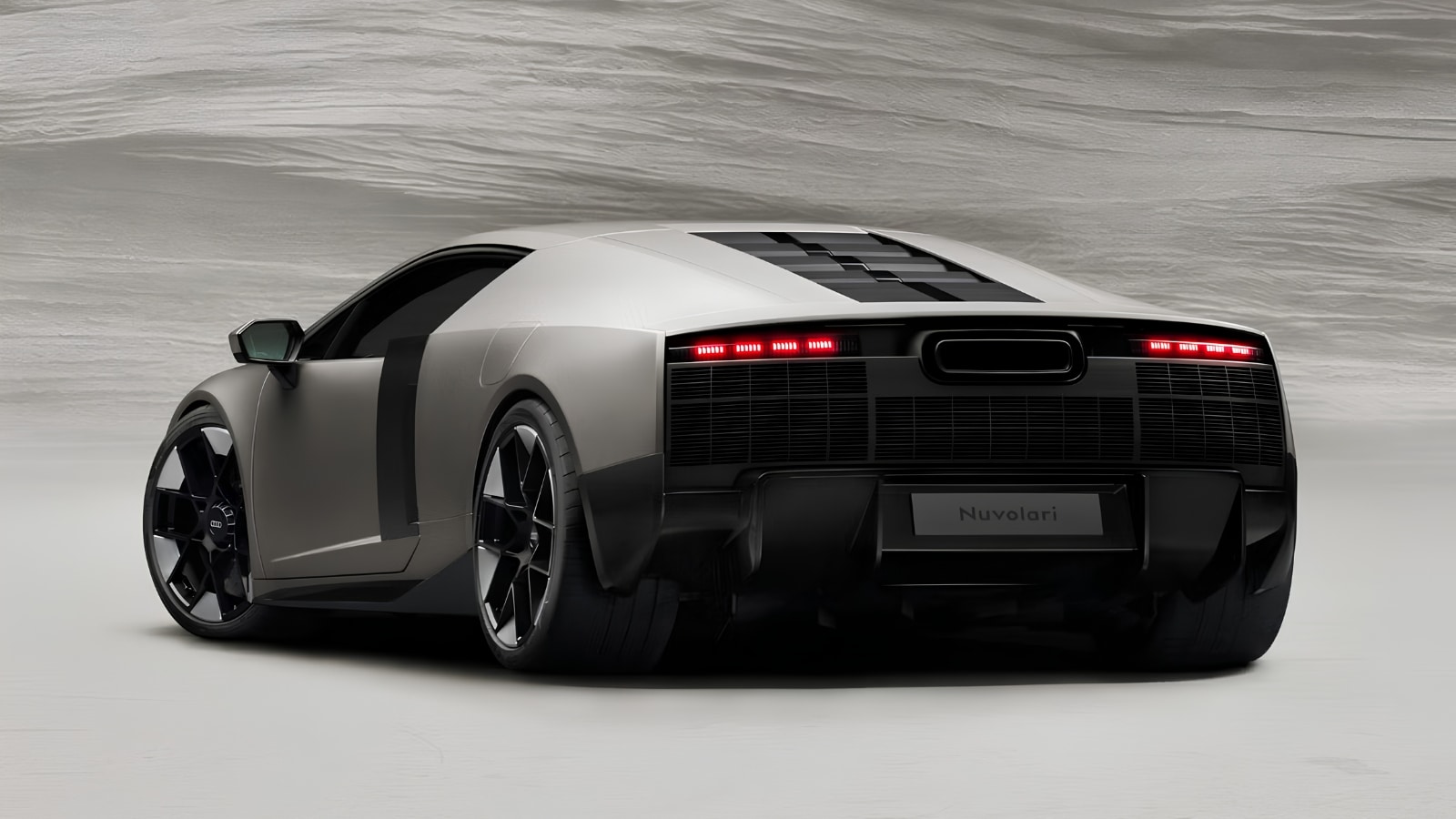
Audi has unveiled the Nuvolari, a 987-horsepower hybrid supercar that claims the title of the fastest and most powerful road car in the history of the four rings. Limiting production to 499 units, the German automaker asserts the vehicle can rocket from 0 to 62 mph in a mere 2.6 seconds. This sudden entrance back into the ultra-high-end mid-engine market answers the lingering question of what would succeed the departed R8. Yet, looking past the staggering performance figures reveals a deeper story of corporate survival, shared Italian engineering, and a desperate need to justify a multi-million-dollar Formula 1 program before ever hitting the grid.
To view the Nuvolari merely as a victory lap for engineering is to miss the structural shifts occurring within the Volkswagen Group. This is not a spiritual successor to the accessible, everyday-supercar ethos of the R8. It is a highly calculated, low-volume corporate statement designed to pull Audi out of a design and technological identity crisis.
The Shared Heart of a Transalpine Alliance
For decades, the hierarchy within the Volkswagen Group was explicit. Lamborghini occupied the wild, uncompromising upper echelon of the supercar market, while Audi provided the civilized, German-engineered alternative. The R8 always stood politely behind its Sant’Agata siblings, explicitly tuned to produce slightly less power than the Gallardo or Huracán with which it shared a platform.
The Nuvolari completely subverts this dynamic.
At the core of the Nuvolari is the exact same twin-turbocharged 4.0-liter V8 engine found in the newly released Lamborghini Temerario. It features the identical, screaming 10,000-rpm redline. However, while the Temerario settles for 907 total horsepower from its hybrid system, the Audi Nuvolari cranks the dial to 987 horsepower (1,001 PS in European metrics).
How did Audi manage to outmuscle its Italian corporate master?
The discrepancy comes down to an aggressive, proprietary torque map and a significantly larger battery pack. While the Lamborghini uses a tiny 3.8-kilowatt-hour battery, Audi stuffed a gross 7.3-kWh lithium-ion unit into the Nuvolari’s chassis. This structural choice gives the electric motors more sustained power to deploy, allowing the German brand to claim the performance crown over its internal rival.
Pulling off this power heist required a highly unusual "cross-brand" engineering team that brought together minds from Ingolstadt, Sant'Agata, and Audi's expanding Formula 1 team. The project was completed in a frantic 14 months under intense secrecy. This rapid development timeline tells us that Audi did not build this car from a clean sheet of paper; they utilized the heavy lifting already completed by Lamborghini, wrapping Italian mechanical fury in a cold, Germanic shell.
The Formula One Justification Engine
The timing of this reveal is entirely political. Audi is scheduled to enter Formula 1 as a full works team, a massive financial commitment that has drawn scrutiny from internal board members and industry analysts alike. A halo supercar provides the perfect marketing bridge to justify hundreds of millions of dollars spent on open-wheel racing.
Audi explicitly credits its F1 division for the "Quattro Predictive Ride" system debuting on the Nuvolari. This setup moves far beyond standard all-wheel drive. By utilizing two oil-cooled axial flux electric motors on the front axle—capable of churning out a massive 1,585 pound-feet of torque—the car uses live telemetry data to predict traction loss before it occurs. The vehicle monitors steering angle, yaw rate, lateral forces, and wheel slip to constantly shuffle power or apply minute braking forces.
The Formula 1 connection shows up clearly in the aerodynamics. The Nuvolari features a functional front S-duct and a multi-stage active rear wing with three distinct positions: Closed, Low Downforce, and High Downforce. Under heavy deceleration, the car automatically snaps the wing into its high-downforce position, working in tandem with a brake-by-wire system and proprietary long-fiber carbon ceramic discs to generate over 880 pounds of downforce. Drivers can even press a dedicated DRS button on the steering wheel to manually shed drag on straights, a direct nod to the grand prix circuit.
Brutalist Minimalism and the Rejection of the R8
Anyone hoping for the return of the smooth, timeless curves of the original R8 will be severely disappointed. The Nuvolari marks a harsh pivot toward a new design language that Audi calls "monolithic volume."
Previewed by the polarizing Concept C, the exterior design relies on straight lines, sharp creases, and a boxy, brutalist minimalism. Painted exclusively in a flat, metallic shade called Titanium—the exact color used on Audi's upcoming F1 car—the vehicle lacks the traditional visual drama of a mid-engine exotic. It looks less like a traditional sports car and more like a high-velocity stealth fighter. The front and rear lighting signatures have been reduced to four simple, glowing horizontal dashes.
Inside, the cabin is intentionally hostile to modern luxury conventions.
- Zero Cupholders: There is nowhere to store a beverage, underscoring the track-focused nature of the machine.
- No Haptic Controls: The steering wheel features real, physical clicky buttons and dials, completely abandoning the frustrating touch-sensitive pads found in standard Audi sedans.
- Fixed Console: The central armrest is a solid piece of trim that does not open, offering zero storage space.
- Dual-Zone Color Scheme: The front portion of the cabin is finished in dark materials to minimize driver distraction, while the rear bulkhead uses a lighter shade called Shadow Dune for contrast.
The lack of a rear window means the rearview mirror is a digital screen fed by a camera buried in the rear mesh grillwork. This is a car stripped of daily usability, a complete departure from the grand-touring capabilities that made the R8 a beloved daily driver.
The Luxury Margin Trap
Production will not begin until early next year, with deliveries staggered throughout the first half of 2027. Audi has not officially published the price, but European sources present at the Antibes unveiling point to a base price tag of roughly $686,000.
This pricing strategy signals a massive shift in how Audi views its place in the market. The R8 was a bargain among supercars, starting well under $200,000 for most of its life. By pricing the Nuvolari closer to $700,000, Audi is abandoning the premium enthusiast sector to chase the hyper-exclusive, ultra-rich collector market dominated by Ferrari’s Special Projects and McLaren’s Ultimate Series.
Building only 499 units ensures that every single car will likely be sold to pre-screened brand loyalists before production even starts. It provides Audi with massive profit margins per unit while shielding the company from the financial risk of a mass-production flop.
The risk, however, lies in brand perception. Tying a flagship vehicle so heavily to an unproven Formula 1 venture means the car's prestige is now tethered to the racing team's on-track performance. If Audi struggles at the back of the F1 grid, the Formula 1-inspired tech inside this $686,000 weapon starts to look less like a badge of honor and more like an expensive marketing gimmick. Audi has built a mechanical masterpiece by raiding Lamborghini’s parts bin and applying its own advanced software, but the true test will be whether the market accepts a seven-figure price tag for a badge that also sits on the trunk of an entry-level hatchback.