We love national parks for their pristine wilderness, endless trails, and crisp mountain air. We rarely stop to think about who lived there first. Behind the postcard views of Virginia's Blue Ridge Mountains lies a harsher reality. Private homes were erased, communities were bulldozed, and families were thrown out by the state.
One man's refusal to accept that fate turned into a dramatic confrontation with the law. It exposes the ugly side of early American conservation.
The Price of Progress in the Blue Ridge
Back in the 1920s and 1930s, boosters wanted a grand national park within a day's drive of millions of eastern city dwellers. They envisioned a scenic escape complete with sweeping vistas and the famous Skyline Drive. There was just one massive obstacle. People lived there.
Hundreds of families owned farms, ran small businesses, and raised generations in these mountain hollows. Promoters and federal officials initially offered mixed messages about whether residents could stay. Some believed mountain folk could remain as caretakers or tourist attractions.
That illusion shattered quickly. National Park Service Director Arno Cammerer announced a strict federal stance. Every single inhabitant, whether landowner, tenant, or squatter, had to clear out. The government refused to accept the land until it was completely empty of human settlement.
Virginia used blanket condemnation laws and aggressive eminent domain tactics to force people off their ancestral properties. Compensation was often meager. The state paid an average of about $12.50 per acre, though valuations swung wildly from a single dollar to over a hundred. Landowners felt cheated. Many argued the state priced their properties based on rocky dirt rather than their actual livelihoods and homes.
Melanchthon Cliser Won't Budge
Most residents eventually gave in and packed up, realizing they could not fight the state and federal governments combined. Melanchthon Cliser chose a different path.
Cliser owned a 46-acre property right along US 211, where he also operated a gas station. He didn't want a government payout, and he certainly didn't want to leave. When letters of protest and appeals to state leaders went nowhere, he dug his heels in. He believed deeply in his property rights and refused to cooperate with the condemnation proceedings.
Other locals voiced similar outrage. One resident wrote to the governor stating he was relying strictly on the Constitution and had nothing to arbitrate. But constitutional arguments didn't stop the machinery of the state.
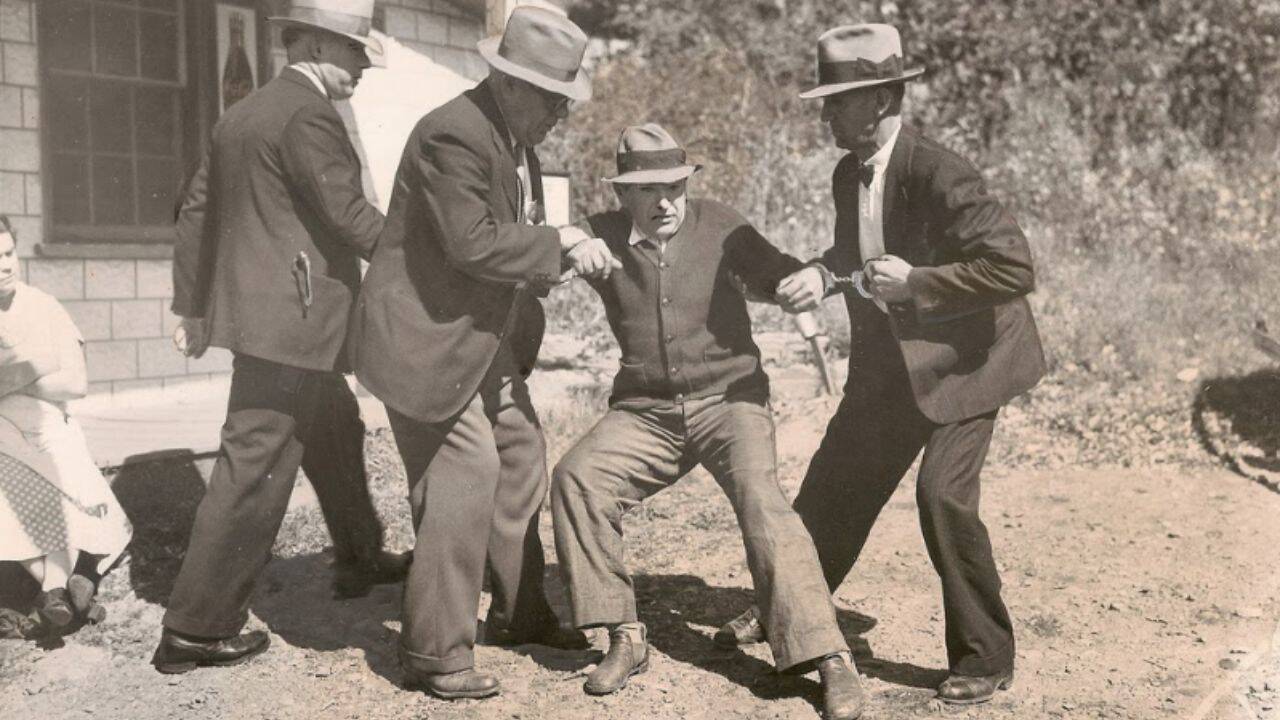
By October 1935, patience wore thin. The local sheriff and his deputies arrived at Cliser's property with orders to clear it. When Cliser stood his ground and refused to leave voluntarily, officers slapped handcuffs on him. Deputies hauled the family's belongings out onto the dirt, locked the doors, and sealed the house.
The state deposited a payment of $4,855 for his land. Cliser never touched the money. He kept the uncashed compensation as a silent testament to a forced displacement he never accepted.
Erasing a Culture to Protect Nature
Cliser's experience wasn't an isolated incident, but it remains one of the most vivid symbols of the collateral damage caused by park creation. Families who had farmed the rocky hillsides for generations were branded by outsiders as backward or out of place. Newspapers and park planners pushed narratives portraying mountain residents as obstacles to civilization rather than citizens with valid rights.
Once the evictions finished, the Park Service went to work sanitizing the landscape. Crews burned down old farmhouses, tore down barns, and dismantled mills. They wanted tourists to see a pure wilderness untouched by human hands, which meant actively erasing the physical evidence that anyone had ever lived there.
A tiny fraction of older residents received special secret exemptions to live out their days in the park rent-free. For the vast majority, though, eviction meant scattering into nearby towns, losing their economic independence, and watching their communities dissolve.
Next time you drive down Skyline Drive or hike the ridges of Shenandoah, look past the trees. Remember the people who were forced out at gunpoint and sheriff's decree, and think of men like Melanchthon Cliser who refused to let their displacement go quietly.
This video details the historical background of how Virginia used eminent domain to remove families from the Blue Ridge Mountains for the creation of Shenandoah National Park.