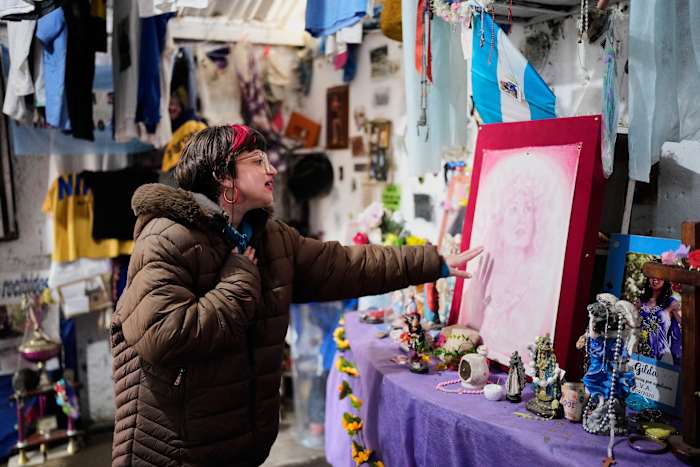
Thirty years have passed since a brutal highway collision on Route 12 silenced Miriam Alejandra Bianchi, known to millions simply as Gilda. To reduce her legacy to a tragic pop music footnote is to miss the entire machinery of Argentine cultural survival. When her tour bus smashed into a truck on September 7, 1996, killing her mother, her daughter, and three of her bandmates, the nation did not merely mourn a rising cumbia star. The country manufactured a secular saint.
Today, the shrine at kilometer 129 is not a quiet place of solemn remembrance. It is a chaotic, living archive of desperation and gratitude. Crutches lean against walls, left behind by those who claim miraculous healing. Wedding gowns hang from rafters, offered by women whose marital prayers were supposedly answered. Police uniforms rest neatly folded on shelves, gifts from officers who attribute career promotions to the intercession of a pop singer who spent her life singing about heartbreak in working-class dance halls.
Understanding why Gilda endures requires looking past the glossy hagiography and examining the raw socioeconomic anxiety of Argentina. Folk saints do not emerge in stable, prosperous societies. They rise from the cracks where institutional trust has completely collapsed.
For decades, the formal Roman Catholic Church has watched its influence shift. While formal religious structures demand adherence, hierarchy, and centuries of bureaucratic canonization, folk saints bypass the Vatican entirely. They are elected by the crowd. Gilda joined a pantheon of unofficial intercessors that includes outlaws, folk heroes, and tragic figures like Difunta Correa. These figures share one vital trait. They suffered ordinary human pain before achieving extraordinary status.
Gilda was not born into royalty or religious privilege. She was a kindergarten teacher well past her twenties who answered a classified newspaper ad to chase a music career in a male-dominated genre. She fought through professional skepticism, financial instability, and the exhausting grind of touring gritty venues. Her music—a propulsive, emotionally direct fusion of cumbia and tropical pop—spoke directly to the marginalized working class. She performed in prisons, answered handwritten letters from fans, and maintained a fierce accessibility that corporate stars carefully avoid.
When she died at age thirty-four, the sudden truncation of her life transformed her vulnerability into permanence. She became frozen in the public imagination as a protector who understands poverty, exhaustion, and broken promises because she lived them.
The transition from pop idol to miracle worker reveals a deep psychological coping mechanism. In a country battered by chronic economic instability, inflation, and political betrayal, ordinary citizens search for agency where they can find it. If the state cannot guarantee healthcare, employment, or safety, people look to the supernatural. But they do not want a distant, austere deity. They want someone who sounds like them, dresses like them, and danced under the same harsh stage lights.
Devotees insist there is no contradiction between praying to Gilda and maintaining their Catholic faith. They view her as a celestial intermediary, a trusted friend in the spiritual bureaucracy who can whisper their grievances directly to God. The institutional church handles this tension with cautious diplomacy. Priests occasionally celebrate Mass at her shrine, carefully ignoring her unofficial saintly status while urging followers to keep God central. The church knows better than to launch a direct culture war against a devotion so fierce that millions bought her posthumous double-platinum albums.
The commercialization of her image adds another layer of complexity. T-shirts bearing her likeness in a shimmering blue dress and flower crown are standard streetwear. Documentaries, biographical films, and tribute albums keep her commercial footprint active. Yet, unlike manufactured pop stars whose fandoms fade with changing musical trends, Gilda's following operates on an entirely different frequency. It is anchored in personal testimony. Walk through the crowds at her annual pilgrimage, and you will hear endless variations of the same narrative. A sick relative recovered. A failing business survived. A lost job materialized.
Skepticism from outsiders is irrelevant to the believer. The sociology of popular religion dictates that faith validates itself through shared experience. When Cleopatra Barrios, a researcher of popular religion at Argentina's national scientific body, notes that devotees feel these figures accompany them daily, she is identifying the core utility of the phenomenon. Gilda provides emotional companionship in an increasingly atomized world.
The thirty-year milestone of her death highlights a broader truth about cultural memory. Nations build monuments to politicians and generals, but they canonize artists who articulate their emotional reality. Gilda did not write high-art poetry. She wrote simple, infectious anthems about loving too hard and losing too much. By doing so, she tapped into the universal reservoir of human heartbreak.
As long as economic precarity forces people to look beyond earthly systems for salvation, figures like Gilda will thrive. The floral wreaths at her roadside shrine may wilt, and the painted metal of her preserved tour bus may rust further under the humid Pampean winds, but the core mythology remains untouched. The formal church moves slowly, tied to its ancient decrees and Rome-centered bureaucracy. But the street moves faster. In Argentina, the people decided long ago who holds the keys to grace