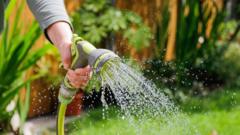
What Happens When You Turn On the Tap
Yes, you can be fined up to £1,000 for using a hosepipe during a temporary use ban. Water companies possess the statutory authority under Section 76 of the Water Industry Act 1991 to issue these bans and enforce criminal penalties through local magistrates' courts.
That is the short answer. The longer, far more uncomfortable answer involves a broken national grid, systemic underinvestment, and a legal enforcement mechanism that relies almost entirely on neighborly betrayal rather than actual police work. You might also find this similar article useful: The Political Cost Function of Executive Nominations: Mechanics of Senate Advice and Consent.
When a drought strikes and reservoir levels plummet, water authorities issue temporary restrictions. These bans typically prohibit outdoor water usage using a hosepipe or connected attachment. That includes watering domestic gardens, cleaning private cars, filling swimming pools, and washing outdoor patio surfaces. Ignoring the restriction is not a civil civil violation like a parking ticket. It is a summary criminal offense.
Yet despite the fierce threat of a four-figure fine, very few people ever end up standing before a judge. As highlighted in detailed articles by TIME, the effects are notable.
The Legal Framework Behind the Pressure
The law gives private water undertakers immense powers to restrict consumer access to water during dry spells.
Under the 1991 Act, as amended by the Flood and Water Management Act 2010, water companies do not need to seek judicial approval to implement a ban. They simply place notices in local newspapers and update their official websites. Once that public notification requirement is satisfied, the restriction carries the full force of criminal law.
The Scope of Restricted Activities
- Watering a garden: Gardens attached to private residences cannot be watered using a hosepipe. Hand-held watering cans remain legal, regardless of how many trips to the kitchen tap you take.
- Washing motor vehicles: Hooking a hose up to wash your private car, motorcycle, or trailer is strictly prohibited. Commercial automated car washes usually remain exempt due to commercial licensing agreements.
- Filling domestic pools: Inflatable paddling pools, hot tubs, and permanent garden pools cannot be topped up or filled with a hose.
- Cleaning outdoor surfaces: Blasting domestic paths, driveways, walls, or decking with a pressure washer connected to the mains is illegal during a active ban.
The law explicitly targets the attachment, not necessarily the water volume. A hosepipe draws roughly 1,000 liters of water an hour. That volume strains pressurized distribution systems already struggling with low groundwater reserves.
How Enforcement Actually Works
If water companies lack dedicated police forces, how do they catch violators?
They rely on your neighbors.
Enforcement officers rarely patrol residential suburbs searching for wet driveways. Instead, utility providers establish dedicated reporting hotlines and web portals when a ban takes effect. The system relies almost entirely on peer-to-peer reporting.
The Chain of Enforcement
When a report comes in, the water company sends an informal warning letter to the accused address. This initial communication reminds the householder of the legal restrictions and outlines potential penalties.
If reports persist regarding the same address, the company sends an inspector. These inspectors do not possess powers of entry. They cannot breach your gate or search your back garden without permission. They can, however, observe your property from public footpaths and document visible violations using photography.
If clear evidence exists, the utility provider can institute legal proceedings in the Magistrates' Court. A conviction leads to a fine not exceeding Level 3 on the standard scale—currently capped at £1,000.
The reality on the ground is starkly different from the text of the statute. Prosecutions are extraordinarily rare. Water companies view legal proceedings as an expensive public relations nightmare that highlights their own structural failures.
The Infrastructure Problem Nobody Wants to Discuss
Punishing consumers for using outdoor hoses obscures a much larger structural failure within the water management sector.
Every single day, hundreds of millions of liters of treated, drinkable water leak out of aging underground pipe networks before reaching a single household tap.
+-------------------------------------------------------------+
|                      DAILY WATER METRICS                    |
+-------------------------------------------------------------+
| Average Hosepipe Usage:           ~1,000 Liters / Hour      |
| Daily Network Leakage (UK Total): ~3,000,000,000 Liters     |
+-------------------------------------------------------------+
Consumers are asked to sacrifice their lawns to protect a system that bleeds water constantly through cracked Victorian infrastructure. While domestic lawn watering certainly increases peak demand during heatwaves, it represents a tiny fraction of total water volume lost through systemic neglect.
This reality creates massive public resentment. Expecting a homeowner to watch their garden wither while miles of pipeline leak beneath their street creates a complete collapse in public compliance.
Exemptions, Gray Areas, and Strategic Loopholed Usage
The law contains precise exemptions designed to protect commercial activity and public health. Understanding these distinctions reveals how arbitrary the restrictions can feel.
Commercial growers, garden centers, and agricultural operations are routinely exempt from temporary restrictions. Their livelihood depends on water access, making a total ban economically catastrophic.
Common Exceptions
- Drip irrigation systems: Deeply buried drip or micro-irrigation systems that run on automated timers are often allowed if they fall within specific efficiency parameters defined by the local water authority.
- Health and safety hazards: Cleaning outdoor surfaces to remove hazardous substances, fuel spills, or animal waste remains permissible even with a hosepipe.
- New lawns: Some water authorities grant temporary dispensations for newly laid turf, provided the homeowner can produce proof of purchase within a specific timeframe.
- Blue Badge holders: Individuals with recognized mobility challenges often receive exemptions allowing them to use hosepipes to maintain their property or wash vehicles.
Using water drawn from rain barrels, graywater collection systems, or private wells does not break the law. The prohibition applies strictly to water supplied by the public water undertaker.
What Happens Next
The threat of a £1,000 fine serves primarily as a psychological deterrent rather than a active legal campaign. Water companies lack the manpower, resources, and public goodwill required to aggressively prosecute every homeowner who washes their car on a Sunday morning.
Public compliance relies on social pressure rather than judicial fear.
As climate patterns shift and summer droughts become longer and more frequent, the tension between failing infrastructure and consumer restrictions will inevitably reach a breaking point. Until utility companies spend the capital needed to seal their leaking networks, the threat of legal fines remains a cheap patch on a leaking foundation.