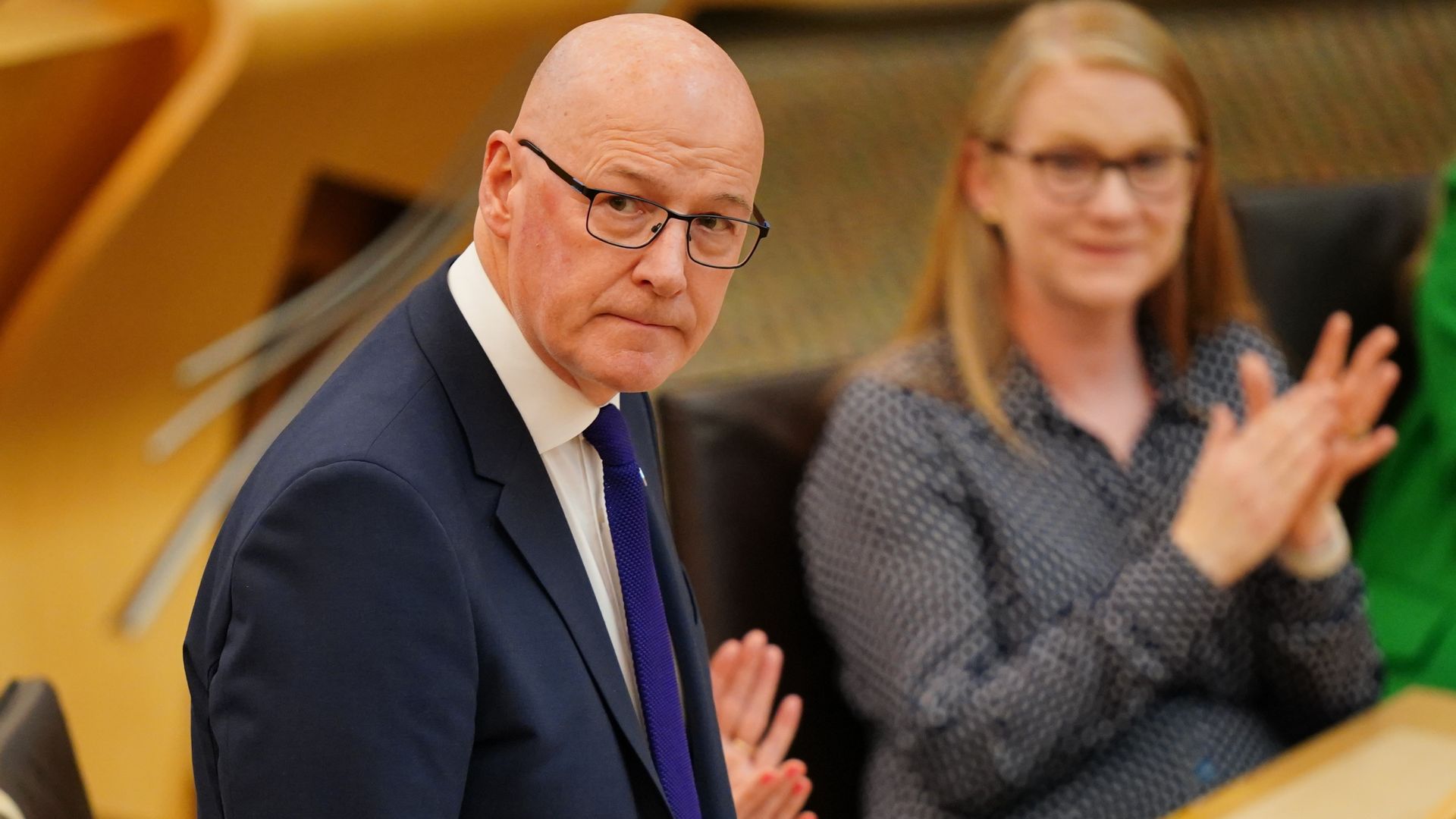
John Swinney has survived a gruelling multi-round knockout vote in the Holyrood chamber to be re-elected as Scotland’s First Minister following the May 2026 election. The Scottish National Party veteran secured his return to Bute House after fending off five rival party leaders, including the Scottish Conservatives’ Russell Findlay and the Liberal Democrats’ Alex Cole-Hamilton, who were both eliminated in the opening rounds. While Swinney’s victory keeps the SNP at the helm of Scottish politics for an unprecedented nineteenth consecutive year, his triumph obscures a fragile parliamentary reality. With 58 out of 129 seats, the SNP remains the largest party but falls short of an outright majority. This creates a highly volatile minority government that must bargain for its survival on every single piece of legislation.
The drama that unfolded on the floor of the Scottish Parliament highlights the deep fracturing of modern Scottish politics. For nearly two decades, the SNP managed to dominate Holyrood through either outright majorities or formal coalition mechanisms, such as the Bute House Agreement with the Scottish Greens. Those days are gone. Swinney now commands a government that is entirely dependent on ad-hoc consensus. For a different view, consider: this related article.
The Anatomy of a Holyrood Knockout
The multi-stage voting process that re-appointed Swinney exposed the shifting battle lines inside the devolution structure. Unlike the Westminster system, where a single party usually commands an absolute majority and can push through legislation without consensus, the Holyrood voting system was explicitly designed to prevent one-party dominance.
By pushing the vote to multiple rounds, the opposition parties forced the SNP to confront its electoral vulnerability out in the open. Russell Findlay and Alex Cole-Hamilton ran ideological campaigns aimed squarely at the SNP's domestic record on healthcare and education. While their campaigns failed to gather enough cross-party support to block Swinney, they succeeded in setting a combative tone for the upcoming parliamentary term. Further coverage regarding this has been published by TIME.
Swinney’s victory rested on his ability to hold the line within his own ranks. The 58 SNP MSPs voted as a single bloc, providing a stable foundation that the fragmented opposition could not match. However, the math of the new parliament means that the executive branch will find itself in a permanent state of negotiation. To pass a budget, Swinney cannot rely solely on nationalist sentiment; he must build bridges with parties that spent the last month trying to unseat him.
The Deputy Factor and Economic Reality
A central component of Swinney’s survival strategy has been his political partnership with Kate Forbes. Re-appointing Forbes as Deputy First Minister and Economy Secretary was a deliberate calculation designed to appease the pro-business wing of the nationalist movement and project economic competence.
Forbes brings a distinct fiscal conservatism to an administration that has frequently been accused by the business community of being hostile to growth. Her presence in the cabinet is meant to reassure international investors and domestic industry leaders that the Scottish Government will focus on wealth creation alongside public spending.
Yet, this partnership creates internal policy tensions that Swinney will have to manage carefully. The progressive wing of Scottish politics, particularly the Scottish Greens, remains deeply suspicious of Forbes’s economic approach and her socially conservative views. During Swinney’s previous term, Green co-leader Patrick Harvie openly questioned whether the SNP was retreating into outdated social values. By doubling down on the Swinney-Forbes axis, the government has prioritized economic stability over its traditional alliance with the radical left.
This internal ideological friction will complicate the government's flagship pledge to eradicate child poverty. Achieving this goal requires massive public investment, which can only be funded through sustained economic growth or higher taxation. Forbes prefers the former; the opposition and the Greens frequently demand the latter.
Governing Without a Net
The immediate challenge for the new administration is the sheer scale of the domestic crises piling up on the cabinet table. The National Health Service in Scotland is buckling under structural deficits and prolonged waiting times. Local authorities are facing severe funding shortfalls that threaten basic municipal services, from road maintenance to social care.
Swinney has pledged to turn personal priorities into national ones, promising to ease the cost-of-living crisis and protect the NHS. But promising protection is vastly different from delivering structural reform. The Scottish Government's financial maneuvers are constrained by the block grant from Westminster and the strict limits of devolved tax powers.
Without a formal coalition partner, every budget will turn into a political hostage situation. If the SNP tilts too far toward the Greens to secure their votes, they risk alienating the centrist and business-friendly elements represented by Forbes. If they compromise with Scottish Labour or the Conservatives on economic policy, they risk fracturing their own base, which views any cooperation with unionist parties as a betrayal of the constitutional movement.
The Independence Conundrum
The constitutional question remains the elephant in the Holyrood chamber. Swinney used his acceptance speech to reaffirm his commitment to an independent Scotland, asserting that the election result gave him a mandate to pursue self-determination. He argued that decisions affecting Scotland should be made in Edinburgh rather than Westminster.
This rhetoric is essential for keeping the SNP’s core membership energized, but it clashes directly with the arithmetic of the new parliament. There is no longer a pro-independence majority in Holyrood capable of forcing a constitutional showdown with London. The Scottish Greens, while still supporting independence, are no longer bound to defend the government’s timeline or strategy.
Consequently, Swinney’s administration must adopt a dual-track strategy that satisfies hardline nationalists while focusing heavily on the immediate governance of the country. This requires a pragmatic approach that shifts the focus away from a second referendum and toward the accumulation of specific devolved powers. It is a slow, incremental strategy that risks frustrating an impatient independence movement that has been waiting for a breakthrough since 2014.
The veteran First Minister is banking on his reputation as a safe pair of hands to navigate these turbulent waters. His decades of experience in government mean he understands the mechanics of devolution better than almost anyone else in the chamber. He knows how to use the machinery of state to outmaneuver fragmented opposition parties.
But competence alone will not be enough to bridge the deep ideological divisions within Holyrood. The opposition parties have tasted blood over the last two years, witnessing the collapse of Humza Yousaf’s administration and the internal policing scandals that have dogged the SNP. They are unlikely to afford Swinney a honeymoon period.
The upcoming legislative session will test whether a minority government can actually govern effectively under intense scrutiny, or if Scotland is entering a prolonged period of political stagnation. Swinney has successfully reclaimed the crown, but the kingdom he rules is more divided, demanding, and fiscally constrained than ever before. The real test begins when the first minority budget hits the floor of the parliament, where survival will be measured not in grand speeches, but in single votes.