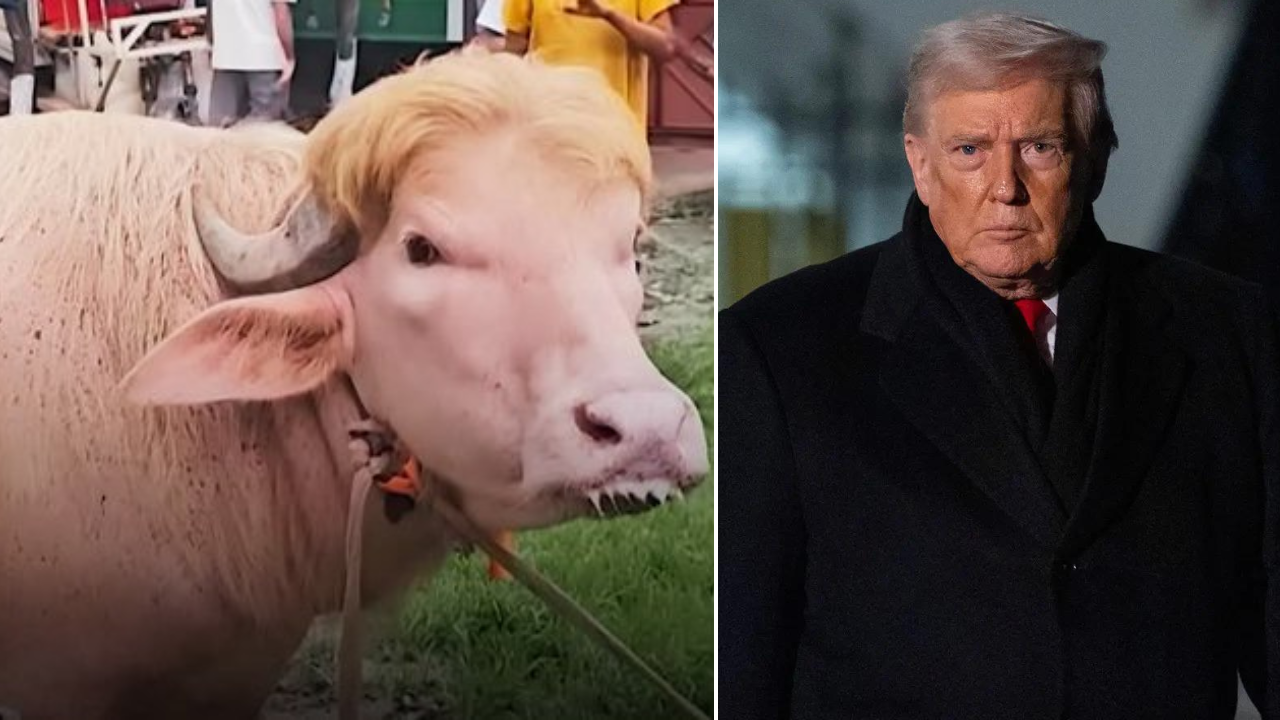
The global media landscape loves a cheap laugh, especially when it involves a bizarre animal lookalike and a high-stakes political rivalry. When Iranian social media users and state-adjacent commentary latched onto a sick, viral buffalo in Thailand that supposedly resembled Donald Trump, the Western press treated it as a textbook example of modern, lighthearted psychological warfare. They framed it as a witty dunk from Tehran—a clever use of digital satire to mock an adversarial leader whose administration crippled their economy.
They got it entirely wrong.
Celebrating meme diplomacy is not just lazy journalism; it is a fundamental misunderstanding of how international power dynamics operate. When a nation-state or its state-sanctioned media apparatus resorts to weaponizing viral animal videos, it does not signal geopolitical confidence or modern asymmetric warfare. It signals desperation. It is a flashing red light that a regime has run out of substantive leverage and is forced to trade in the cheap currency of internet engagement points.
The Illusion of Digital Dominance
The mainstream narrative surrounding state-sponsored mockery often treats digital trolling as a legitimate tool of statecraft. Pundits claim that by lowering the dignity of an adversarial leader, a state can shift public perception or project a form of soft power.
This premise is deeply flawed. True soft power, as originally defined by political scientist Joseph Nye, relies on the ability to shape the preferences of others through appeal and attraction—culture, political values, and legitimate policies. A viral joke about a sick buffalo does not convert adversaries, nor does it project strength to neutrals.
What it actually does is create a closed-loop confirmation bias. It is geopolitical theater designed for internal consumption and cheap external engagement. I have spent years analyzing how state actors manipulate digital narratives, and the pattern is always the same: the moment a government starts leaning heavily into schoolyard mockery, it is usually because their actual diplomatic and economic options have shrunk to zero.
Imagine a scenario where a multinational corporation is facing a massive regulatory antitrust lawsuit that threatens to dismantle its entire business model. Instead of filing robust legal briefs or restructuring its compliance framework, the executive team spends its budget creating mocking TikTok videos about the lead regulator's haircut. Nobody would call that a brilliant PR strategy. They would call it a corporate suicide note. Yet, when a nation-state does the exact same thing on the global stage, commentators rush to call it "savvy digital trolling."
Dismantling the Premise of Meme Warfare
Let us address the fundamental questions that mainstream analysts continually get wrong about this specific brand of international friction.
Does public mockery actually weaken a foreign leader's position?
No. In fact, standard political science literature on the "rally 'round the flag" effect demonstrates the exact opposite. When a foreign adversary uses superficial, personal attacks against a nation's leader, it frequently solidifies that leader's base of support domestically. It reframes complex policy disputes—like nuclear enrichment or economic sanctions—into a simplistic story of cultural disrespect. The adversary hands the leader an easy win by allowing them to paint the foreign state as petty and unserious.
Is digital satire an effective substitute for conventional diplomacy?
To ask the question is to expose its absurdity. A nation cannot negotiate a treaty, lift a trade embargo, or secure a maritime corridor using a viral image. When state actors elevate memes to the level of official or semi-official communication, they actively degrade the channels of formal diplomacy. It signals to international mediators that the state prefers Twitter engagement over structured, back-channel negotiations.
The Hard Math of Geopolitical Leverage
Let us look at the actual data that matters, rather than the metrics on a social media dashboard. International relations run on hard power assets: gross domestic product, currency stability, naval choke points, and alliance depth.
| Metric of Leverage | Meme Diplomacy (The Illusion) | Hard Statecraft (The Reality) |
|---|---|---|
| Primary Currency | Retweets, clicks, and viral headlines | GDP growth, reserve currencies, secondary sanctions resistance |
| Target Audience | Domestically aligned echo chambers and online onlookers | Foreign ministries, central banks, and military commands |
| Long-Term Impact | Zero structural change to policy or economic realities | Measurable shifts in trade balances and defense postures |
| Risk Profile | Low cost, but completely erodes diplomatic credibility | High stakes, requiring tangible sacrifice and strategic patience |
When you contrast these two columns, the reality becomes stark. The state that relies on the left column is fundamentally losing to the state that commands the right column.
During my time consulting on political risk assessment, I watched organizations burn through millions of dollars trying to counter online disinformation and narrative trends, only to realize that the underlying economic realities completely ignored the digital noise. The market does not care if an internet trend makes fun of a president's appearance. The market cares about shipping lanes, interest rates, and energy exports.
The High Cost of Unserious Statecraft
There is a distinct danger in adopting a counter-intuitive approach that ignores the internet entirely. In the modern era, total silence can sometimes be misconstrued as a lack of technical capability. However, the alternative—wallowing in the mud of internet subcultures—comes with a much steeper price tag.
When a government validates meme culture as a tool of statecraft, it surrenders the moral high ground and the veneer of institutional stability. It lowers the state to the level of an anonymous internet forum. This creates a highly volatile environment where actual, dangerous policy miscalculations can occur because both sides are reading the digital room instead of the intelligence briefings.
True authority on the international stage is silent, predictable, and devastatingly precise. It does not wait for an animal in Thailand to lose its appetite to make a point. It adjusts a tariff line, signs a bilateral security pact, or moves a carrier strike group.
Stop looking at the viral side-shows and treating them as significant geopolitical data points. They are distractions designed to keep you from looking at the deteriorating structural realities of the entities deploying them. The next time a state actor attempts to dunk on an adversary using a viral pet, do not applaud their digital savvy. Recognize it for what it truly is: a confession of weakness.
Turn off the feed. Watch the ports, the pipelines, and the banks instead. That is where history is actually being written.