The sound is what stays with you. It is not the thunderous roar of a jet engine or the sharp crack of conventional artillery. Instead, it is a high-pitched, persistent whine, like an angry swarm of hornets suspended in the air.
For decades, security meant looking at the ground. We built walls, installed cameras, and locked gates. But open the window of any high-security facility today, and the threat comes from above, drifting casually over the concrete barriers. A consumer drone, purchased online for a few hundred dollars, can carry a camera, a payload, or a disruption device. It can paralyze an airport, halt a shipping port, or spy on critical energy grids. In other developments, we also covered: The Electronic Warfare Myth and the Lethal Reality of Ballistic Missile Defense.
Traditional weapons are useless here. You cannot fire a surface-to-air missile at a plastic quadcopter hovering over a crowded suburban terminal. The collateral damage would be catastrophic. Radio jamming works occasionally, but it also scrambles the local emergency frequencies, blinding the very people trying to protect the perimeter.
The sky has become crowded, chaotic, and deeply vulnerable. The Next Web has provided coverage on this fascinating topic in great detail.
To understand the stakes, consider a hypothetical security director named David. He stands on the tarmac of a major international transit hub. Somewhere in the gray morning fog, an unauthorized drone has been spotted near the main runway. Flights are grounded. Thousands of passengers are stranded inside idling planes. Millions of dollars slip away with every ticking minute. David has plenty of tools to stop a truck or a trespasser on foot. But for the plastic intruder drifting three hundred feet above his head, he is entirely powerless.
Until now.
Far from the traditional hubs of military aerospace production, an engineering team in South Africa has looked at this exact vulnerability and built an entirely new way to fight back. They realized that to catch a drone, you need a drone. But not just any quadcopter. You need a dedicated hunter.
The Evolution of the Aerial Chase
The concept sounds deceptively simple. A larger, faster autonomous aircraft is launched the moment an intruder enters restricted airspace. This hunter tracks the rogue target, closes the gap, and neutralizes it before it can cause harm.
But the engineering required to achieve this is staggering.
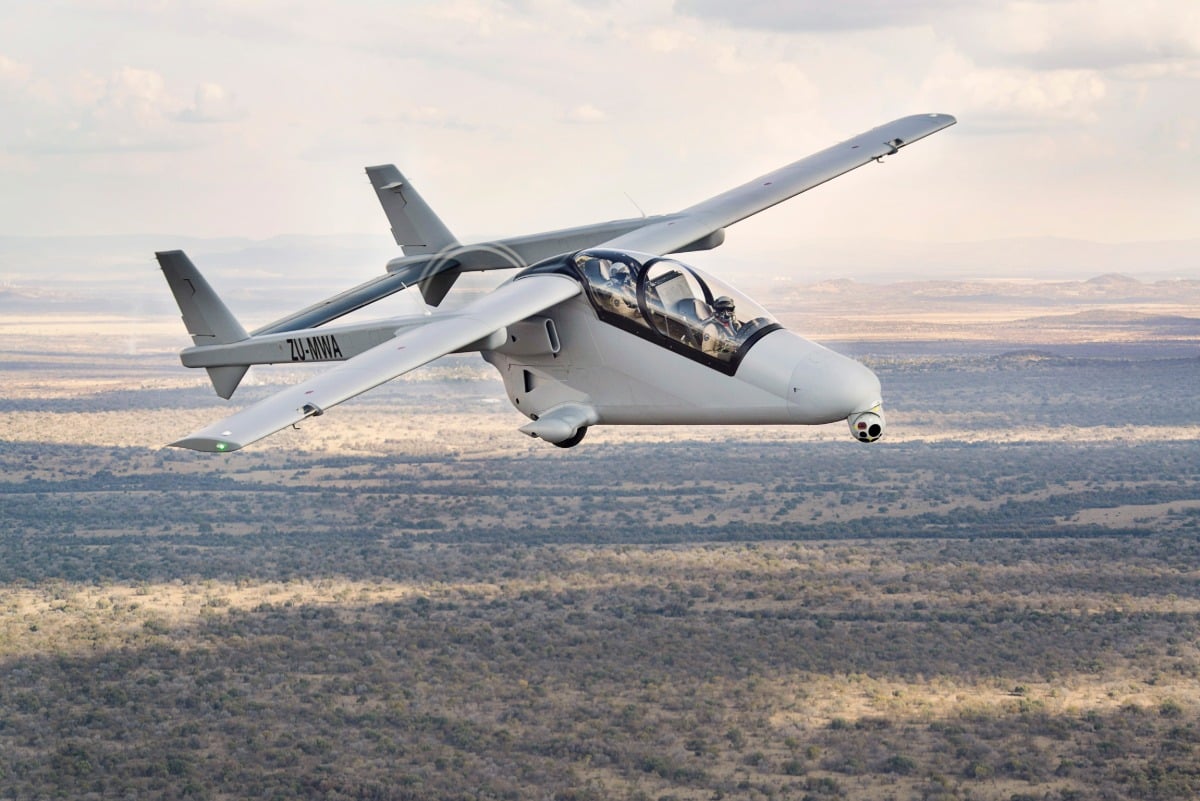
When a South African defense firm unveiled its latest airborne drone hunter, the industry took notice because it bypassed the clumsy limitations of ground-based defenses. The aircraft does not rely on a human pilot frantically toggling joysticks from a distant bunker. Human reflexes are simply too slow to match the erratic, split-second banking turns of a modern quadcopter.
Instead, the hunter utilizes onboard tracking systems that lock onto the target's thermal signature and visual silhouette. It pursues the intruder with terrifying precision.
The physics of an aerial intercept are brutal. Airplanes rely on forward momentum. Drones rely on hovering agility. Combining these two elements into a single platform means building a machine that can sprint across miles of open sky, then instantly brake, hover, and strike. The South African design handles this transition through a specialized multi-rotor layout combined with a fixed-wing architecture. It flies to the target area like a traditional plane, then hunts like a bird of prey.
Consider what happens next in our scenario with David.
The alarm sounds. The hunter launches vertically from a small platform, clearing the tree line in seconds. It does not need a runway. It does not need a pilot to guide its path. The onboard systems calculate intercept trajectories within milliseconds. On David’s monitor, the rogue drone appears as a flashing red dot. The hunter appears as a green arrow, closing the distance at speeds that leave commercial quadcopters looking stationary.
The Capture in the Clouds
How do you stop a drone without blowing it to pieces over a city street?
The developers of the South African hunter focused heavily on physical capture. Shooting a drone down leaves falling debris, which can injure civilians on the ground. Jamming its signal can cause the rogue drone to drop like a stone, creating an unpredictable kinetic hazard.
The hunter solves this by deploying a physical capture mechanism. It gets close enough to deploy a high-tensile net, tangling the rotors of the intruder instantly. Once caught, the rogue drone does not plummet. The hunter can either carry the snared target away to a safe detonation zone or deploy a tiny parachute, ensuring both aircraft drift safely to an empty patch of earth.
It is an elegant, almost silent resolution to a chaotic problem.
The engineering team behind this platform spent years analyzing the failures of Western and Eastern defense systems. Many global defense conglomerates tried to solve the drone problem by scaling down massive military hardware. They attached lasers to trucks or modified anti-aircraft cannons. These systems cost millions of dollars per unit, making them impractical for commercial airports, ports, or power stations.
The South African approach focuses on cost-effective, scalable utility. By utilizing localized manufacturing pipelines and focusing on rugged reliability, they created a system that can be deployed by a local security team, not just a national military force.
The Changing Geometry of Security
This shift alters the entire logic of airspace defense. For years, malicious actors held all the cards. They could buy a fleet of off-the-shelf drones, modify them in a basement, and cause billions of dollars in economic damage with zero personal risk. The defense was always playing catch-up, spending millions to counter a threat that cost pennies.
The airborne hunter balances the ledger.
It moves the battlefield away from the vulnerable ground infrastructure and into the open sky. Security teams no longer have to wait for a drone to approach a sensitive asset before reacting. They can intercept it at the outer boundary of their airspace, miles away from human activity.
This technology arrives at a moment of deep geopolitical uncertainty. The proliferation of small uncrewed aerial vehicles in global conflicts has proven that the nature of modern security has changed forever. The sky is no longer a safe haven. It is a vector.
For professionals like David, looking up at the gray fog no longer feels like waiting for an inevitable disaster. The arrival of autonomous, intelligent hunters means that the advantage has finally swung back to the protectors. The angry buzz of an intruding drone is no longer an unstoppable threat. It is merely a signal for the hunter to launch.