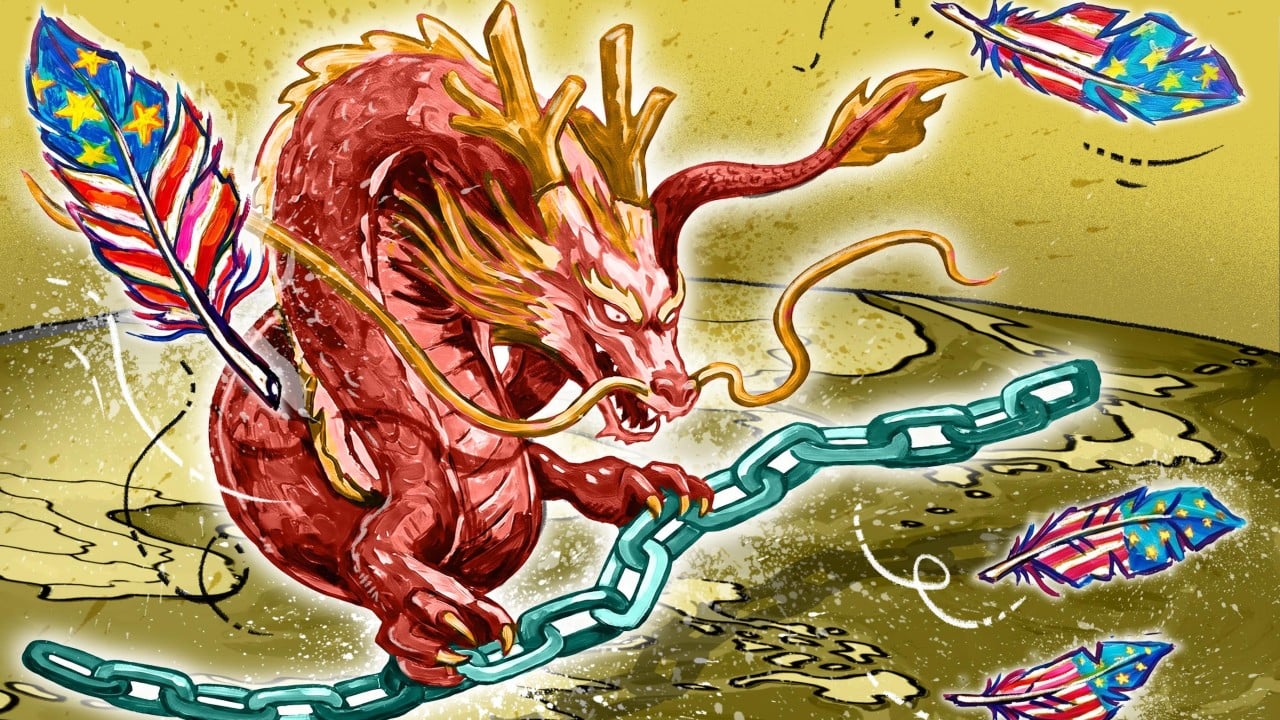
Strategic competition in the Western Pacific is governed by a simple logistical and geographical asymmetry: the People's Republic of China operates on interior lines of communication, while the United States depends on extended maritime supply chains spanning thousands of miles. Popular analyses often frame this dynamic as a nebulous "numbers game" of competing ship counts or defense budgets. This framing is analytically lazy. The erosion of the United States position along the First Island Chain—the archipelagic defensive barrier running from the Japanese archipelago through Taiwan down to the Philippines and Borneo—is not driven by raw monetary inputs, but by structural friction, cost-function imbalances in missile economics, and the erosion of regional escalation dominance.
Evaluating this theater requires moving past surface-level capability comparisons. Deterrence by denial along the First Island Chain relies on three operational pillars: persistent sensor-shooter networks, resilient and distributed basing architecture, and ammunition inventory depth. When these variables are mapped against the People's Liberation Army modernization trajectory, a clear systemic decay emerges.
The Cost Function of Anti-Access and Area Denial
The core mechanism shifting the military balance is an asymmetric expenditure curve. Military economists categorize regional defense investments through the lens of cost-per-kill and magazine depth. For decades, American power projection relied on high-end, multi-role platforms: nuclear-powered aircraft carriers, large surface combatants, and fifth-generation tactical aircraft based on massive hubs like Kadena Air Base in Okinawa or Andersen Air Base in Guam.
These platforms represent hyper-concentrated nodes of capability. The People's Liberation Army has exploited this centralization by constructing a dense, land-based anti-access and area denial architecture. This network relies on mobile, ground-launched ballistic and cruise missiles, long-range surface-to-air missile systems, and over-the-horizon radar arrays.
The economic mismatch dictates the strategic outcome. A single DF-21D or DF-26 medium-range ballistic missile costs a fraction of the capital asset it targets. When multiplied across an industrial base capable of producing precision munitions at scale, the adversary establishes a prohibitive cost-imposition strategy. The United States cannot win a war of attrition where the defender expends multi-million-dollar interceptors to neutralize cheaper offensive vectors, nor can it sustain forward operations if its primary airbases and ports can be systematically cratered during the opening hours of a conflict.
The Tyranny of Distance and Logistical Vulnerability
Geography dictates operational tempo. The First Island Chain sits directly on China's maritime doorstep, allowing the People's Liberation Army Navy, the China Coast Guard, and the maritime militia to operate under land-based air cover. Conversely, American forces must project power across the Pacific Ocean, creating a severe mass-accumulation bottleneck.
This spatial reality exposes a critical vulnerability in reinforcement timelines. If a crisis erupts in the Taiwan Strait or the South China Sea, the speed at which the United States can flow combat power forward is constrained by airlift and sealift capacity, port availability, and contested logistics. While surface action groups and carrier strike groups can steam toward the theater, they enter an operational zone saturated by reconnaissance-strike complexes capable of tracking surface vectors in real time.
Furthermore, the defense industrial base of the United States currently operates on a peacetime procurement model characterized by long lead times and low production rates for complex tactical munitions. In a high-intensity, peer-level exchange, critical missile inventories—such as Long Range Anti-Ship Missiles and Joint Air-to-Surface Stasm Missiles—would face rapid depletion within days, long before industrial surge capacities could compensate for expenditure rates.
Alliance Friction and the Burden-Sharing Dilemma
Deterrence along the archipelagic barrier is structurally dependent on regional allies. Japan, the Philippines, and Australia form the political and geographic anchors necessary to sustain a denial defense. However, alliance cohesion is strained by divergent threat perceptions and the economic costs of front-line militarization.
Washington's strategic posture demands that allies absorb higher defense expenditures and integrate more deeply into joint operational concepts. Yet, pushing partner nations to adopt provocative defense postures without providing immediate, impenetrable defensive umbrellas creates severe domestic political friction within those host nations. Beijing exploits this friction through economic coercion, diplomatic pressure, and gray-zone operations designed to decouple regional capitals from American security guarantees. When front-line states calculate that alignment with the United States invites economic retaliation and catastrophic localized destruction without absolute assurance of timely reinforcement, their willingness to function as forward-basing platforms degrades.
The Information and Gray-Zone Erosion
Physical combat is only the final stage of a continuous competitive cycle. The adversary has institutionalized a framework known as the Three Warfares—encompassing legal, media, and psychological operations—to achieve strategic objectives below the threshold of armed conflict.
In the South China Sea and around disputed island features, maritime militia and coast guard vessels execute persistent, incremental encroachments. This approach relies on salami-slicing tactics: each individual action is too minor to trigger a collective self-defense response or a major military escalation, yet the cumulative effect alters the territorial status quo. The United States and its allies lack an effective institutional response to gray-zone coercion. Traditional naval deployments are over-calibrated for high-end combat and ill-suited for countering thousands of tonnage-heavy hulls operating under the guise of commercial fishing or law enforcement. This dynamic gradually pushes American influence outward, translating operational passivity into strategic retreat.
To arrest this trajectory, defense planners must abandon legacy assumptions regarding global military dominance and transition toward a distributed, asymmetric denial posture. This requires accepting a smaller footprint of high-value assets, prioritizing ultra-low-cost autonomous surface and subsurface vessels, decentralizing logistics into hardened, mobile nodes across the Indo-Pacific, and radically overhauling defense procurement to match the industrial output velocity of the competitor. Without this structural adaptation, the mathematical reality of cost curves and geography will continue to erode the American position along the maritime perimeter.