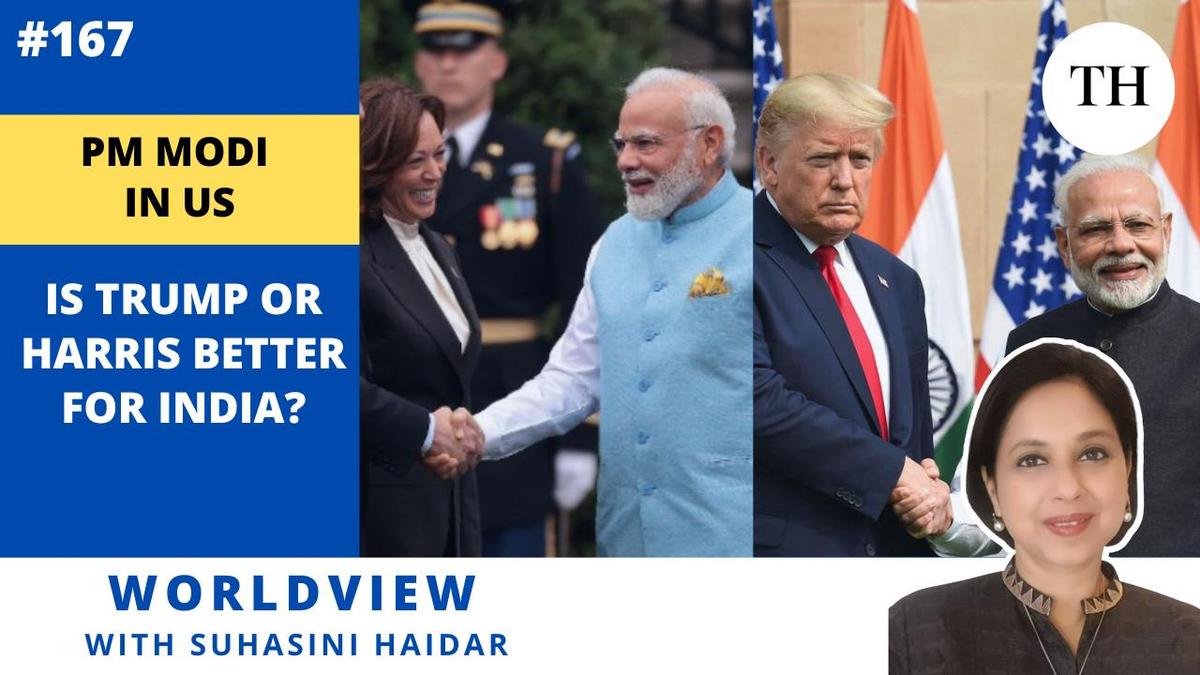
Foreign policy analysis concerning New Delhi and Washington frequently degenerates into superficial personality assessments. Commentary focuses intensely on whether a Republican or Democratic executive occupies the White House, treating bilateral ties as a function of personal rapport between heads of state. This approach obscures the structural realities governing the relationship. Bilateral relations between the United States and India are driven by hard geopolitical calculations, institutional inertia, and overlapping security imperatives that operate independently of electoral outcomes. Evaluating whether a second Trump administration or a Democratic continuation under Harris is superior for India requires stripping away campaign rhetoric and examining the underlying cost functions, trade mechanics, and strategic friction points that define the partnership.
The Structural Baseline: The Indo-Pacific Security Matrix
The primary variable anchoring U.S.-India relations is the systemic competition between Washington and Beijing. Institutional architecture in both capitals views China as a peer competitor capable of altering the regional balance of power in Eurasia and the Indo-Pacific. This structural reality creates a bipartisan convergence in Washington. Whether policymakers sit in the West Wing under a Republican or Democratic banner, the strategic necessity of containing Chinese hegemony remains constant.
This convergence manifests in institutionalized mechanisms such as the Quadrilateral Security Dialogue, bilateral intelligence-sharing agreements like the Basic Exchange and Cooperation Agreement, and critical technology partnerships. These arrangements are embedded within the permanent national security bureaucracy of both nations. They cannot be easily undone by an individual executive's whims or short-term electoral shifts.
For New Delhi, this alignment provides a necessary security shield. India shares a disputed, militarized border with China and faces persistent maritime pressure in the Indian Ocean. Cooperation with Washington grants India access to advanced defense technologies, intelligence assets, and diplomatic backing. However, this security alignment imposes a distinct cost function: reduced strategic autonomy. As Washington intensifies its security demands, New Delhi must continuously calibrate its defense procurement and diplomatic posture to avoid complete entanglement in American containment strategies.
The Transactional Mechanics of Republican Foreign Policy
A Republican administration under Donald Trump introduces a distinctly transactional operating model into bilateral relations. Under this framework, foreign policy is conducted primarily through the lens of bilateral trade balances, market access reciprocity, and direct deal-making.
During the 2017 to 2021 period, this approach generated acute economic friction. The administration prioritized reducing trade deficits, leading to the revocation of India's designation under the Generalized System of Preferences program, which had allowed billions of dollars in Indian exports duty-free entry into American markets. Furthermore, aggressive protectionist measures, including steel and aluminum tariffs, provoked retaliatory tariffs from New Delhi.
Beyond trade balances, immigration policy serves as a primary friction point under Republican governance. The restriction of H-1B non-immigrant work visas directly impacts the Indian technology sector and human capital export pipelines. Trump administration policies targeting high-skilled labor migration create severe compliance costs for Indian IT service firms and disrupt labor mobility.
Yet, this transactional model possesses specific operational advantages for New Delhi. Transactional leaders prioritize personal diplomacy and bilateral deals over normative lectures. A Republican administration is markedly less inclined to scrutinize India's domestic governance, internal legislation, or human rights record. For Prime Minister Narendra Modi's administration, this transactional insulation from external governance critiques provides valuable political breathing room. The relationship operates on clear, explicit terms: if New Delhi procures American defense hardware or opens specific energy markets, trade disputes are compartmentalized from broader strategic cooperation.
The Normative Framework of Democratic Foreign Policy
A Democratic administration led by figures aligned with the party establishment operates under a fundamentally different framework. Democratic foreign policy integrates strategic containment of China with a strong emphasis on normative values, multilateral institution-building, and domestic governance scrutiny.
While strategic cooperation persists—exemplified by joint initiatives on critical and emerging technologies—diplomatic friction migrates from trade tariffs to human rights and democratic norms. Democratic administrations face intense pressure from congressional wings and civil society organizations to address domestic policy shifts within partner nations. Legislative actions, judicial restructuring, and minority rights in India receive continuous monitoring and occasional public critique from American officials.
This normative friction creates diplomatic discomfort for New Delhi, which guards its sovereignty fiercely. Official reactions to external commentary on internal legislation are uniformly sharp, asserting that bilateral partnerships must not infringe upon domestic sovereignty.
Simultaneously, Democratic economic policy utilizes multilateral frameworks and clean energy financing initiatives to drive engagement. Mechanisms focused on supply chain resilience, semiconductor manufacturing investments, and green energy transitions offer substantial industrial opportunities for India. Washington seeks to integrate Indian manufacturing capacity into diversified supply chains, reducing dependence on Chinese industrial nodes. This economic integration aligns directly with India's domestic industrial strategy, specifically manufacturing incentive programs designed to boost domestic output.
The Economic Trade-Off Matrix
Assessing the net economic impact of either administration requires analyzing distinct vectors of friction and opportunity.
- Tariff structures and market access negotiations: Republican administrations pursue aggressive bilateral tariff reduction demands, utilizing market exclusion threats to force concessions on agricultural and medical device imports. Democratic administrations pursue similar trade skepticism but embed demands within multilateral labor and environmental standards.
- High-skilled labor mobility: Republican visa restrictions impose direct financial and operational penalties on Indian technology firms. Democratic administrations generally exhibit more accommodating stances on legal migration channels, though regulatory scrutiny of visa processing remains high.
- Defense and technology co-development: Both political parties support advanced technology transfer, yet Democratic frameworks emphasize multilateral regulatory compliance, whereas Republican frameworks prioritize direct commercial procurement contracts.
New Delhi must navigate these divergent economic pressures without sacrificing domestic industrial priorities. The fundamental economic challenge for India is avoiding total alignment with any single trade bloc while maximizing foreign direct investment inflows from Western capital markets.
The Mechanics of Strategic Autonomy and Hedging
Regardless of whether a Republican or Democratic executive occupies the Oval Office, Indian foreign policy maintains a foundational commitment to strategic autonomy. New Delhi operates on the principle of multi-alignment, refusing permanent vassalage to any superpower.
This strategic hedging is most visible in India's energy procurement and defense relationships. Despite intense pressure from Washington to sever military and economic ties with Moscow, India continues to balance its historic defense relationship with Russia while simultaneously expanding interoperability with the United States. During periods of heightened oil price volatility, New Delhi exercises its sovereign prerogative to procure discounted energy assets from sanctioned or restricted suppliers, prioritizing domestic macroeconomic stability over Western geopolitical alignment.
Furthermore, India maintains active engagement in alternative multilateral forums such as BRICS and the Shanghai Cooperation Organisation. These platforms allow New Delhi to project independent leadership in العالم الثالث (the Global South), serving as a counterweight to perceptions that India acts merely as an American proxy in Asia.
Strategic Forecast and Operational Playbook
Indian policymakers must approach Washington with a clear-eyed assessment of structural constraints rather than partisan preferences. Neither political party in the United States offers an unalloyed benefit to Indian national interests.
Under a Republican executive, New Delhi should anticipate aggressive trade negotiations and restrictive visa policies, balanced by an absence of normative lecturing and a willingness to execute rapid, high-value defense procurement deals. The operational imperative is to deploy precise commercial concessions—such as targeted energy purchases or selective tariff adjustments—to neutralize trade retaliation while protecting core domestic manufacturing sectors.
Under a Democratic executive, New Delhi should anticipate complex regulatory frameworks, multilateral technology partnerships, and persistent scrutiny regarding domestic governance standards. The operational imperative here is to leverage technology cooperation initiatives while maintaining rigid diplomatic boundaries against external interference in internal affairs.
Ultimately, the trajectory of U.S.-India relations is not contingent on executive personalities. It is shaped by the capacity of Indian statecraft to extract maximum strategic and technological utility from Washington while preserving absolute freedom of action across Eurasian and global domains.


