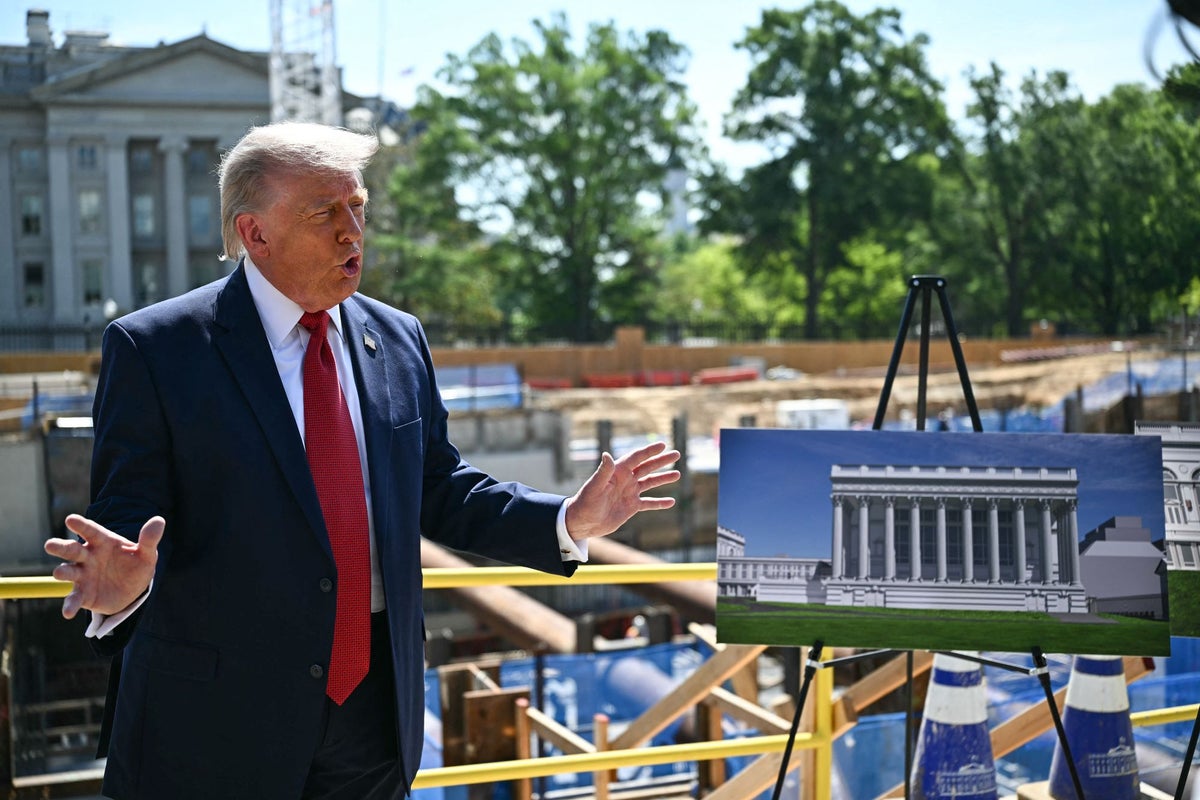
The intersection of private capital, federal infrastructure, and legislative mechanics has created a structural bottleneck in the execution of the White House East Wing Modernization Project. Originally positioned as a $400 million corporate-and-donor-funded architectural expansion, the project’s execution relies on a dual-funding capital structure. This model splits nominal construction costs from systemic security enhancements.
The introduction of a $1 billion federal funding rider for the United States Secret Service (USSS) altered the legislative risk profile of the initiative. By analyzing this real estate and legislative operation through structural frameworks—specifically capital stratification, legislative procedural constraints, and cost-allocation mechanisms—we can isolate the friction points that led to the recent procedural rejection by the Senate parliamentarian.
The Bifurcated Capital Framework
The financial architecture of the East Wing expansion avoids standard capital procurement models by separating structural shell construction from systemic security integration. This dual-funding mechanism establishes two distinct risk categories:
Private Capital Stratification (The Above-Ground Shell)
The visible 90,000-square-foot structure is budgeted at $400 million, sourced through private equity, corporate sponsorships, and high-net-worth donations. Entities like Amazon, Apple, Google, Meta, Palantir, and Lockheed Martin form the core corporate donor base.
The financial structure allows for donor anonymity in specific tranches. This creates an asymmetric information environment regarding corporate influence, which has triggered litigation from oversight groups like Public Citizen under the Freedom of Information Act (FOIA).
Public Capital Appropriation (The Security Sub-Structure)
The underlying infrastructure, which includes a heavily fortified subterranean military complex, medical facilities, and bomb shelters, is structured as a public utility. The justification for federal capital deployment shifted following the April 25 security breach at the Washington Hilton during the White House Correspondents' Association dinner.
The USSS subsequently quantified its systemic risk mitigation requirements at $1 billion, seeking to integrate these funds into a broader $72 billion Immigration and Customs Enforcement (ICE) and Customs and Border Protection (CBP) funding package.
+-----------------------------------------------------------------------+
|                 EAST WING MODERNIZATION PROJECT                       |
|                         (Dual Funding)                                |
+-----------------------------------------------------------------------+
                                   |
         +-------------------------+-------------------------+
         |                                                   |
         v                                                   v
+-----------------------------------+   +-----------------------------------+
|      ABOVE-GROUND STRUCTURE       |   |       SUBTERRANEAN COMPLEX        |
|        (The Ballroom Shell)       |   |      (Security Infrastructure)    |
+-----------------------------------+   +-----------------------------------+
| Budget: $400 Million              |   | Request: $1 Billion               |
| Source: Private Donations         |   | Source: Federal Appropriations    |
| Risk: Disclosure & Legal Filings  |   | Risk: Procedural Compliance       |
+-----------------------------------+   +-----------------------------------+
The $1 Billion Cost Function Breakdown
The public capital requirement is not a monolithic allocation for interior design; it represents a comprehensive fortification budget for the broader White House compound. The Secret Service's internal cost function, submitted to Senate appropriators, categorizes the $1 billion request into six distinct operational line items:
- White House Complex Hardening ($220 million): Direct structural engineering modifications, including the installation of ballistic-rated glass, drone interdiction networks, and chemical/biological/radiological filtration systems. This capital is split between the subterranean bunker and above-ground structural reinforcement.
- Visitor Security Screening Facility ($180 million): The construction of a high-throughput, technologically advanced ingress point designed to process external guests before they enter the secure perimeter.
- Secret Service Operational Training ($175 million): Capital allocated toward specialized tactics, simulation environments, and physical training facilities required to manage high-density events within the new space.
- Enhancements for Protectee Security ($175 million): Mobile and fixed technological assets deployed to secure the executive during transits to high-frequency external venues.
- Evolving Threats and Countermeasures ($150 million): Research, development, and deployment of electronic warfare assets, specifically targeting low-radar-cross-section drones and automated airspace intrusions.
- Events of National Significance ($100 million): A liquid operational reserve fund to offset the localized logistical costs of hosting large-scale, high-profile summits within the expanded complex.
Legislative Friction and the Byrd Rule Bottleneck
The strategic decision by Senate leadership to append this $1 billion security appropriation to a partisan budget reconciliation bill created an immediate procedural vulnerability. Budget reconciliation allows legislation to pass with a simple 51-vote majority, bypassing the traditional 60-vote filibuster threshold in a closely divided 53-47 Senate. However, this path requires strict adherence to statutory spending rules.
The Senate parliamentarian’s subsequent adverse ruling demonstrated the limits of using reconciliation for complex capital expenditures. Under the governing statutory framework (specifically the Byrd Rule), all provisions in a reconciliation bill must have a direct, non-incidental impact on the federal budget.
The parliamentarian ruled that funding for an infrastructure project as broad and complex as the East Wing renovation failed to meet these narrow procedural criteria. The funding mechanism was deemed extraneous to the core immigration enforcement bill.
The impact of this ruling is twofold:
Elimination of the Partisan Fast-Track
Without the protection of the reconciliation framework, any legislative vehicle containing the $1 billion security appropriation must face standard Senate procedures. This introduces the requirement for a 60-vote cloture threshold.
Leverage Shift to Fiscal Hawks and Opposition
Because the Senate math requires at least seven opposition votes to clear a filibuster, moderate members and fiscal conservatives gain significant leverage. Lawmakers like Senate Appropriations Chair Susan Collins have demanded granular accounting data, while fiscal conservatives express concern over deficit expansion. This pushback highlights internal party friction regarding capital discipline.
Judicial and Operational Interdependencies
The architectural timeline faces further complications due to a feedback loop between the ongoing construction and federal litigation. The National Trust for Historic Preservation filed suit alleging that the administration bypassed mandatory statutory reviews required by the National Capital Planning Commission and the National Historic Preservation Act.
The current operational state is governed by a conditional stay issued by the U.S. Court of Appeals for the District of Columbia Circuit. This ruling created a sharp divide in project execution:
                  +-----------------------------------+
                  |      APPEALS COURT RULING         |
                  +-----------------------------------+
                                    |
         +--------------------------+--------------------------+
         |                                                     |
         v                                                     v
+-----------------------------------+                 +-----------------------------------+
|     ABOVE-GROUND CONSTRUCTION     |                 |      UNDERGROUND FORTIFICATION    |
+-----------------------------------+                 +-----------------------------------+
| Operational Status: PAUSED        |                 | Operational Status: ACTIVE        |
| Condition: Pending June 5 Hearing |                 | Condition: National Security      |
+-----------------------------------+                 +-----------------------------------+
This operational decoupling creates a serious engineering bottleneck. Executive communications indicate that the subterranean complex relies on the structural load-bearing design of the above-ground facility.
If the June 5 appeals hearing reinstates the lower court's full construction halt, the Secret Service faces an incomplete construction site inside the primary secure perimeter. This situation complicates defensive logistics and increases daily operational overhead.
Strategic Playbook For Capital Realignment
To resolve the impasse and advance the project, project planners must transition away from high-risk legislative maneuvers and adopt a dual-track strategy focused on capital reallocation and structural concessions.
Isolate and Unbundle the Security Assets
The primary strategic error was grouping general agency training ($175 million) and external protectee security ($175 million) into an infrastructure rider. Capital procurement teams should strip these items from the East Wing project entirely and reintroduce them via standard Department of Homeland Security appropriations bills.
By narrowing the immediate request strictly to "Complex Hardening" ($220 million), the capital requirement drops by 78%. This significantly reduces the political target size.
Leverage the Statutory Security Exemption
Because the courts have explicitly carved out an exemption allowing national security infrastructure construction to continue, developers should pivot entirely to subterranean engineering.
By exhausting the current private capital allocations on foundational and underground work that overlaps with USSS requirements, the administration can advance the project's critical path while legislative negotiations occur above ground.
Establish a Bipartisan Escrow Oversight Board
To satisfy the data requests of centrist lawmakers, leadership should establish an independent, bipartisan oversight board to manage the distribution of the private donation pool.
Providing transparency into corporate vetting and donor identities removes the "secret contract" narrative used by the opposition. This creates the political cover necessary to secure the 60 votes required for standard appropriations access.
The survival of the modernization project depends on recognizing that legislative procedures cannot be bypassed through sheer capital volume. Only by aligning the financial structure with institutional rules can the project clear its current hurdles.