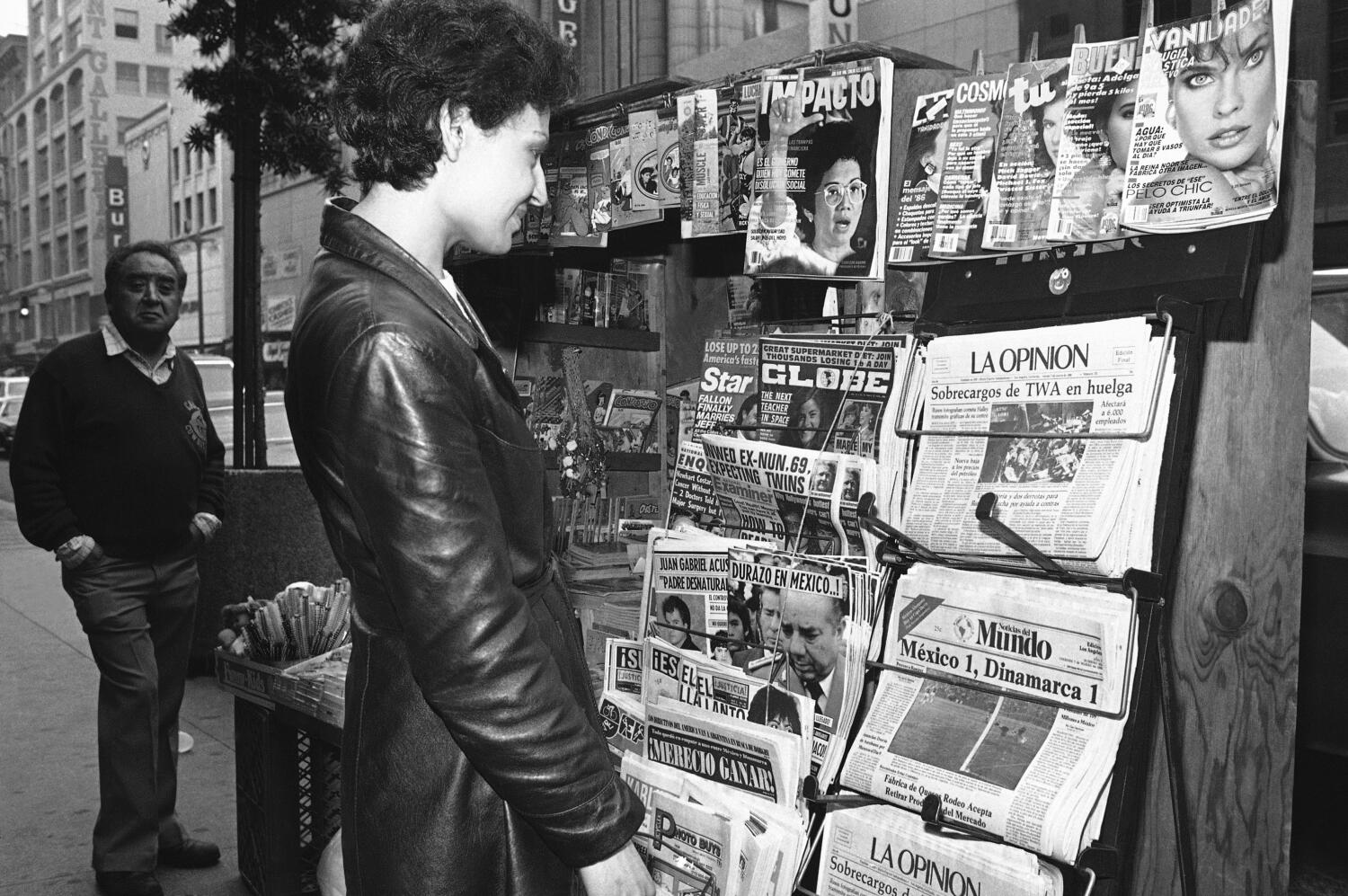
Anniversary retrospectives are comfort food for industries on life support. When publications like La Opinión hit milestone markers, the institutional reflex is to reach for the hagiography. We get long-form poetry about ink on fingertips, the noble chronicler of immigrant struggles, and the romantic defense of democracy's watchdog.
It is a comforting lie.
The lazy consensus in media commentary treats a centurys survival as proof of inherent value, as if longevity in print is a moral victory against the digital age. It is not. Nostalgia is not a business model, and romanticizing the survival of a legacy title obscures the brutal mechanics of why local journalism actually collapsed. We spent decades mourning the loss of the physical paper while ignoring the structural hubris that made it obsolete.
To understand why traditional ethnic and local media struggles today, you have to strip away the sentimentality. Publications do not die because readers stopped caring about their communities. They die because they mistook distribution monopolies for audience loyalty.
For the better part of the twentieth century, local newspapers held a tollbooth over information. If you wanted to know what happened in Los Angeles neighborhoods, if you wanted classified ads, if you wanted local retail coupons, you went through the gatekeeper. That monopoly funded the newsroom. It funded the investigative pieces, the cultural chronicling, and the daily grind of reporting.
Then the tollbooth vanished.
When the internet unbundled distribution, it exposed the core vulnerability of legacy outlets: their revenue was never built on deep community engagement; it was built on advertising rent extraction. The moment local businesses could buy targeted digital ads cheaper and more effectively elsewhere, the financial foundation evaporated.
Yet the institutional narrative refuses to adapt. Commentators look at a hundred years of publishing and attribute endurance to editorial virtue alone. That is a dangerous inversion of cause and effect. Institutions survive not because they are pure, but because they are slow to die and heavy enough to absorb shocks until subsidies, acquisitions, or philanthropic lifeboats catch them.
The contrarian truth is this: treating a hundred-year-old publication as a sacred artifact dooms it to irrelevance.
When an outlet relies on institutional romance, it stops taking risks. It produces safe, predictable content designed to validate the historical identity of its readers rather than interrogate their present realities. Look at how immigrant communities are covered across legacy Spanish-language press. For decades, the framing defaulted to a monolithic narrative of struggle, assimilation, and external victimhood. It served a purpose during eras of intense legislative hostility, but it fundamentally patronizes a modern demographic that is economically stratified, politically diverse, and digitally native.
The modern audience does not need a patriarch telling them their own story back to them with a melancholic soundtrack. They need granular data, economic literacy, housing market accountability, and investigative rigor that cuts across linguistic silos.
If you want to build a sustainable information ecosystem for a metropolis like Los Angeles, you have to let go of the ghosts of print history. The future does not belong to the institution that has been around the longest. It belongs to the entity that solves the coordination and trust problem for fragmented communities most efficiently.
Stop asking how we can preserve the monuments of twentieth-century media. Ask why we ever expected a printing press to do the job of a civic network. The next century of local reporting will not be written on newsprint, and it will not be saved by nostalgia. It will be built by ruthless adaptation or it will not exist at all.