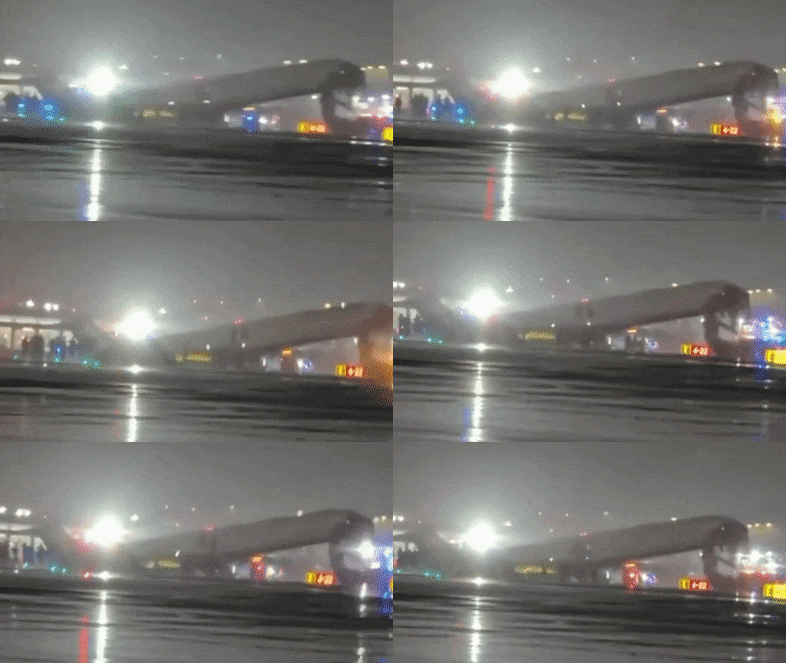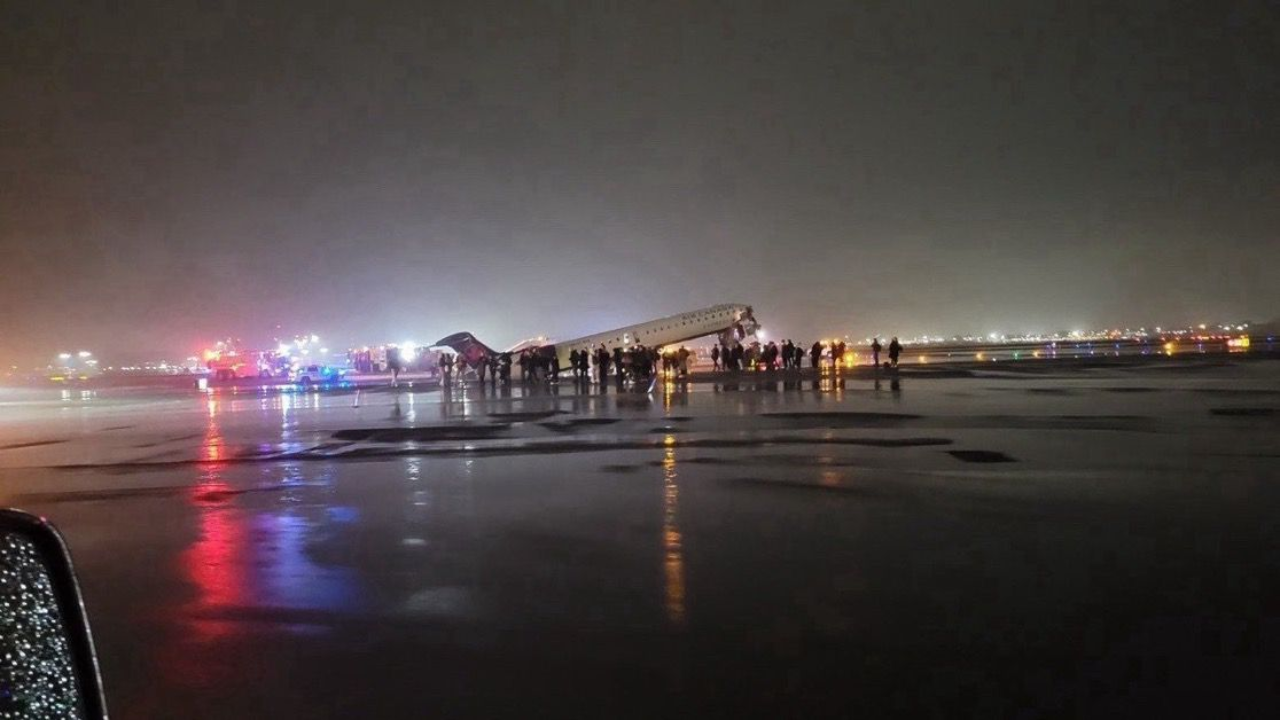
Ground operations at major hubs are reaching a breaking point. On a clear morning at LaGuardia Airport, an Air Canada Express Mitsubishi CRJ-900—carrying dozens of passengers—slammed into a parked FDNY crash truck. The collision sheared off a portion of the aircraft's wing and sent a shockwave through the aviation industry. While the immediate reporting focused on the visual wreckage and the lack of serious injuries, the incident uncovers a much deeper, systemic failure in how one of the world’s most congested airports manages its surface traffic. This was not a fluke. It was the predictable result of a crowded, high-pressure environment where communication gaps and outdated ground-tracking protocols are becoming the norm rather than the exception.
The mechanics of the crash are as simple as they are terrifying. The Air Canada Express flight, operated by Jazz Aviation, was taxiing toward its gate after arriving from Toronto. At the same time, New York City Fire Department equipment was positioned on the ramp, purportedly for a training exercise or a standby maneuver. The pilot’s line of sight, the vehicle’s positioning, and the frantic pace of LaGuardia’s ground control all converged in a single moment of impact.
The Myth of the Sterile Ramp
Aviation safety experts often talk about "sterile cockpit" rules, where non-essential chatter is banned during critical phases of flight. However, the ramp—the area where planes park, refuel, and load—is anything but sterile. It is a loud, chaotic, and increasingly dangerous workspace. At LaGuardia, the spatial constraints are legendary. Unlike the sprawling fields of Denver or Dallas-Fort Worth, LaGuardia is a postage stamp of an airport. Every square inch is contested.
When a wingtip slices through a fire truck, the investigation usually starts with the "human factor." Did the pilot see the truck? Did the ground controller warn the crew? These are the surface-level questions. The real inquiry needs to look at the Surface Movement Guidance and Control System (SMGCS). In many modern airports, technology is supposed to provide a digital safety net, alerting controllers when two objects are on a collision course. But at the ramp level, the responsibility often shifts back to "see and avoid," a primitive strategy for a 2026 aviation environment.
The FDNY presence on the airfield is a constant. They are there to protect, yet in this instance, they became the hazard. This highlights a disconnect between the Port Authority of New York and New Jersey, the FAA, and the emergency services that operate within the airport's perimeter. If a fire truck is parked in a "safety zone" that can still be reached by the 81-foot wingspan of a CRJ-900, the zone itself is a failure.
The Cost of Congestion and the Push for Turnaround Times
Airlines are under immense pressure to keep "turnaround times" as short as possible. Every minute a plane sits on the tarmac is a minute it isn't making money. This pressure trickles down from the executive suite to the pilots and the ground crews. When you combine this rush with the physical limitations of LaGuardia’s aging infrastructure, the margin for error disappears.
The Air Canada Express incident is a symptom of saturation. We are shoving more flights into narrow windows than the physical layout of these airports was ever designed to handle. We see it in the "close calls" that have spiked over the last 24 months. While the FAA often points to pilot training as the solution, veteran aviators argue that the complexity of the ground environment has simply outpaced human processing speed.
Consider the layout of the CRJ-900. It is a long, narrow-body aircraft. From the cockpit, the wingtips are not visible to the pilots. They rely entirely on the accuracy of the taxiway markings and the guidance of ground controllers. If a vehicle is even a few feet outside of its designated area, or if a pilot drifts slightly off the yellow line, the result is metal-on-metal.
Ground Radar Gaps and Terminal Dead Zones
One of the most ignored factors in airport safety is the "blind spot" in ground radar. While the Airport Surface Detection Equipment (ASDE-X) provides high-resolution coverage of runways and taxiways, its effectiveness often drops off as a plane nears the terminal gates. This is the Ramp No-Man’s Land.
In this gray zone, the aircraft transitions from the strict control of the FAA tower to the more informal management of airline-specific ramp towers. It is during this handoff that many collisions occur. The Air Canada jet was in this transitional space.
- Communication Lag: Controllers are managing dozens of frequencies. A warning issued three seconds too late is the same as no warning at all.
- Infrastructure Decay: Faded taxiway lines and confusing signage at LaGuardia have been cited by pilots for decades.
- Vehicle Proliferation: There are more tugs, fuel trucks, baggage carts, and emergency vehicles on the ramp today than at any point in history.
The industry likes to pretend that automation will solve this. There are talks of "autonomous tugs" and GPS-tracked ground vehicles. But the reality is that the current fleet of emergency vehicles—like the FDNY truck involved in the crash—are not integrated into the airport’s digital traffic management system. They are ghosts on the radar until they are hit.
The Regional Carrier Strain
We must also look at the role of regional operators like Jazz Aviation. These companies operate on razor-thin margins under contracts for major brands like Air Canada. The pilots are often highly skilled but are forced to fly high-frequency, short-haul routes that involve multiple landings and taxi sequences a day. The fatigue associated with the "short-hop" lifestyle is a documented safety risk.
When a regional jet hits an object on the ground, the parent company often escapes the brunt of the PR damage, but the safety culture of the regional partner is what actually determines the outcome. We need to ask if the crews operating these "Express" flights are being given the same level of support and situational awareness tools as the crews flying wide-body jets on international routes. The physics of a collision doesn't care about the name on the ticket.
Infrastructure is the Real Bottleneck
Politicians love to cut ribbons on shiny new terminals, as they recently did at LaGuardia. They talk about the "world-class" experience for passengers. But the "airside"—the part of the airport where the planes actually move—has not seen the same revolutionary upgrades. We have built 21st-century malls on top of 20th-century runways.
The "New LaGuardia" is still plagued by the same cramped taxiways that defined the old one. If the Port Authority does not address the physical spacing between taxi paths and service vehicle lanes, we are going to see a catastrophic event that involves more than just a clipped wing. We are going to see a fuel spill or a fire in a crowded gate area.
The Liability Shift
In the aftermath of the Air Canada Express crash, the finger-pointing began immediately. The airline will blame the airport's vehicle placement. The Port Authority will likely point to pilot error. The FDNY will claim they were where they were supposed to be.
This legal dance avoids the core truth: the system is failing. We are operating at 110% capacity in a space designed for 80%. When you run a system at over-capacity for long enough, the "accidents" become statistical certainties.
We need to demand a complete overhaul of ground movement technology. This includes:
- Mandatory Transponders: Every vehicle that touches the airfield, from the smallest baggage tug to the largest fire truck, must be visible on the pilot’s cockpit display.
- Standardized Ramp Control: Eliminating the "gray zone" between FAA tower control and airline ramp control.
- Physical Barriers: Using retractable bollards or clearer physical lane separations to keep ground vehicles away from active taxi paths.
Until these changes are made, passengers are essentially gambling every time their plane pushes back from the gate. The collision in New York was a loud, expensive warning.
I can help you analyze the specific NTSB incident reports or map out the high-risk "hot spots" at other major US airports if you want to see where the next collision is likely to happen.