The air in Tehran smells faintly of old paper, exhaust fumes, and a quiet, unyielding tension that has lasted for generations. If you stand near the grand bazaars or walk past the concrete facades of Vali-Asr Street, you do not just hear the hum of a city of millions. You feel the weight of history pressing down on every shoulder. People go to work, buy warm bread, and sip dark tea from small glass cups, but underneath the mundane rhythm of daily life runs a constant, nervous current. Everyone knows the game. Everyone knows the board.
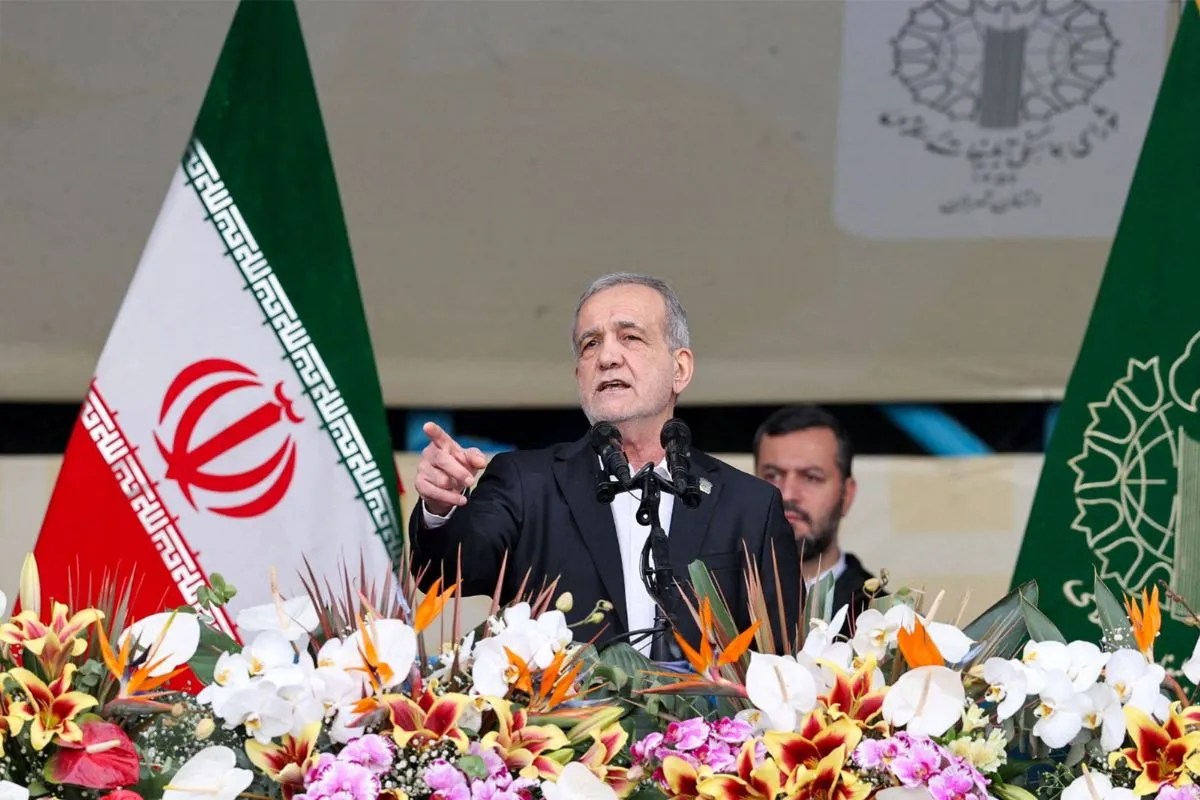
And recently, Iranian President Masoud Pezeshkian named the players out loud.
He stood before an audience and laid bare a charge that has long simmered in the background of Middle Eastern geopolitics. The United States and Israel, he argued, are intentionally engineering divisions among Muslim nations, driving wedges into ancient relationships, and turning neighbors against neighbors. To hear it from Tehran is to hear a narrative of calculated fracture—a design where external powers sit comfortably at a distance while regional capitals burn through their own resources, blood, and trust.
Consider what happens next when foreign architects draw lines in the sand.
Borders stop being mere geographical boundaries and transform into fault lines. When governments in West Asia look across their borders, they are conditioned by decades of strategic manipulation to see an immediate threat rather than a shared future. It is a classic doctrine of statecraft, whispered in the corridors of Western capitals since the collapse of empires: divide and rule. Keep the chessboard crowded with minor skirmishes so no single regional coalition can ever rise to challenge the global hegemony.
To understand why this strategy works with such devastating efficiency, we have to look past the official press releases and diplomatic handshakes. We have to look at the human cost on the ground.
(Note: Imagine a young merchant in a bustling Middle Eastern port city, someone whose grandfather traded freely across these very waters. Today, that merchant watches shipping lanes close, insurance rates skyrocket, and traditional regional markets evaporate behind a wall of sanctions, political mistrust, and severed diplomatic ties. The abstract conflict between Washington, Jerusalem, and Tehran is not a headline on a screen for him; it is the silent killer of his family's livelihood.)
Pezeshkian’s accusation is not born in a vacuum. It rests on a well-documented playbook of foreign intervention in West Asia. For over a century, outside powers have recognized a simple mathematical reality: a united region with shared economic power, common religious and cultural ties, and immense energy reserves would be an independent powerhouse. It would dictate terms. It would push back against foreign military bases. It would demand true sovereignty.
Therefore, the geopolitical imperative for outside actors has always been friction.
If you cannot conquer them directly, make them conquer each other. Feed historic sectarian tensions between Sunni and Shia communities. Flood the region with advanced weaponry while preaching the gospel of stability. Whisper warnings of imminent invasion into the ear of every regional leader until paranoia becomes the primary lens of foreign policy.
Yet, listening only to Tehran tells half the story.
From the perspective of Washington and Jerusalem, the narrative of division looks entirely different through the lens of national survival and regional containment. Israeli leaders view the current Iranian government through an existential framework—pointing to decades of explicit rhetoric vowing the destruction of the Jewish state, the funding of proxy militias across Lebanon, Syria, Yemen, and Gaza, and a relentless pursuit of nuclear capabilities. In this light, building alliances with moderate Arab states through frameworks like the Abraham Accords is framed not as malicious division, but as defensive architecture. It is presented as a coalition for stability against what Israeli security analysts call the axis of disruption.
The United States sees its presence in the region through the prism of global trade security, protecting critical energy chokepoints like the Strait of Hormuz, and countering the expanding influence of rival superpowers like China and Russia in the Middle East. To American strategists, keeping close partnerships with Gulf monarchies and Israel is a vital strategic anchor in a volatile world.
Two completely different realities. Two absolute truths held by their respective believers. And in the middle of this clash of perspectives lie millions of ordinary people who just want to live without waiting for the next missile strike or economic collapse.
This is where the tragedy of West Asia deepens. The leadership in Tehran points outward, blaming the twin engines of American diplomacy and Israeli military strategy for the region's fractures. Meanwhile, critics of the Iranian government point inward, arguing that decades of revolutionary ideology, regional proxy wars, and domestic suppression are the real architects of Iran’s isolation. Both arguments hold fragments of reality. Foreign meddling is undeniably real, dating back to the 1953 coup in Iran and the artificial borders drawn by European colonial powers after the First World War. At the same time, authoritarian governance and militarized foreign policies pursued by regional actors themselves have continuously slammed the door on genuine regional integration.
When leaders like Pezeshkian point the finger outward, they are tapping into a profound, historically validated collective memory. People across the region remember the invasions, the puppet regimes, the economic blockades, and the cynical betrayals by Western powers who promised democracy but delivered chaos. That memory is a powerful political tool. It unites a population against a common external enemy, shielding domestic systems from accountability.
But pointing fingers does not rebuild shattered infrastructure. It does not bring back the young lives lost in proxy conflicts from Yemen to Syria. It does not heal the deep economic scars of a region locked in a permanent arms race.
The real trap of West Asian geopolitics is not just that outside powers are playing a high-stakes game of divide and rule. The trap is that regional powers keep agreeing to play their assigned roles on the board. They step into the ideological traps laid for them. They trade long-term prosperity for short-term deterrence. They spend billions of dollars on imported weapons while millions of their citizens grapple with inflation, water scarcity, and unemployment.
We have seen this script before. Empires rise, draw lines, arm local factions, and then retreat when the cost becomes too high, leaving behind a scarred landscape of broken nations to clean up the mess. The British left it. The Soviets left it. And as the global balance of power shifts toward a multipolar world, the shadow of American dominance is changing shape, too.
The question facing Tehran, Jerusalem, Washington, and every capital in between is not who started the fire. The question is who has the courage to stop throwing fuel on it.
Until someone breaks the cycle, the chessboard remains set. The pieces move. The rhetoric sharpens. And somewhere in a quiet alley in Tehran, or a coastal town in the Levant, a family sits down to dinner, listening to the evening news, wondering how much longer the board will dictate their lives.


