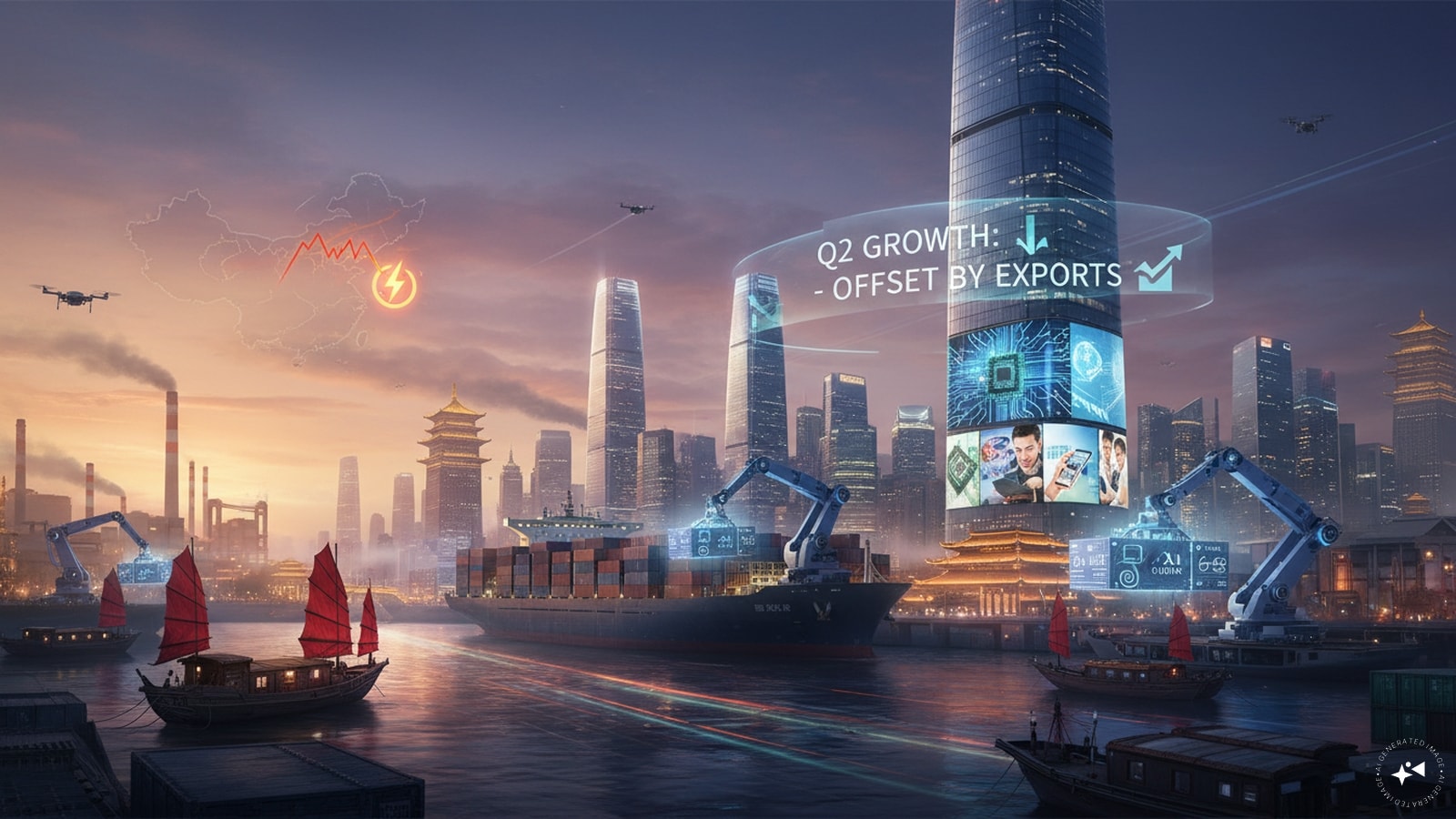
China's economy isn't hitting a wall, but it's definitely riding the brakes. If you look at the raw numbers coming out of Beijing, things might seem fine on the surface. The government set a gross domestic product growth target of 4.5% to 5.0% for 2026, and most major institutions think they'll squeak by. The International Monetary Fund even upgraded its full-year outlook for the country to 4.6%.
But don't let those high-level numbers fool you.
The underlying machinery is deeply out of balance. A fresh round of forecasts from top analysts reveals that economic growth likely cooled down to about 4.5% year-on-year in the second quarter. That's a noticeable drop from the 5% expansion we saw in the first three months of the year.
The real story isn't the slight drop in percentage points. It's the alarming gap between what China sells to the rest of the world and what its own people are willing to buy at home. Beijing has created a twin-track economy where advanced factories are humming at maximum capacity while local shops sit empty. It's an economic model running on one engine, and that engine is increasingly vulnerable to global crosswinds.
The Global AI Craze is Masking Deep Internal Pain
If you want to know what's keeping the lights on in China right now, look at the global tech sector. The massive global wave of spending on artificial intelligence infrastructure and high-tech hardware has been a massive lifeline for Chinese factories. Overseas demand for electronics, advanced machinery, and automobiles has gone through the roof.
Look at the trade data from May. Overseas shipments jumped by a massive 19.4% year-on-year. China managed to build an eye-watering $1.2 trillion trade surplus last year, and they are on track to match or beat that momentum. Analysts from institutions like Oxford Economics point out that China is rapidly gaining global market share and scaling up production in high-value manufacturing sectors faster than almost anyone anticipated.
But relying on foreign tech buyers is a dangerous game.
The global tech boom has helped insulate China from some massive global shocks, including the recent shipping crises and energy price hikes triggered by the Middle East conflict. When hostilities escalated and threatened shipping lanes through the Strait of Hormuz, many feared a massive drop in demand for Chinese goods. Instead, the relentless demand for high-end tech kept the export engine firing.
But what happens when that external demand cools off?
Dan Wang, a director on Eurasia Group's China team, points out that this export success isn't lifting all boats. While high-tech sectors see spectacular performance, smaller exporters and lower-end consumer goods manufacturers are getting hammered by weaker global demand. The money flowing into the country is getting concentrated in a few highly automated sectors, leaving the rest of the business community out in the cold.
The Domestic Consumer Strike is Very Real
Step away from the high-tech industrial parks and look at the average Chinese high street. The picture changes instantly. Chinese consumers are simply refusing to spend, and no amount of government coaxing seems to change their minds.
In May, retail sales fell for the first time in three years. Think about that for a second. Despite the government pouring billions of yuan into special bonds since 2024 to fund trade-in programmes for electronics and cars, people are choosing to keep their cash locked down. Fixed-asset investment has similarly slumped.
The root cause of this consumer freeze isn't a secret. It's the property sector.
China's real estate market is grinding through its fifth consecutive year of a brutal downturn. For decades, regular families put their life savings into apartments because it was seen as the safest store of wealth. Now, new home starts, total sales, and overall property investments are down between 50% and 80% from their peaks in 2020 and 2021.
Home prices across major cities have completely stagnated or fallen. Imagine watching your biggest financial asset lose value month after month. You wouldn't go out and buy a new car or splurge on luxury goods either. You would hoard cash.
Financial experts at Rabobank have made it clear that until the real estate crisis shows genuine signs of hitting a bottom, a real recovery in domestic consumption is basically impossible. The government's attempts to fix this with minor subsidies are like treating a broken leg with a band-aid.
Factory Superpower Meets Empty Pockets
The disconnect between supply and demand has created a strange economic phenomenon. Analysts at BBVA Research describe the situation as a massive structural shift where China is transforming from a traditional manufacturing factory into a high-end manufacturing superpower.
That sounds great on paper, but it ignores a fundamental rule of economics. You need someone to buy the things you make.
Because local consumers aren't buying, Chinese companies are forced to dump their excess production onto international markets. This is why we see Chinese electric vehicles, solar panels, and batteries flooding global ports at prices Western manufacturers can't possibly match.
This strategy is running headfirst into a wall of geopolitical resistance. The United States and the European Union are actively erecting massive tariff walls to protect their own industrial bases from this wave of cheap Chinese imports. If these trade frictions intensify later this year, China's last remaining economic engine will take a direct hit.
Furthermore, this high-tech manufacturing push doesn't solve the country's employment problem. Advanced semiconductor plants and automated EV assembly lines require brilliant engineers and sophisticated robotics, but they don't hire millions of ordinary workers.
The domestic labour market has been noticeably weak. Private sector hiring indicators are hovering at some of their lowest levels in a decade, outside of old pandemic lockdowns. Wage growth trackers show urban nominal wage growth slowing to a crawl. If people don't have stable, well-paying jobs, they aren't going to spend money. It's a vicious cycle that Beijing hasn't figured out how to break.
What Policymakers Must Do Next
The current hands-off approach from the People's Bank of China and top economic planners isn't working. Throughout the second quarter, policymakers kept their focus squarely on debt resolution and long-term industrial reforms. They've been reluctant to unleash massive, old-school stimulus packages because they don't want to reinflate the real estate bubble or pile more bad debt onto local governments.
But the cooling growth data shows they can't afford to stay patient forever.
Market observers at Hutong Research expect a major pivot in the second half of the year. The upcoming meeting of the Communist Party's decision-making Politburo in late July will be the moment to watch. Expect authorities to re-prioritise raw growth over structural discipline if the numbers continue to slide.
To actually fix this mess, the government needs to stop subsidising factories and start supporting households. Here's what needs to happen immediately to get the economy back on track.
First, the central government must step in with direct income support or significant tax cuts for low- and middle-income families. Instead of offering a small discount when someone trades in an old refrigerator, give workers direct cash incentives or reduce their social security contribution burdens.
Second, there needs to be an aggressive expansion of the social safety net. Part of the reason Chinese households save an incredibly high percentage of their income is because they are terrified of future healthcare costs and retirement instability. Building out better unemployment benefits and subsidising public services would give families the confidence to stop hoarding cash.
Third, the private sector needs a genuine boost of confidence. Small and medium enterprises provide the vast majority of jobs in China, but they've been crowded out by state-backed industrial champions. Policymakers must ease up on regulatory crackdowns and give private entrepreneurs the legal and financial assurances they need to start investing again.
As Sarah Tan from Moody's Analytics rightly pointed out, China's long-term ability to sustain its economic ambitions doesn't depend on how many microchips its factories can churn out. It depends entirely on whether regular households regain their confidence and start spending money again. Until Beijing accepts that reality, any economic rebound will be temporary at best.