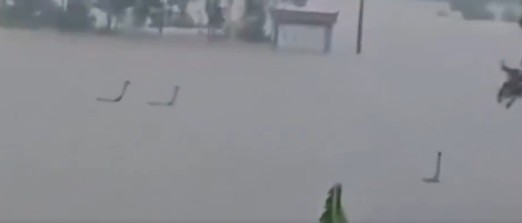
Imagine wading through waist-deep, muddy floodwaters outside your home, trying to salvage what's left of your belongings. Now imagine looking down and seeing a venomous cobra lifting its head just inches from your hands.
That's the terrifying reality facing residents in South China right now.
On July 6, 2026, severe flooding triggered by Typhoon Maysak tore through Hengzhou, a city in the Guangxi Zhuang Autonomous Region. The storm didn't just breach reservoirs and displace thousands of people. It completely washed away local commercial breeding facilities, sending an estimated 800 to 900 snakes slithering directly into flooded villages.
Among the escapees? King ratsnakes, water snakes, and highly venomous cobras.
The Logistics of a Reptilian Great Escape
When you think of a snake escape, you might picture a loose pet or a single broken cage. This was an industrial-scale failure. Guangxi is the epicenter of China's commercial snake farming industry, historically breeding millions of reptiles for traditional medicine and meat.
When the Liulan and Yunbiao reservoirs overflowed and breached under the pressure of torrential downpours, the surging water obliterated several small-scale farms located in low-lying areas.
[Breached Reservoirs] ➡️ [Flash Floods] ➡️ [Destroyed Low-Lying Farms] ➡️ [900 Snakes Loose]
The sheer scale of the flooding meant that containment walls vanished instantly. Snakes are excellent swimmers. While mountain-dwelling species like king ratsnakes face high mortality rates after prolonged exposure to deep water, water snakes and cobras handle the aquatic environment shockingly well. They didn't just escape; they took the fast track straight into residential zones.
Reality on the Ground: Bites and Blocked Roads
The situation escalated quickly from an online viral sensation to a public health emergency. Videos across Chinese social media showed locals using dip nets and bamboo sticks to fend off reptiles while standing in deep water. But you can't fight off what you can't see beneath the muddy surface.
Multiple villagers have been bitten while attempting to clear debris from their homes. One man told local reporters he encountered five or six snakes right inside his ground floor before being bitten by a cobra.
The real tragedy lies in the logistics of flood response:
- Blocked infrastructure: Flooded roads made it nearly impossible for emergency vehicles to reach remote areas.
- Delayed treatment: In Dengwei village, a woman unfortunately lost her life after a snakebite because the journey to the nearest major medical center was entirely cut off by high water.
- Supply shortages: Stranded pockets of residents quickly faced critical shortages of basic medical care and targeted antivenom.
In response, the Hengzhou People's Hospital has been designated as the primary emergency hub, setting up fast-track treatment channels specifically for snakebite victims. Because roads remain blocked, rescue personnel and medical specialists are actively setting up temporary clinic stations directly in the affected zones.
When Climate Reality Clashes with Animal Agriculture
This isn't an isolated stroke of bad luck. It's a structural vulnerability that highlights a massive issue in regional planning. When you pack high-density animal farming—whether it's the pig farms also inundated during this storm or commercial snake facilities—into regions prone to extreme weather, disaster is inevitable.
Officials had already warned that the 2026 flood season would be abnormally intense due to El Niño and global warming patterns. Yet, many of these small-scale farms were built in low-lying floodplains right below aging reservoir systems. When the infrastructure failed, the biological hazard amplified the natural disaster tenfold.
A ten-member professional rescue team equipped with fishing nets and stun guns is currently working alongside local snake-catching volunteers. They are racing against time to clear out homes, staircases, and riverbanks before the water recedes and the reptiles find permanent hiding spots inside drying structures.
If you live in or near a flood-prone area close to agricultural zones, you need to treat floodwater as a hazardous biological zone, not just a property threat.
- Assume zero visibility: Never reach into opaque water or under submerged debris with bare hands. Always use a long tool or stick to probe areas first.
- Seal elevated entry points: As waters rise, displaced wildlife will seek higher, dry ground. Check upper levels, stairwells, and structural corners where reptiles naturally congregate to escape current flows.
- Know your local medical routing: Before storm season peaks, identify the specific regional hospital designated for toxicological emergencies. Standard clinics rarely carry specialized antivenom cocktails during a localized crisis.