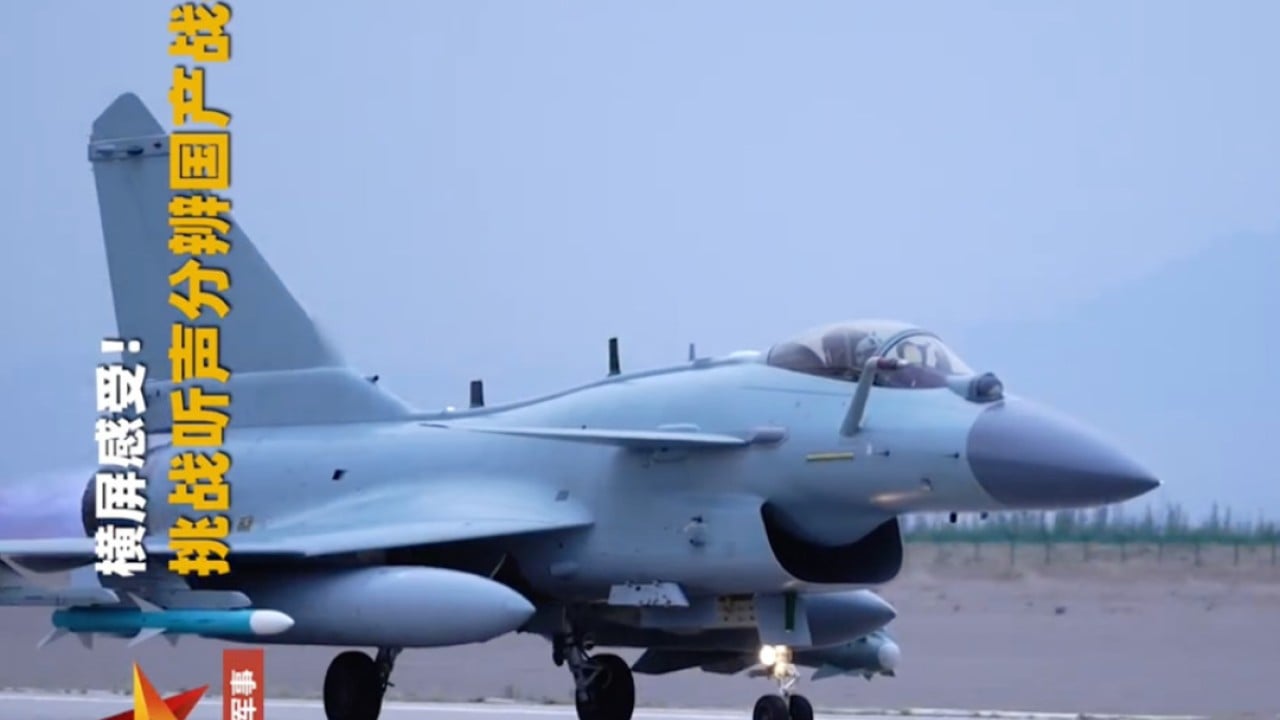
Photographs circulating on Chinese defense forums show a People’s Liberation Army Air Force J-10C fighter carrying a heavily modified variant of the Russian-origin Kh-31 supersonic missile—a tactical shift that turns a lightweight single-engine interceptor into a long-range maritime and anti-radiation strike platform. By integrating a weapon traditionally reserved for heavier twin-engine jets onto the nimble J-10C, Beijing is solving a critical operational bottleneck in the Western Pacific. They need more airframes capable of punching through dense, ship-borne air defense networks without risking their limited fleet of stealth fighters or heavy bombers.
For decades, military analysts boxed the Chengdu J-10C into a predictable role. It was the workhorse. Built as a single-engine, fourth-and-a-half-generation multirole fighter, its primary job was air superiority and point defense, operating alongside heavier, twin-engine Sukhoi derivatives like the J-11 and J-16. When you needed to haul massive ordnance across hundreds of miles of open water to sink an aircraft carrier or blind an Aegis destroyer, you sent the heavyweights. You did not send the J-10.
That assumption just broke.
The weapon spotted slung beneath the J-10C’s wing is not a standard off-the-shelf Russian export. While its aerodynamic silhouette—specifically the distinctive four-inlet ramjet configuration—betrays its lineage as a Soviet-designed Kh-31 (known to NATO as the AS-17 Krypton), the airframe visible in recent imagery shows subtle, deliberate alterations. The radome profile, seeker housing, and lack of standard Russian stenciling point toward an indigenous Chinese derivative, widely tracked by defense observers as the YJ-91, or an even newer domestic evolution built on the same ramjet architecture.
The Anatomy of a Mach 3 Tank-Buster for the Sea
To understand why this pairing matters, you have to look at the physics of the missile itself. Most subsonic anti-ship missiles, like the American Harpoon or China's own YJ-83, hug the waves at around Mach 0.9. They rely on stealth and low altitude to avoid detection until the final seconds of flight. Modern naval defense systems, particularly the U.S. Navy’s Aegis Combat System paired with SM-6 interceptors and Phalanx close-in weapon systems, are specifically engineered to hunt and kill subsonic sea-skimmers.
The Kh-31 architecture takes the exact opposite approach. It does not hide. It sprints.
Powered by an integral rocket-ramjet engine, the missile accelerates via a solid-fuel booster before igniting its kerosene-burning ramjet, pushing the airframe to speeds exceeding Mach 3.1 at altitude and over Mach 2.5 near the deck. At those velocities, a defender’s reaction window collapses from minutes to mere seconds. Even if a ship's radar locks onto the incoming threat, the kinetic energy of a 600-kilogram projectile moving at nearly a kilometer per second creates a massive interception problem.
China originally acquired the Kh-31P anti-radiation variant from Russia in the late 1990s to counter Taiwan's Patriot missile batteries and American naval radars. Beijing never stops at simple acquisition. Over the last twenty-five years, Chinese state-owned defense conglomerates reverse-engineered the propulsion system, stripped out the analog Russian electronics, and replaced them with modern, programmable digital seekers. The result was the YJ-91 series—a dual-purpose family of missiles capable of either homing in on enemy radar emissions (anti-radiation) or locking onto the massive metallic hull of a surface warship (anti-ship).
Seeing this specific weapon on a J-10C tells us two things immediately. First, Chinese engineers have successfully miniaturized or re-balanced the avionics interface required to cue a heavy ramjet missile from a light fighter's fire-control radar. Second, the PLAAF is actively qualifying its single-engine regiments for complex Suppression of Enemy Air Defenses (SEAD) and maritime strike missions.
Why Put a Heavy Weapon on a Light Airframe
Aircraft weight limits are unforgiving. A fully fueled Kh-31 or YJ-91 weighs roughly 600 to 650 kilograms (over 1,300 pounds) and stretches nearly five meters in length. Hanging two of those under the wings of a J-10C imposes severe aerodynamic drag and structural stress, inevitably cutting into the jet’s combat radius and maneuverability.
If you already possess hundreds of J-16 heavy fighters—which carry twice the payload and fly twice as far—why compromise the J-10C’s agility by bolting on heavy strike ordnance?
The answer lies in simple math and operational saturation.
In any high-intensity conflict over the Taiwan Strait or the South China Sea, heavy fighters like the J-16 and stealth platforms like the J-20 will be stretched thin. The J-20 is needed for high-end counter-air patrols, hunting down enemy tankers, AWACS surveillance planes, and F-35s. The J-16 fleet will be tasked with hauling massive, oversized hypersonic and long-range cruise missiles like the YJ-21 or KD-88. Meanwhile, the PLAAF operates over 250 J-10C fighters, with production lines still warm and export variants like the J-10CE actively flying in Pakistan.
By certifying the J-10C to carry the modified Kh-31/YJ-91, Chinese planners instantly multiply the number of high-speed strike shooters available in theater.
Consider a hypothetical strike package approaching a carrier strike group. In older doctrine, enemy radar operators could easily classify threats based on flight profiles and aircraft types. If air defense controllers spotted a flight of J-10Cs on long-range radar, they knew those jets were likely carrying PL-15 air-to-air missiles—a threat to friendly fighters, certainly, but not an immediate kinetic threat to a guided-missile destroyer 150 kilometers away. Now, every single J-10C on a radar screen must be treated as a potential supersonic anti-ship or anti-radiation platform. That ambiguity forces naval commanders to burn expensive surface-to-air missiles earlier and complicates defensive prioritization across the entire battle group.
The Technical Hurdles Nobody Talks About
Strapping a heavy missile onto a wing pylon is the easy part. Making it hit a moving target in a contested electronic environment is where the real engineering happens.
The J-10C is equipped with an indigenous Active Electronically Scanned Array (AESA) radar, a massive upgrade over the mechanical radars found on earlier J-10A models. An AESA radar can track multiple surface and air targets simultaneously while resisting jamming. However, a light fighter’s nose cone is physically smaller than that of a Su-30 or J-16. Smaller nose cones mean smaller radar antennas, which inherently limits detection range and power output against surface vessels over the horizon.
To fire a Mach 3 missile at its maximum effective range—often stretching beyond 110 to 150 kilometers depending on launch altitude—the J-10C cannot rely solely on its own onboard sensors. It has to plug into China’s broader kill web.
In practice, this means the J-10C acts as a forward truck. Target coordinates are generated by high-altitude reconnaissance drones like the WZ-7 Soaring Dragon, KJ-500 airborne early warning aircraft, or orbiting electronic intelligence satellites. That targeting data is beamed via secure tactical datalinks directly into the J-10C’s mission computer, which updates the missile’s inertial navigation system seconds before release. Once the weapon clears the rail and its booster ignites, the fighter can immediately bank away, leaving the missile's active radar or passive anti-radiation seeker to handle the terminal phase.
This networked approach exposes a critical vulnerability, though. Without intact datalinks, a J-10C carrying heavy ramjet missiles is forced to fly much closer to enemy air defenses to acquire targets with its own radar—a dangerous proposition for a non-stealthy aircraft with limited fuel reserves.
Reading the Intelligence Between the Lines
Defense photography out of China is rarely accidental. While spotters legitimately camp near airbases in Chengdu, Yanliang, and coastal test centers, the images that survive censorship and propagate across global social media usually serve a strategic signaling purpose.
Look closely at the airframe configuration in the recent sightings. The J-10C is not just carrying the missile; it is carrying it alongside external fuel tanks on the centerline and inner pylons, plus wingtip electronic warfare pods or short-range PL-10 infrared missiles for self-defense. This is not a clean-wing aerodynamic test flight. This is an operational combat loadout.
It also signals the complete maturation of China's domestic propulsion and seeker supply chains. For years, Russian defense officials quietly smirked at Chinese attempts to clone the Kh-31, noting that the complex titanium alloys and precise fuel metering required for a sustained Mach 3 ramjet caused frequent engine flameouts in early Chinese prototypes. Those teething problems appear to be solved. Beijing no longer relies on Moscow for the engines, the airframes, or the seekers. What started as a 1990s Russian import has been fully absorbed, digitized, and mass-produced to arm the backbone of China’s tactical fighter fleet.
The implications extend beyond the Taiwan Strait. China aggressively markets the J-10CE to foreign buyers looking for an affordable alternative to the American F-16V or French Rafale. Pakistan has already inducted dozens of them, and nations across the Middle East and Southeast Asia have kicked the tires. While Russia’s own defense export industry remains crippled by Western sanctions and the massive material demands of its war in Ukraine, Beijing is stepping into the vacuum. If China can offer export customers a fourth-and-a-half-generation fighter complete with an AESA radar, long-range PL-15E air-to-air missiles, and a Mach 3 anti-ship/anti-radiation missile derived from proven Russian kinematics, it alters the regional balance of power in places like the Persian Gulf and the Arabian Sea.
Western naval planners spent the last decade obsessing over China's exotic systems—the DF-21D "carrier killer" ballistic missiles, the stealthy J-20, and the massive Type 055 cruisers. Those systems grab headlines. Yet wars of attrition are rarely decided by silver-bullet weapons alone. They are decided by volume, adaptability, and the ability to turn every available airframe into a lethal shooter. By handing a Mach 3 heavy-strike weapon to its most numerous modern fighter, Beijing just made the skies over the Western Pacific significantly harder to defend.