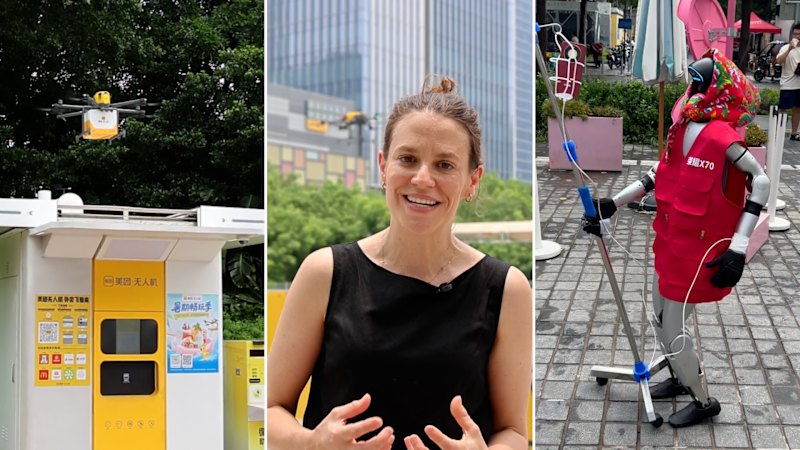
You can look at any major industrial zone in Shenzhen or the Yangtze River Delta right now and see the future taking shape. It isn't software running on a cloud server or another generative text model. It's physical iron, copper, and silicon. China's massive bet on robotics and artificial intelligence is rewriting the rules of global manufacturing, and the sheer scale of it leaves traditional Western automation strategies in the dust.
The strategy isn't a secret. Beijing's 15th Five-Year Plan puts embodied artificial intelligence at the absolute center of its modern industrial system. Analysts often get distracted by flashy marketing videos of bipedal machines doing backflips or dancing on stage. Those make good headlines, but the real capital and state backing flow toward practical floor deployment. China installed roughly 276,000 industrial robots in a single recent year, outstripping the combined totals of the United States, Japan, Germany, and South Korea.
The Manufacturing Advantage No One Else Can Copy
Hardware density dictates everything in this space. If you want to build a functional mechanical system, you need a local supply chain that can turn around a prototype in days instead of months. Shenzhen component makers can iterate on a custom motor or actuator casing in under two weeks. Western hardware startups routinely face twelve-week cycles for simple iterations.
That velocity changes the economics of trial and error. Domestic Chinese manufacturers now supply nearly 60 percent of the industrial units used in their own electronics sector, and up to 85 percent in metal and machinery. Companies like Unitree and AgiBot are pushing production lines to turn out thousands of humanoid platforms alongside their established quadruped and industrial arms. When giants like BYD and CATL demand automated assembly solutions for millions of electric vehicles and batteries, the domestic robotics ecosystem absorbs those requirements and scales up instantly.
Moving Beyond Simple Automation
Old-school industrial robots are rigid. They do one repetitive welding or placement task over and over because changing their programming requires specialized engineering teams. The current push marries physical hardware with advanced foundation models—systems capable of understanding messy, unstructured environments.
Startups are racing to move past simple teleoperation. Vision-Language-Action models allow machines to watch human workers perform a task and mimic the motion, learning through demonstration rather than hard-coded lines of script. Yet, the commercial reality check is harsh. Executives at robotics firms admit that public listings are coming faster than actual widespread profitability. Venture capital poured billions into these companies, but turning a research prototype into a machine that generates reliable return on investment on a chaotic factory floor is brutally difficult.
The Commercial Reality Test
State initiatives have set targets to push tens of thousands of humanoid units into commercial pilot programs across logistics, retail, and assembly. But scaling past controlled demo environments remains an uphill battle. The human body has hundreds of degrees of freedom, and mimicking that physical dexterity reliably without burning out expensive actuators is an engineering nightmare.
Most factory managers aren't looking for bipedal workers anyway. They want specialized arms, mobile base platforms, and smart logistics carts that reduce bottlenecks without crashing into inventory racks. Humanoids grab the attention, but specialized automation carries the financial weight.
Geopolitical Pressures and Supply Chain Realities
This massive industrial push has triggered sharp reactions abroad. Security regulators in Western nations have moved to restrict or outright ban advanced robotic devices and connected hardware originating from Chinese supply chains, citing data collection and remote access risks. These trade barriers mean Chinese robotics firms face a heavily restricted export market in North America, forcing them to look inward or pivot aggressively toward domestic adoption, Southeast Asia, and the Middle East.
The friction won't slow down internal development. China's combination of rare-earth material control, deep manufacturing clusters, and state-directed procurement guarantees that the iteration cycle will keep spinning at high velocity. The race isn't about who builds the coolest machine for a tech expo. It's about who can integrate intelligent machines deeply enough into everyday commerce to offset a shrinking workforce and permanently lower production costs.
Set up your supply chain for extreme agility or get left behind by competitors who build and test hardware ten times faster than you can draw it.

(mh=zBXkz9ZRQ7nTRvbU)15.jpg)