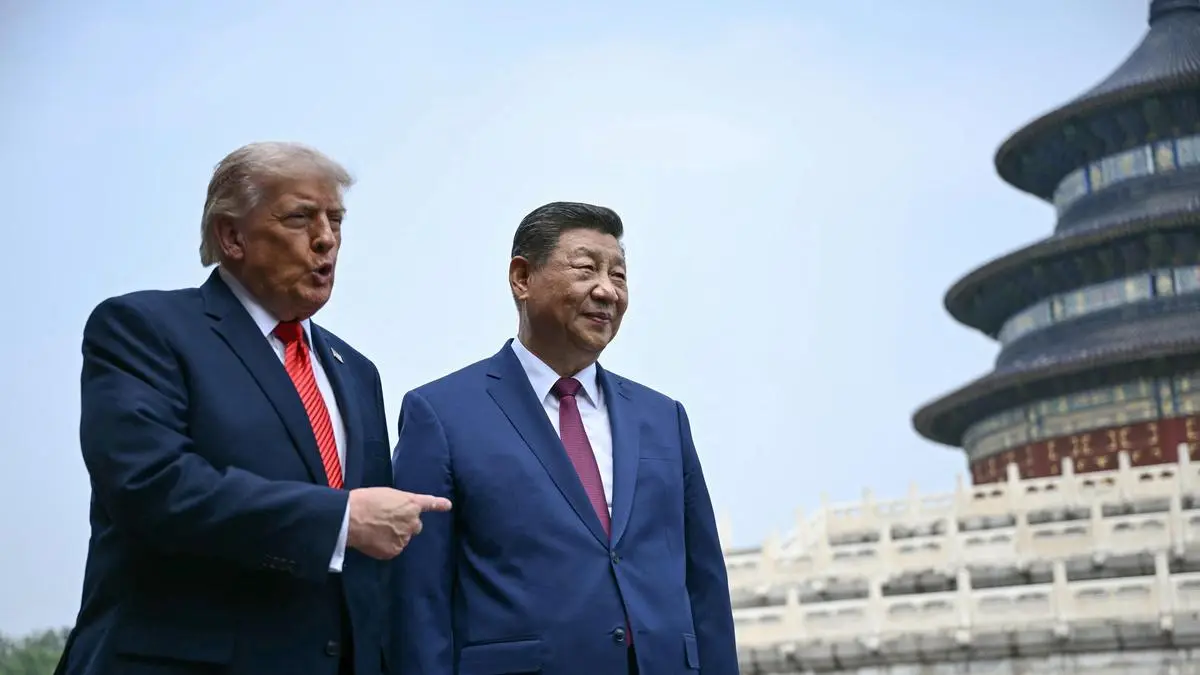
Xi Jinping just told a room full of American CEOs that China is opening its doors wider. The mainstream press is eating it up. They’re calling it a "thaw." They’re talking about "re-engagement." They are completely wrong.
When a superpower tells you the door is open, you need to check if there’s a brick wall on the other side of the frame. I’ve spent two decades watching Western capital flow into Beijing based on these exact same promises, only to see it get trapped in a maze of "national security" audits and forced IP transfers. This isn't a grand opening. It’s a strategic pivot to keep American capital flowing while China finishes building its own self-sufficient ecosystem.
If you believe the door is opening, you’re the mark.
The Myth of the Level Playing Field
The competitor narrative suggests that because Trump is back in the mix and CEOs are visiting Beijing, we’re heading back to the "Golden Era" of globalization. That era is dead. It’s buried under a mountain of export controls and state-subsidized "Little Giants."
China doesn’t want your competition; it wants your liquidity.
The "open door" policy is a specific tactical maneuver. Beijing faces a massive demographic collapse and a property market that looks like a slow-motion car crash. They need US dollars to stabilize the yuan and fund their push into "New Quality Productive Forces"—that’s code for high-end chips, EVs, and biotech.
They aren't opening the door for you to sell more Fords or iPhones. They are opening the door so you can build the infrastructure they will eventually take over. Look at Tesla’s Giga Shanghai. It was hailed as a breakthrough for foreign ownership. In reality, it served as a masterclass for the entire Chinese domestic EV industry. Musk didn't just build a factory; he built a supply chain that BYD and Xiaomi are now using to eat his lunch.
Why the CEOs are Playing a Losing Hand
Why do these CEOs keep going back? It’s not because they’re blind. It’s because they’re desperate for growth that doesn't exist in the West. But they are operating on a 1990s playbook in a 2026 reality.
The mainstream press asks: "Will China treat US firms fairly?"
The answer is: "Define fair."
In the eyes of the Chinese Communist Party (CCP), "fair" means alignment with the Five-Year Plan. If your business model involves extracting profit and sending it back to Delaware, you are a temporary guest. If your model involves transferring R&D to a local joint venture, you get a seat at the table until the local partner learns how to do it better.
I’ve seen Fortune 500 boards dump billions into "China-specific" R&D centers. Within three years, their top local engineers leave to start a state-backed competitor that mysteriously has the exact same patent architecture. That’s the "open door." It’s a vacuum cleaner.
The Trump Factor: Not a Reset, a Reckoning
The media loves to frame Trump’s presence as a catalyst for a "new deal." This ignores the fundamental shift in the American consensus. Both sides of the aisle in DC have reached a rare agreement: decoupling (or "de-risking," if you prefer the polite term) is the only way forward.
Trump’s tariffs aren't just a negotiating tactic. They are a structural barrier designed to force supply chains out of the Pearl River Delta. Xi’s "open door" rhetoric is a direct counter-move to prevent that exodus. He’s trying to convince the C-suite to lobby against the White House.
Imagine a scenario where a US tech firm doubles down on a new facility in Shenzhen because of these "wider doors," only to face a 60% tariff on the way back and a "security review" on the way out. You aren't just risking your margin; you’re risking your entire balance sheet on the word of a government that views private capital as a tool of the state.
The Data Reality: FDI Doesn't Lie
Ignore the speeches. Look at the money. Foreign Direct Investment (FDI) into China turned negative for the first time in decades recently. Smart money is already halfway to Vietnam, Mexico, or back to Ohio.
The people sticking around are the ones with "sunk cost syndrome." They’ve spent thirty years building a presence and can't admit to their shareholders that the environment has fundamentally turned hostile. They mistake "access" for "opportunity." Access is being allowed to stay in the room. Opportunity is being allowed to win. In China’s current economic model, a foreign firm is never allowed to win at the expense of a National Champion.
The Great Divergence in Tech
Let’s talk about the hardware stack. For years, the world ran on a single globalized tech stack. Now, we have two.
- The Western Stack: Built on Nvidia, TSMC, and US-designed software.
- The Domestic Stack: Built on Huawei’s HarmonyOS, SMIC silicon, and state-monitored data lakes.
When Xi talks about opening doors, he isn't inviting the Western Stack to take over. He’s inviting Western firms to pay for the privilege of migrating to the Domestic Stack. Once you migrate your data and your logic to Chinese servers, you are no longer a global player. You are a localized subsidiary at the mercy of the local regulator.
The Contrarian Play: Close Your Own Door
The "lazy consensus" says you need to be in China to be a global player. I argue that for many, being in China is now a liability that devalues your global brand.
If you’re a CEO, the move isn't to take the bait. The move is to accelerate the exit. The "open door" is a window of liquidity—a chance to sell off assets while there’s still a semblance of a market before the door slams shut for good.
- Audit your IP: If it’s in China, assume it’s already been copied.
- Diversify your manufacturing: If 80% of your components come from one region, you don't have a business; you have a hostage situation.
- Stop the "China-lite" strategy: Creating products specifically for the Chinese market often results in "good enough" competitors that eventually export those same cheap products to your home turf.
The People Also Ask: Dismantling the Delusion
Is China’s economy finally recovering?
Recovering to what? The 8% growth days are gone. They are transitioning to a controlled, state-led economy. Any "recovery" you see is a result of massive liquidity injections, not a return to free-market dynamics.
Can US companies still succeed in China?
Only if they are selling something China cannot yet build—and only for as long as it takes them to learn. Look at Apple. They are the gold standard of China success, yet they are aggressively moving production to India because they see the writing on the wall.
Should we trust Xi's promises of reform?
Trust the incentives, not the speeches. Xi’s incentive is the survival of the CCP. Foreign capital is a means to that end. The moment you are no longer useful to that survival, the "wide open door" will become a one-way exit.
The Cost of the Bait
The danger of this "open door" rhetoric is that it provides a false sense of security to mid-cap companies that can't afford the hit. The giants can weather a total loss in China. You can't.
We are seeing a massive "re-shoring" movement not because it’s patriotic, but because it’s the only way to ensure continuity of supply. The risks—regulatory capture, exit bans, and data sovereignty laws—now far outweigh the rewards of cheap labor and a shrinking middle class.
The competitor article wants you to think this is a moment of hope. It’s actually a moment of extreme danger. When the hunter puts out the most bait, that’s when the trap is closest to springing.
If you think you're being invited to a feast, look closely at the menu. You're probably the main course.
Stop looking at the door. Start looking at the locks.