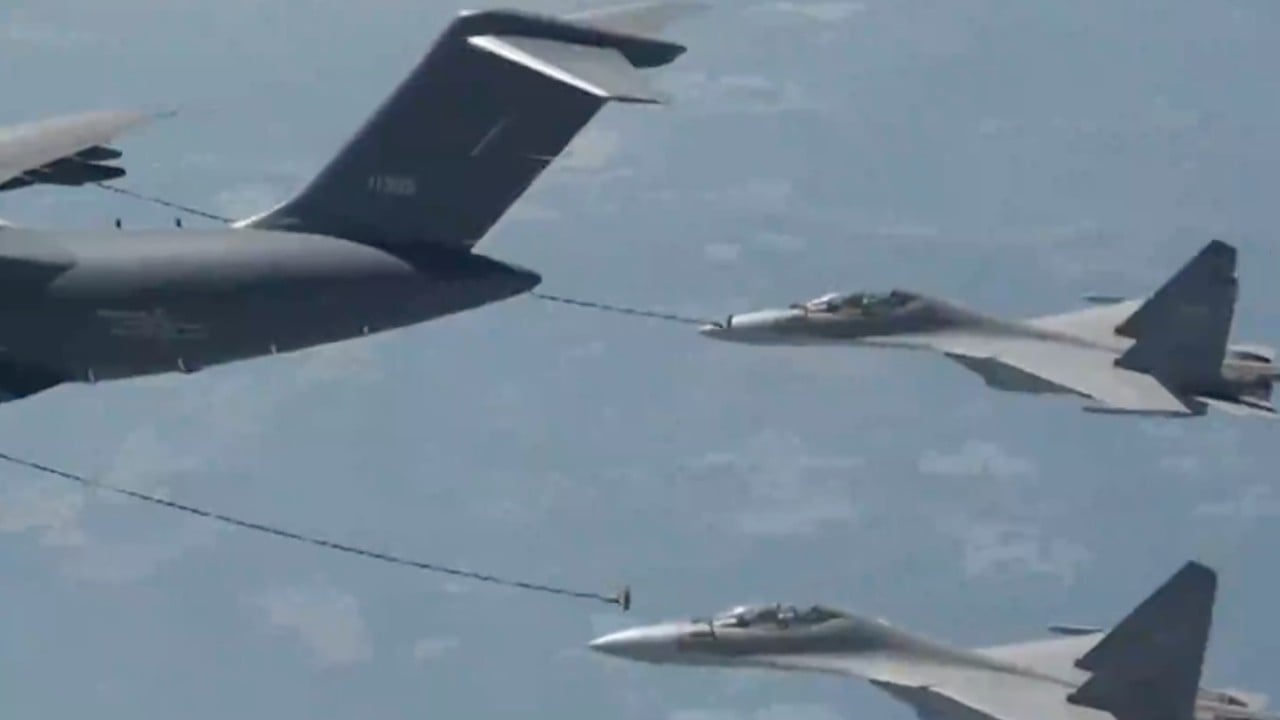
When six Chinese Shenyang J-16 heavy fighters touched down in Egypt for the Eagles of Civilization 2026 joint drill, military analysts missed the real story. This isn't just routine defense diplomacy. It’s a physical demonstration of long-range projection that changes how Beijing and Cairo look at Middle Eastern airspace.
The People's Liberation Army Air Force didn't just send jets. They flew a 6,000-kilometer gauntlet across continents, supported by YY-20A aerial refueling and KJ-500 airborne early-warning aircraft. Let's break down what this means, why Washington is sweating, and what actually happens when Eastern heavy fighters mix with Western-supplied air defense architectures.
The Long Flight Across Two Continents
Moving fighter jets thousands of miles is notoriously hard. Doing it with heavy multirole platforms requires a mature logistics chain.
The formation didn't just appear in North Africa. They staged through stops like Pakistan, relying on strategic transport and midair tanking. Last year's inaugural drills relied on lighter J-10C fighters. That was a toe in the water. Bringing the J-16—a massive twin-engine powerhouse with massive internal fuel capacity and heavy payload ratings—shows real operational confidence.
You're looking at an air force testing its ability to fight far from home. The flight path itself maps out a modern security corridor.
Inside the Eagles of Civilization 2026 Exercise Architecture
Running from mid-August through early September, the training goes far beyond basic flybys. Egypt isn't just hosting static displays. Egyptian pilots are sitting down for intense theoretical synchronization, followed by joint combat sorties.
The integration of the KJ-500 early-warning aircraft is the crown jewel here. A fighter is only as good as its data feed. The KJ-500 acts as an airborne brain, tracking targets across vast horizons and feeding situational awareness directly into the tactical processors of the J-16s and local assets.
The curriculum tackles specific tactical problems:
- Offensive and defensive counter-air operations
- Joint air battle management under electronic warfare conditions
- Combat search and rescue protocols
- Interoperability between disparate command structures
Why Egypt Wants Advanced Chinese Hardware
Cairo has historically relied on Western gear, mostly American F-16s alongside French Rafales and older MiG variants. But buying Western means dealing with endless political strings, delivery delays, and strict usage conditions.
By inviting Chinese top-tier fighters into its airspace, Egypt is diversifying its strategic portfolio. It gives Cairo immense leverage. More importantly, it lets Egyptian flight crews evaluate Chinese avionics up close. The J-16 packs a massive active electronically scanned array radar that dwarfs the sensor suites found on standard legacy jets. Seeing how that radar performs against regional threats offers invaluable data.
If these drills go well, don't be shocked if commercial procurement talks follow. Egypt needs affordable, high-end modernization without Western oversight. Beijing is more than happy to supply it.
The Geopolitical Shockwave in Washington and Tel Aviv
Military planners in the United States and Israel are watching these exercises with deep discomfort. For decades, Washington held a firm monopoly on high-end military tech in the Middle East.
When a regional powerhouse like Egypt opens its doors to Chinese heavy fighters, that monopoly cracks. It puts advanced Eastern air power right at the doorstep of the Suez Canal, a critical maritime chokepoint. Israel now has to factor heavy Chinese electronic warfare capabilities and long-range strike options into its operational calculus.
Cairo is sending a clear message. Foreign policy isn't about exclusive partnerships anymore. It's about multi-alignment.
Keep an eye on how defense contracts shift over the next year. The footprint established during these weeks will dictate future air power equations across North Africa and the Middle East for a long time.