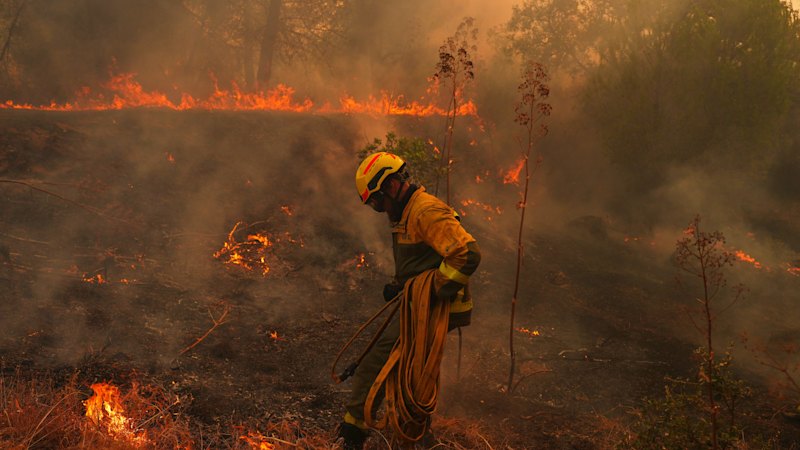
The spatial distribution of European wildfire hazard is shifting from an episodic Mediterranean contingency to a systemic continental vulnerability. When atmospheric blocking patterns coincide with prolonged antecedent moisture deficits across the Iberian Peninsula and southwestern France, regional ecosystems experience rapid desiccation. The mechanics driving the threat to regions such as Bordeaux and broader French and Spanish territories do not stem merely from elevated temperatures. Instead, they represent a complex convergence of forestry management history, land-use evolution, and volatile microclimatic feedback loops.
Understanding this risk profile requires discarding generalized narratives of natural disasters. Wildfires function as dynamic energy-release systems governed by three distinct physical variables: fuel availability, meteorological drivers, and topography. When these variables cross critical thresholds, fire propagation transitions from surface consumption to crown-fire behavior, overwhelming standard tactical suppression capacities.
The Structural Drivers of Continental Vulnerability
To deconstruct why regions historically unaccustomed to severe fire regimes—such as the Landes forest ecosystem surrounding Bordeaux—now face recurrent acute threats, we must examine the underlying structural components.
1. The Fuel Load Paradox and Monoculture Vulnerability
Twentieth-century afforestation programs, particularly the extensive planting of maritime pine (Pinus pinaster) in southwestern France, prioritized economic yield and stabilization of shifting sand dunes. While successful in those objectives, this monoculture strategy created continuous, homogenous fuel vectors.
- Maritime pine possesses high resin content, acting as a potent accelerant under thermal stress.
- Single-species stands lack the structural diversity of mixed-hardwood forests, which naturally impede high-intensity crown fire runs.
- Decades of fire suppression policies inadvertently allowed dead biomass accumulation on the forest floor, increasing base fuel loading well beyond historical baselines.
2. Microclimatic Amplification via Soil Moisture Depletion
Atmospheric heatwaves alone do not ignite forests; they desiccate the vegetation matrix. The vapor pressure deficit measures the difference between the pressure exerted by the water vapor actually present in the air and the saturation pressure at a given temperature. When vapor pressure deficit spikes, plant transpiration rates accelerate.
- Vegetation draws down residual groundwater until xylem cavitation occurs, effectively cutting off internal water transport.
- Once moisture content in fine dead fuels drops below ten percent, ignition potential approaches absolute maximums.
- Dry soils fail to provide evaporative cooling, creating a localized boundary layer of superheated air that preheats surrounding canopy layers before direct flame contact occurs.
3. Topographical and Meteorological Channelling
Geography dictates rate of spread. The flat terrain of the Aquitaine basin removes terrain-induced barriers to wind acceleration.
- Maritime winds off the Atlantic shift direction unpredictably when meeting rising inland thermal columns.
- This generates erratic fire behavior, including sudden flank-to-head transitions that flank tactical defensive lines.
- Low-pressure anomalies over the Iberian Peninsula often pump hot, dry air northward across the Bay of Biscay, directly impacting the French western seaboard with sustained winds exceeding standard suppression thresholds.
Evaluating Suppression Limits and Operational Bottlenecks
Emergency response networks in France and Spain face structural constraints that cannot be resolved solely through asset acquisition. Aerial firefighting fleets, including Canadair water-scoopers and Dash water-bombers, operate under strict meteorological safety margins. High winds, dense smoke plumes that reduce visual flight rules visibility, and extreme thermal updrafts frequently ground aerial assets during peak burning hours.
Ground crews encounter severe access limitations. Legacy forestry access tracks, designed for timber extraction rather than rapid heavy-vehicle transit during emergency evacuations, create logistical bottlenecks. Furthermore, municipal firefighting units structured for structural urban defense face acute training and equipment deficits when transitioned to wide-area wildland-urban interface operations.
The economic cost function of these events extends beyond timber loss and emergency suppression expenditures. Viticultural assets, a cornerstone of the regional economy around Bordeaux, suffer compound impacts. Direct destruction of vineyards is statistically rare compared to the systemic threat of smoke taint. Microscopic volatile phenols released by combustion penetrate grape skins during sensitive veraison and ripening phases, rendering entire harvests chemically unsalvageable for premium wine production. This introduces an unpriced risk factor into agricultural insurance and long-term land valuation models.
Strategic Allocation of Capital and Preventative Engineering
Mitigating recurring continental wildfire crises requires a pivot from reactive suppression economics to preventative ecosystem engineering.
Resource allocation must shift toward mechanical thinning and prescribed burning during low-risk seasonal windows. Introducing structural heterogeneity into dense monoculture forests disrupts continuous fuel paths. Creating strategic fuel breaks along infrastructure corridors limits maximum fire run distances, giving ground crews defensible anchoring points.
Land-use planning within the wildland-urban interface must enforce mandatory defensible space regulations, strict building material standards resistant to ember lofting, and redundant municipal water infrastructure independent of electrical grids that routinely fail during regional heat emergencies. Insurance markets must concurrently price wildfire risk accurately to discourage unsustainable development in high-hazard zones, compelling property owners to invest in passive mitigation infrastructure.
Future mitigation depends entirely on treating wildfire hazard as an ongoing, engineered risk management problem rather than an intermittent meteorological anomaly. Operational readiness requires continuous real-time fuel moisture telemetry, predictive atmospheric modeling that accounts for local microtopography, and a legal framework that prioritizes landscape-scale ecological resilience over short-term timber yield optimization.