Ghost structures leave deep marks on the earth. For decades, the cooling towers of Rugeley Power Station dominated the Staffordshire skyline, marking an era when coal burned day and night to keep the West Midlands humming. Today, that heavy industry is entirely gone, replaced by something far quieter and infinitely more complex. The transformation of a former power station golf course into a sprawling wetland and public trail system is not just local landscaping. It is an industrial autopsy and a rebirth rolled into one.
Stripping Away the Concrete Legacy
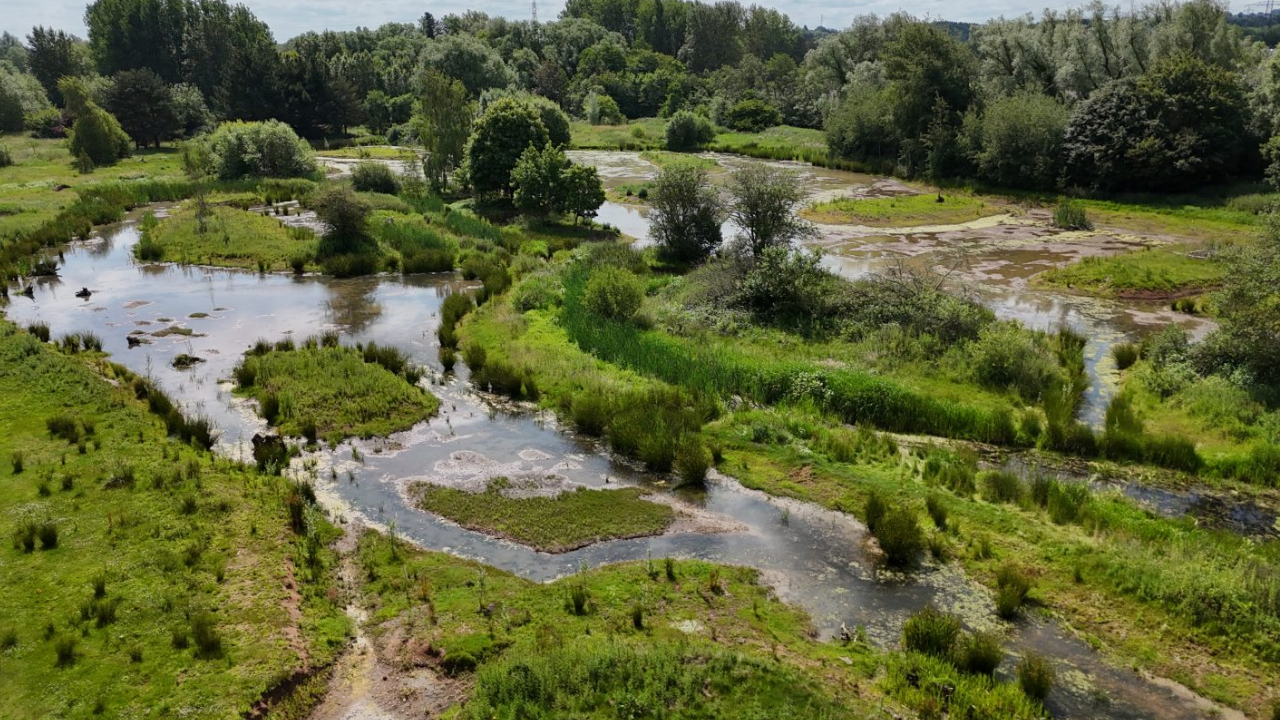
Heavy industry leaves behind more than empty promises. When the site shuttered, local authorities faced a massive tract of land choked by decades of operational waste, compacted soil, and an old recreational golf course that served as a manicured bandage over a scarred ecosystem. Transforming this space into a functioning wetland required tearing up manicured fairways and replacing them with native reedbeds, wet woodlands, and shallow scrapes designed to catch rising river water.
Engineers did not simply plant trees and walk away. They had to alter the hydrology of the area entirely. By reconnecting the floodplain to the neighboring River Trent, the project engineers created a natural sponge. When winter rains swell the river, the water now spills harmlessly into the newly minted wetland rather than flooding nearby residential streets. This is functional ecology disguised as scenic public space.
The 1.5 Kilometer Thread
Set to open fully in 2026, the new 1.5 kilometer trail weaves directly through the heart of this newly engineered wilderness. Walkers, cyclists, and naturalists will navigate a landscape where industrial remnants stand cheek-by-jowl with nesting lapwings and migrating wildfowl.
Access matters. Too often, ecological regeneration projects turn into fenced-off nature reserves guarded by zealous trusts, keeping the public at a distance. Rugeley Riverside Park takes the opposite approach. The trail cuts straight through the recovery zone, forcing human beings to witness the messy, beautiful reality of a post-industrial ecosystem healing itself. Concrete paths give way to raised boardwalks across marshy ground, offering vantage points where local residents can watch kingfishers darting over pools that once served as industrial drainage channels.
The Economic Reality Beneath the Mud
Environmentalism without financial viability is a luxury towns like Rugeley cannot afford. This transformation is deeply tied to broader regeneration schemes turning the wider power station footprint into housing and commercial zones. New homeowners do not want to look out over abandoned industrial rubble. They want green space, walking trails, and proof that their neighborhood has a future.
Property developers poured millions into the remediation process, driven partly by strict biodiversity net-gain regulations that demand new developments leave nature in a better state than they found it. But do not mistake this for pure altruism. Green infrastructure drives property values. The wetland acts as both a flood defense and a massive selling point for the thousands of new homes rising on the opposite side of the perimeter fence.
The Fragile Balance of Manufactured Nature
Purists often sneer at wetlands that come out of an engineer's blueprint. They argue that a constructed marsh can never replicate the intricate, ancient web of a truly wild ecosystem. They have a point. Every channel was dug by an excavator. Every reed plug was planted by hand.
Yet cities and towns do not have the luxury of waiting centuries for nature to heal its own wounds. Rugeley's new wetland is an urgent intervention. It acknowledges that once we break an ecosystem, we carry the responsibility to stitch it back together, stitch by heavy stitch. As the first herons settle into the reeds and the 1.5 kilometer trail opens its gates, the ghost of the coal station finally recedes, buried beneath mud, water, and green shoots.