The ocean around Western Australia does not make mistakes. When the swells crash against the jagged limestone of the coastline near Albany, they do so with a heavy, rhythmic violence that has claimed ships, sailors, and seasoned fishermen for generations. It is a place of beautiful, terrifying certainty. If you fall in, the water keeps you.
On a biting Tuesday afternoon, that certainty blinked.
It started with a sound that every dog owner feels in their marrow before they even process it with their ears—a sudden, sharp scratch of nails on wet stone, followed by a hollow splash. Inside the churn of the foam was Duke. He is a three-year-old kelpie cross, built of muscle, instinct, and a stubborn loyalty that usually keeps him glued to his owner’s heel. But a rogue wave is an indifferent thing. It swept over the low ledge where they stood, lifting the forty-pound dog as if he were nothing but driftwood, and dragged him backward into the washing machine of the Southern Ocean.
His owner, a local fisherman named Marcus, did what human instinct demands and reason forbids. He lunged. A spray of saltwater blinded him, cutting his shins against the barnacles. When his eyes cleared, Duke was gone. Not drowned—not yet—but bobbing forty yards out, his black nose cutting through the gray froth, carried by a rip current that was moving faster than a man could sprint.
Most stories about the sea end right here. They become statistics on a notice board at the boat ramp, warnings muttered to tourists over pints at the local pub. Instead, what followed over the next forty-eight hours was a strange, desperate collision of human stubbornness and animal endurance that turned a bleak stretch of isolated rock into an arena of survival.
The Island of the Dead
To understand the panic that set in on the shore, you have to understand Mistaken Island. It sits roughly five hundred yards off the coast, a desolate lump of granite and scrub brush surrounded by sheer drops and unpredictable breaks. The locals call it an island, but it functions more like a fortress. The channel separating it from the mainland is a gauntlet of surging tides and white water.
Marcus stood on the mainland cliffs, his binoculars shaking against his face. The sun was dipping, painting the sky in bruised shades of purple and orange. The water temperature was hovering around fourteen degrees Celsius. In conditions like that, hypothermia is not a distant threat; it is a countdown. A dog’s core temperature drops faster than a human's once exhaustion takes hold.
Then, a speck of movement.
Through the lenses, Marcus saw a wet, dark shape crawl out of the surf on the eastern ledge of Mistaken Island. Duke had made it to the rocks. But winning that battle meant entering a different kind of trap. The island has no fresh water. The cliffs are steep, slippery, and plagued by nesting sea birds that will aggressively dive-bomb anything that moves near their territory. Duke was alive, but he was marooned on a granite desert surrounded by a moat of death.
Consider what happens next when the authorities are called in a situation like this. The police boat cannot get close; the jagged reefs would tear the hull open. A helicopter is a massive expenditure of public resources for a pet, no matter how beloved. The official word that evening was grim: it was too dangerous to launch a marine rescue operation in the dark. Marcus was told to go home, to wait for morning, and to prepare for the worst.
"You don't sleep," Marcus said later, his voice hollowed out by the memory. "You just sit in the kitchen listening to the wind hit the windows, knowing every gust is hitting him out there in the dark. You feel the warmth of your own house like it's a betrayal."
The Mechanics of Hope
By dawn, the community had mobilized in the way only small coastal towns can. This was no longer just about a dog. It was a refusal to let the ocean win a predictable victory.
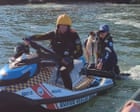
A volunteer marine rescue crew assembled at the boat ramp at 6:00 AM. Among them was Sarah, a veteran volunteer who had pulled everything from capsized kayakers to tangled whales out of these waters. She knew the layout of Mistaken Island better than anyone. She also knew that a terrified, injured kelpie is not a cooperative rescue subject.
"Animals in shock don't see a savior," Sarah explained as they prepped the rigid-hulled inflatable boat. "They see a predator coming off the water. If we cornered him, there was a very real chance he would leap back into the surf out of pure panic. Then it's over."
The strategy required precision rather than brute force. They couldn't use sirens or loud engines. They had to stalk the island, locate the dog, and send a single swimmer ashore to make contact using familiar scents and a soft voice.
The boat launched into a two-meter swell. The hull slammed against the troughs, sending freezing spray over the crew. As they neared the western flank of Mistaken Island, the scale of the challenge became obvious. The rocks were covered in black algae, slick as grease. Every wave that hit the island's base exploded into a four-meter wall of spray.
They searched for two hours. Nothing.
No movement on the ridges. No barking over the roar of the wind. The silence was heavy, the kind that makes you want to pack up the gear and look away. The human mind is built to find patterns, and after a while, every dark shadow in the granite cracks starts to look like a dog waiting for help.
The Contact
But the real breakthrough came from a completely unexpected direction.
A local drone operator, responding to a plea on social media, had flown his quadcopter out from the mainland cliffs, pushing the battery limits to its absolute edge. The screen flickered, fighting the coastal interference. Then, the camera caught it: a patch of black fur wedged deep into a crevice, high above the waterline. Duke had burrowed into the stone to shield himself from the freezing wind. He was motionless.
The drone footage gave the boat crew an exact coordinate. Sarah slipped into the water, fighting the backwash that threatened to smash her against the granite shelf. She scrambled upward on her hands and knees, her fingers bleeding from the sharp edges of the barnacles.
When she reached the crevice, she stopped. She didn't reach out. She didn't yell.
Instead, she sat down on the wet stone, three feet away from the shivering animal, and pulled a piece of dried beef jerky from her dry-suit pocket. She began to talk. Not about the rescue, but about nothing at all—the weather, the football scores, the sound of the birds.
Duke’s ears twitched. His eyes, clouded with salt crust and exhaustion, focused on her. His tail gave a single, pathetic thump against the stone. It was the pivot point of the entire ordeal. The transition from a wild, surviving beast back to a domestic companion.
It took another forty minutes to secure him into a specialized canine rescue harness. He didn't fight. He let himself be lifted, a dead weight of spent adrenaline, as Sarah navigated the treacherous descent back toward the surging inflatable boat. When the crew pulled Duke over the pontoons, he collapsed onto the deck floor, wrapped in heavy wool blankets, his eyes locked on the horizon where the mainland sat waiting.
The Return
The boat ride back was quiet. The tension had drained out of the crew, replaced by that particular, exhausted clarity that comes after defying the odds.
On the jetty, Marcus was waiting. The reunion wasn't a cinematic moment of running and leaping; it was quieter, more grounded in the reality of what they had all just endured. Duke managed to stand on trembling legs, his head buried directly into Marcus’s chest, his small frame shaking with a mixture of cold and relief.
We tend to look at these events as isolated incidents of luck. We call them miracles because it spares us from thinking about how close they came to tragedy. But the survival of one dog on a forgotten strip of Australian rock wasn't a miracle. It was a testament to a very specific human trait: the willingness to expend immense energy, risk skin and bone, and fight the natural order of things for a creature that cannot say thank you.
The ocean around Albany is still there, heavy and indifferent, breaking against the limestone with the same ancient rhythm. It will take something else another day. But on that afternoon, the ledger was short one soul.
Duke slept for fourteen hours straight on the rug by the fireplace, his paws twitching as he ran through whatever dreams follow a night spent listening to the sea from the dark side of the glass. Marcus sat in the chair beside him, his boots still damp, watching the rise and fall of his dog's ribs in the firelight.