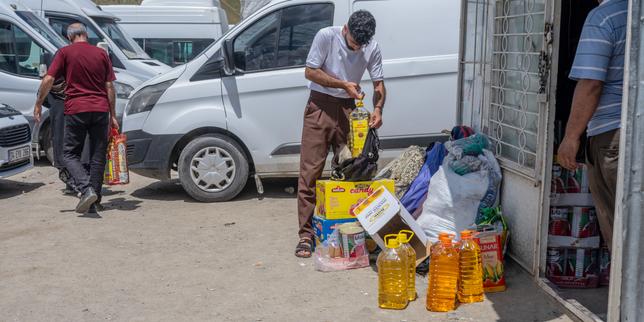
The air at five thousand feet does not care about international sanctions. It only knows how to bite.
Reza tucks a plastic-wrapped bundle of Turkish denim deeper into his faded canvas pack. His breath forms brief, ragged ghosts in the freezing dusk. A year ago, he sat in a classroom in Tabriz, explaining the nuances of Persian literature to disinterested teenagers. Today, his universe has shrunk to the width of a rocky, unmarked mountain path stretching between northwestern Iran and the eastern edge of Turkey.
He is not a criminal by inclination. He is a man trying to outrun a mathematical nightmare.
When a nation’s currency loses its grip on reality, the citizens are forced to find their own gravity. In Tehran, the official inflation numbers hover in the upper double digits, a sterile statistic that translates to a brutal truth on the ground: a week’s wages today might only buy a three-day supply of groceries tomorrow. The economy is bleeding, drained by years of isolation, mismanagement, and geopolitical gridlock. For millions of ordinary citizens, survival has become a logistical puzzle solved only by physical grit.
They call this the survival trade. It is a desperate, informal network of human mules, small-time merchants, and border-town opportunists who bridge the gap between two worlds. On one side lies Iran, rich in history but suffocated by economic embargoes. On the other lies Turkey, a gateway to Western goods and a relatively stable market. Between them lie the Zagros Mountains, a beautiful, treacherous barrier that has become the de facto marketplace for a dying economy.
Consider the mechanics of a single journey.
Reza’s day begins long before the sun hits the peaks. He meets a contact in a nondescript tea house on the Iranian side. Money rarely changes hands here in large volumes; instead, the economy runs on trust and desperate margins. He agrees to transport a load of cheap Iranian fuel or domestic textiles across the border. In return, he will bring back electronic components, specific medicines unavailable in Iranian pharmacies, or branded clothing.
The math is simple but devastating. A gallon of subsidized fuel in Iran costs less than a bottle of mineral water in Istanbul. If you can move that fuel across the mountain, its value multiplies instantly. But the cost is not measured in currency. It is paid in shoe leather, frostbite, and the constant, thrumming terror of border patrols.
The path is a vertical maze of loose shale and sudden drops. One misstep means a broken ankle, which, in these mountains, is a death sentence. The border guards on both sides are notoriously unpredictable. Sometimes they look the other way, understanding that this black-market artery keeps entire border provinces from starving. Other times, the silence of the night is shattered by gunfire.
Let us be precise about who is walking these paths. This is not the domain of hardened cartel bosses. Look closely at the faces under the heavy wool caps. You will see former accounting clerks, mechanics whose shops ran out of imported spare parts, and university graduates holding engineering degrees that are worth less than the paper they are printed on.
The collapse of a formal economy does not happen all at once. It is a slow, grinding erosion. First, the luxury items disappear from the store shelves. Then, the mid-tier brands vanish. Finally, the essentials—the specific heart medication an elderly mother needs, the baby formula, the specialized livestock feed—become scarce.
When the shops go empty, the mountains fill up.
But the real problem lies elsewhere. This informal border commerce is an unstable band-aid on a gaping wound. It creates a strange, distorted reality in the border towns. Places like Maku or Khoy have become economic twilight zones. In these communities, a teenager with a sturdy back and a willingness to hike through a blizzard can earn more in forty-eight hours than his father earned in a month as a government employee.
This flip of societal norms destroys the long-term prospects of a generation. Why stay in school when education offers no protection against poverty? Why build a legitimate business when the currency fluctuates so wildly that pricing a product accurately is impossible?
The systemic damage is quiet, deep, and generational.
Imagine standing on the Turkish side of the border, looking back toward Iran. The lights of the small villages flicker in the mountain shadows. To an outsider, it looks peaceful, almost timeless. But if you zoom in, you see the reality of families waiting for a knock on the door, praying that the silhouette appearing in the doorway is their son returning with a full pack rather than a border guard carrying bad news.
This trade is a mirror. It reflects a nation forced to live hand-to-mouth, stripping away the grand narratives of politics and statehood to reveal the raw, naked instinct of human preservation. The individuals walking these tracks are not symbols of a political movement; they are parents, siblings, and neighbors refusing to let the numbers on a bank screen dictate whether they eat tonight.
The sun dips completely behind the Turkish ridges, plunging the pass into a deep, bruising blue. Reza adjusts the straps of his pack. His shoulders ache with a dull, rhythmic pain that has become his constant companion. He looks down at his boots, then looks ahead at the narrow line of gray rock twisting into the dark.
There is no grandeur here. There is only the next step, the weight on his back, and the cold reality of a mountain that demands everything just to stay even.


