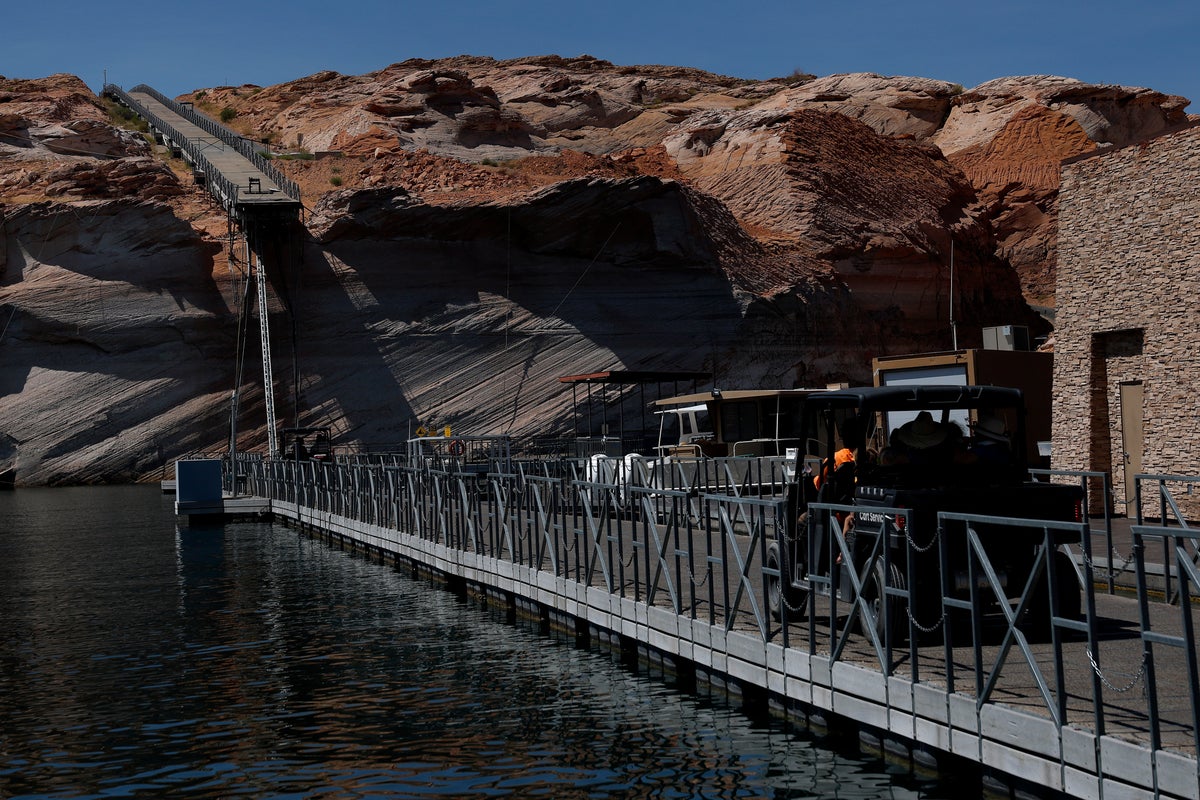
The structural deficit of the Colorado River basin is an arithmetic failure rather than a meteorological anomaly. When total legal allocations established under the 1922 Compact and subsequent 1944 Mexican Treaty exceed mean annual natural flow by millions of acre-feet, demand destruction becomes the only remaining policy variable. Recent federal mandates forcing emergency water delivery reductions across Arizona, Nevada, and California shift the administrative burden onto municipal and agricultural end-users, yet these cuts address volume without recalibrating the underlying pricing mechanisms or priority doctrines.
Evaluating the crisis requires dissecting the basin into three discrete operational layers: the hydrological supply baseline, the legal priority architecture, and the microeconomic cost function borne by districts facing mandatory curtailments. Meanwhile, you can explore related stories here: Why Iraq Is Drawing a Hard Line Against Regional Proxy Wars.
The Hydrological Reality and the Supply Deficit
Long-term streamflow records demonstrate that the river's historical apportionment of 16.5 million acre-feet was calculated during an anomalously wet multi-decade window. Modern hydrological modeling pegs the true average natural flow closer to 12.5 to 13.5 million acre-feet, and warming temperatures across the Upper Basin accelerate evaporative losses in Lake Powell and Lake Mead, widening the net deficit.
When reservoir elevations breach critical buffer thresholds, federal intervention under operational guidelines forces Tier 1, Tier 2, or Tier 3 shortages. These tiers dictate automatic volumetric subtractions from the Lower Basin states, primarily hitting Arizona because of its junior priority status relative to California under the Supreme Court decree in Arizona v. California. To understand the bigger picture, we recommend the detailed analysis by NBC News.
The primary limitation of these federal shortage tiers lies in their static volume triggers rather than dynamic basin health metrics. Operating rules rely on absolute water surface elevations at Lake Mead rather than soil moisture deficits, snowpack sublimation rates, or real-time storage depletion velocities. This creates a regulatory lag. By the time elevation triggers force a tier downgrade, the system has already absorbed severe structural stress, leaving water managers scrambling to implement emergency reductions within months rather than planning across multi-year cycles.
The Priority Doctrine and Legal Friction
Water rights throughout the American West operate on the doctrine of prior appropriation, colloquially known as first-in-time, first-in-right. In interstate river basins, this principle is layered over compact allocations and federal decrees.
California holds senior rights to the first 4.4 million acre-feet allocated to the Lower Basin, protected by federal agreements that insulate its agricultural juggernauts—principally the Imperial Irrigation District—from proportional cuts during early shortage stages. Arizona absorbs the brunt of Tier 1 and Tier 2 reductions because its Central Arizona Project canal system holds junior priority status.
This legal asymmetry generates profound economic inefficiencies. Senior entitlement holders continue low-value, high-evaporative-loss flood irrigation for forage crops like alfalfa, while junior municipal users in Phoenix and Tucson invest heavily in advanced potable reuse infrastructure, desalination, and underground aquifer storage recovery. The legal framework protects archaic consumption patterns while penalizing municipal systems that have already institutionalized demand hardening.
To bypass this rigidity, the Bureau of Reclamation relies on System Conservation Implementation Agreements. These are voluntary, compensated fallowing programs where federal funds pay agricultural districts to leave fields dry. While these programs temporarily stabilize reservoir levels, they function as short-term liquidity injections rather than permanent structural reforms. They cost millions of dollars annually without altering the underlying property rights or forcing long-term crop switching toward high-value, low-water-intensity agriculture.
The Microeconomic Cost Function of Curtailments
When municipal and agricultural districts receive mandatory cutback targets, the economic impact is non-linear. The cost function of a water cut depends entirely on the marginal value of the displaced use.
For agricultural producers, a twenty percent reduction in irrigation water does not equate to a twenty percent reduction in revenue. Fixed capital costs for equipment, land servicing, and debt remain static, while crop yields drop precipitously if water is withheld during critical pollination windows. Farmers respond by fallowing marginal acreage first, concentrating water on higher-yield fields, or shifting from perennial crops to seasonal annuals. However, multi-year tree crops like almonds and citrus cannot be easily fallowed without killing the capital asset, creating immense financial distress during prolonged curtailments.
For municipal utilities, water cuts trigger structural revenue shocks. Utilities operate on capital-intensive fixed assets with high debt service costs for treatment plants and distribution pipes. When conservation mandates succeed and volume sales drop, utility revenues plummet while fixed costs remain constant. To maintain fiscal solvency, utilities must raise volumetric rates, which penalizes consumers who have already maximized indoor efficiency and leaves the utility with a regressive revenue model.
Furthermore, demand hardening limits how far municipal efficiency can go. Once a city transitions to xeriscaping, low-flow fixtures, and advanced leakage detection, the remaining water use is essential sanitation, commercial activity, and firefighting. Forcing further reductions requires aggressive rationing, commercial moratoriums, or hauling water, which imposes severe economic drag on local commerce.
Alternative Policy Instruments and Market Mechanisms
The reliance on top-down volumetric quotas fails to account for regional economic diversity. Economists have long argued for market-based water transfers, where rights can be leased or sold across municipal and agricultural boundaries without losing the underlying legal title.
Water banks allow users to store conserved water in underground aquifers and lease those credits to municipalities facing shortages. This introduces price discovery to a resource that has historically been heavily subsidized by federal infrastructure investments and artificially cheap electricity rates generated by Hoover Dam hydropower. When water has an explicit, fluctuating market price, agricultural producers face a rational economic choice: use the water to grow low-margin feed or lease the water rights to a municipality at a higher net return.
The friction in water markets stems from third-party return flow effects. When an upstream farmer diverts water from the Colorado River, a portion of that water percolates back into the water table or flows downstream, supplying other users. Allowing upstream water sales without accounting for these return flows can inadvertently starve downstream senior rights holders, requiring complex administrative oversight by state water engineers to approve every transaction.
Strategic Execution for Basin Stabilization
Stabilizing the Colorado River basin requires moving away from crisis-driven federal mandates and toward automated, risk-adjusted demand management.
States must decouple municipal growth approvals from speculative paper water rights. New real estate developments should not be permitted unless the developer can demonstrate a verified, wet-water portfolio that remains resilient under Tier 3 shortage conditions.
Federal drought contingency funding should be transitioned from temporary fallowing subsidies to permanent capital grants for pressurized drip irrigation infrastructure, canal lining, and municipal wastewater recycling loops. Subsidies must be conditional on permanent retirement of high-evaporation water rights in hyper-arid microclimates.
The pricing structure for Bureau of Reclamation water deliveries must incorporate tiered volumetric pricing that scales exponentially as reservoir levels approach dead pool. As storage drops, the marginal cost of extraction must rise to reflect the true opportunity cost of system depletion, forcing immediate efficiency gains across both agricultural and municipal sectors before federal emergency cuts become the only lever left.