Dawn broke cold over the Potomac, casting long, gray shadows against the stark marble of the capital's premier stage. Down below, the streetlights still flickered against the damp pavement. A solitary figure in a heavy winter coat stood shivering near the basin, watching silhouettes move behind a towering wall of gray fabric and rigid steel scaffolding.
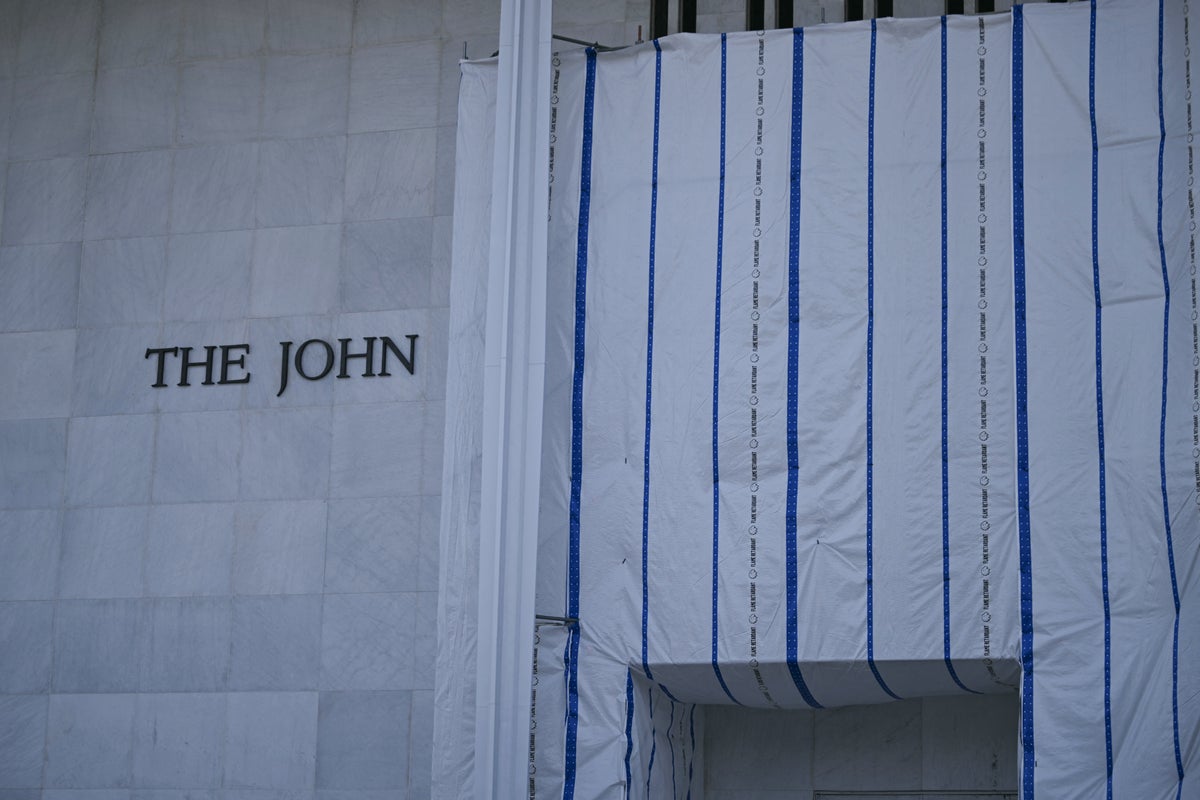
For weeks, that massive tarp had hung like a shroud across the grand entrance of the John F. Kennedy Center for the Performing Arts. Commuters squinted at it from passing buses. Tourists raised their phones, capturing a monument wrapped in a construction worker's cocoon. It looked like an ordinary renovation project, the mundane upkeep of a brutalist monolith weathering the Mid-Atlantic humidity.
It was nothing of the sort.
Underneath that protective shield lay a legal battlefield. Months prior, a federal judge had dropped a hammer on a rushed, handpicked board decision that had abruptly slapped Donald Trump's name onto the national memorial. The court order was absolute: the letters had to come down. They did, vanishing into the predawn hours under the glare of flashlights and police cruisers. But the physical removal of the lettering left raw scars on the historic marble facade, and more importantly, it left a vacuum of pride and defiance.
Instead of an unveiled entrance, the public got a textile wall.
Critics called it a literal coverup, an act of petty stubbornness designed to shield an empty space from prying eyes. Lawmakers fired off scathing briefs, demanding to know why a piece of canvas remained stubbornly hoisted long after the disputed signage had been dismantled. To the outside observer, it was a bureaucratic comedy of errors.
The reality was far messier, steeped in an ongoing tug-of-war over who gets to claim the soul of America's cultural institutions.
Consider what happens next in the quiet chambers of federal court filings. Government attorneys insisted in recent reports that the tarp and its metal skeleton are vital armor, acting as a structural necessity for water testing and roof overhang repairs. They argue that the initial mounting of the contested letters did a number on the delicate stone underneath, necessitating painstaking cosmetic surgery.
Yet, across the aisle, legal teams representing dissenting board members view those explanations with deep suspicion. They see the scaffolding not as a tool for healing, but as a staging ground for a sequel. The board doubled down with fresh resolutions, pushing to weave new plaques and alternative honorary titles into the structural fabric of the grounds once the legal dust settles.
The tarp stays because the argument never left.
Standing on the plaza, listening to the muffled hum of traffic bounce off the synthetic barrier, you realize that buildings in Washington are never just stone and mortar. They are canvases for ideology. Every chisel mark, every plaque, and every yard of heavy-duty industrial fabric tells a story about power, memory, and who gets to write the final draft of history.
The fabric will eventually fall. The marble will be patched. But the silhouette of the dispute will remain etched into the city's skyline long after the scaffolding is packed away.
Why the Kennedy Center's name is still hidden
This short clip provides a close look at the physical appearance of the heavy tarp and scaffolding shrouding the Kennedy Center entrance following the court-ordered removal of the signage.