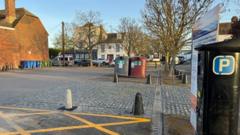
The asphalt is still dark, fresh enough that the painted white lines of the parking bays gleam with a clinical, mocking brightness. It is 11:00 AM on a Tuesday in a commuter town forty miles outside of London. By all rights, this should be the frantic heart of the morning rush. There should be the rhythmic thud of car doors, the chirp of central locking, and the hurried scuff of leather shoes against pavement.
Instead, there is silence. For another look, check out: this related article.
A single crisp packet skitters across the empty expanse, driven by a wind that has no obstacles to break its path. This car park, built to hold four hundred vehicles, currently holds three. One belongs to a security guard who is paid to watch nothing. The other two belong to shop workers who are currently dusting shelves for customers who haven't arrived.
To a casual observer, an empty car park is a failed business venture or a planning oversight. To an economist, it is a crime scene. The vacant stalls are the physical manifestation of a structural rot that has quietly hollowed out the British middle class. This isn't just about people choosing to shop online. It is about a nation that has run out of gas, both literally and figuratively, because its citizens are drowning in a sea of invisible red ink. Related analysis on this matter has been shared by Financial Times.
The Weight of the Unseen
Consider a hypothetical driver named Sarah. Five years ago, Sarah didn’t think twice about driving to this multi-storey. She would pay the £4.50 parking fee, grab a latte, browse the clothing racks, and perhaps buy a birthday gift for a friend. Today, Sarah is sitting in her kitchen, three miles away, staring at a spreadsheet.
Sarah hasn't lost her job. Her salary has actually increased by 3%. However, the mathematics of her life have fundamentally shifted. Her mortgage, once a manageable £800, has reset to £1,400 following the interest rate hikes designed to curb inflation. Her energy bill is a volatile beast. Her grocery shop, which used to be a background expense, now requires the strategic precision of a military operation.
When Sarah looks at that £4.50 parking fee, she doesn't see a convenience. She sees three liters of milk. She sees the margin between making it to payday and dipping into an overdraft that already feels like a permanent resident of her bank account.
The empty car park is the primary symptom of a "squeezed middle" that has finally reached its breaking point. In the UK, household debt-to-income ratios have hovered at staggering levels for over a decade. But for years, cheap credit acted as a sedative. If you couldn't afford the car, you leased it. If you couldn't afford the holiday, you put it on a card with 0% interest for eighteen months. We lived in a world of deferred reality.
That reality has now arrived, and it brought a clipboard.
The Interest Rate Guillotine
For a generation, the British economy was built on the assumption that money would always be virtually free. When the Bank of England held base rates near zero, the empty car park was full. People felt wealthy because their homes—their primary assets—were inflating in value while their debt was stagnant.
But when the central bank raised rates to combat the soaring cost of living, the trap snapped shut.
Suddenly, the "disposable" part of disposable income vanished. It was diverted, almost overnight, into the coffers of mortgage lenders and credit card providers. This is the mechanical reason the car park is empty. Every empty bay represents a household that has retreated into survival mode. They are "trench-shopping"—buying only the essentials, ignoring the lures of the high street, and staying home to avoid the "hidden" costs of existing in public.
It creates a lethal feedback loop. Small businesses in the town center, seeing the empty car park, realize their footfall has plummeted. They cut hours. They lay off staff. Those staff members, now earning less, further reduce their own spending. The silence in the car park grows louder.
The Myth of the Online Shift
It is easy to blame the internet. We are told that the high street is dying because we are lazy, preferring the glow of a smartphone to the tactile experience of a shop floor. While the digital shift is real, it's often used as a convenient mask for a much grimmer truth: people aren't just shopping differently; they are shopping less because they are poorer.
If you look at the data for "non-essential" retail, the slump isn't just migrating to Amazon. It is evaporating. The UK’s debt problem has created a "vortex of the mundane." When the majority of a population is spending 40% to 50% of their take-home pay on housing and utilities, the very concept of a "retail economy" starts to look like a relic of a more prosperous era.
We are witnessing a decoupling of the British consumer from the British town. The car park was the bridge. It was the entry point to a social and economic ritual. Now, that bridge has a toll that fewer people can afford to pay.
The Psychological Toll of the Ledger
There is a specific kind of exhaustion that comes with chronic debt. It’s a low-level hum of anxiety that sits at the base of the skull. It influences every decision, from the brand of beans you buy to whether or not you visit your parents for the weekend.
In a debt-heavy society, the "human" element is the first thing to be sacrificed. Spontaneity dies. If every outing must be calculated against a mounting credit card balance, you stop going out. You stop participating in the local economy not out of spite, but out of necessity.
The empty car park serves as a monument to this collective withdrawal. It is a visual representation of a society that has become "house-poor"—living in structures they can barely afford, driving cars they don't own, and avoiding the town centers that used to define their communities.
The Invisible Stakes
If the bays stay empty, the infrastructure that relies on them begins to crumble. Local councils, already pushed to the brink of bankruptcy, rely on parking charges and business rates to fund social care, library services, and road repairs. When the cars disappear, the revenue disappears.
This leads to a degradation of the public realm. The car park becomes a magnet for anti-social behavior. The shops surrounding it boarded up. The town loses its identity, becoming a "ghost town" not because of a plague or a war, but because of a balance sheet.
We often talk about "the economy" as if it is a weather system, something that happens to us from above. But the economy is just the sum of millions of tiny decisions made by people like Sarah. When Sarah decides that the cost of a trip to town is no longer worth the emotional stress of checking her banking app afterward, the economy changes.
The UK's debt problem isn't just a series of charts in a boardroom in Threadneedle Street. It is the sound of a lone crisp packet blowing across a sea of empty, expensive asphalt. It is the sight of a security guard watching a void. It is the realization that we have spent years building spaces for a lifestyle that we can no longer afford to maintain.
The car park isn't waiting for the weekend. It is waiting for a version of Britain that might not be coming back. As the sun sets, casting long, distorted shadows across the vacant bays, the silence feels less like a temporary lull and more like a permanent shift. The lights flicker on, illuminating rows of nothing, burning electricity that someone, somewhere, is still struggling to pay for.