Saltwater tastes different when you know it is being conquered.
Stand on the deck of a wooden fishing vessel drifting somewhere near the Spratly archipelago, and the horizon looks deceptively empty. Just a dizzying, unbroken collision of turquoise water and blinding sky. For generations, men who pull tuna and mackerel from these swells treated the open sea as an untamed commons, a liquid wilderness belonging to no single flag. But the horizon is lying. Beneath that glare of sun on spray, a profound geography is shifting.
Consider a hypothetical fisherman named Chen, casting his nets into water that his grandfather fished decades ago. Chen does not care about geopolitics. He cares about diesel prices, the sudden scarcity of flying fish, and the grey shapes on the radar that are not rain clouds. Those shapes are dredges. They are massive, industrial leviathans swallowing the ocean floor and vomiting it back out into the sun.
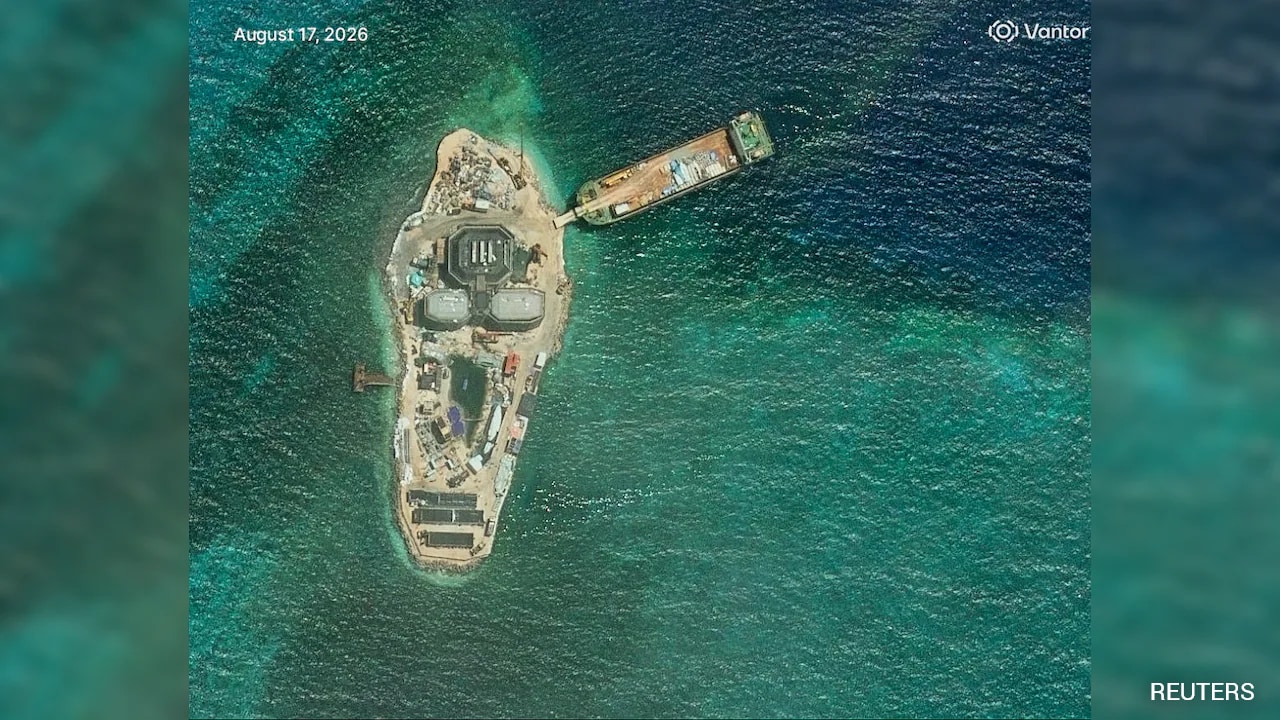
What is happening in the South China Sea is not merely a territorial dispute over lines drawn on a map. It is a physical rewrite of the planet. And the latest chapter involves Beijing adding yet another new island to its staggering military buildup in these contested waters.
To understand the weight of this, you have to look past the dry language of defense intelligence briefings. We are watching the creation of unsinkable aircraft carriers out of sand, coral rubble, and millions of tons of concrete.
The Architecture of Quiet Dominance
Dredging sounds mundane. It sounds like harbor maintenance. But in the hands of an ambitious superpower, it is an act of geological theater.
Specialized vessels grind against the submerged reefs, chewing up the fragile marine ecosystem and pumping a slurry of sand and mud through massive steel intestines. Day and night, the sludge piles up. Within weeks, shallow coral heads that had sat undisturbed beneath the waves for millennia find themselves hoisted above the surface. Soon come the seawalls, then the barracks, the radar domes, the runways, and the fuel depots.
This is the largest military buildup in the region since the Second World War. And it is happening in slow motion, hidden behind a curtain of maritime distance.
Satellite imagery captures the progression with chilling clinical precision. First, a smudge of white sand appears on a blue disc. Then, the straight lines of a pier take shape. Months later, the unmistakable geometry of a fighter jet runway stretches across a reef that once barely offered a perch for a wandering seabird.
Beijing calls this defensive infrastructure. Neighboring nations like the Philippines, Vietnam, Malaysia, and Brunei call it an existential threat. They watch from their own fragile outposts as a web of military installations tightens around some of the busiest shipping lanes on Earth.
Nearly a third of global shipping passes through these waters. Trillions of dollars in cargo traverse this liquid highway every single year. When a new island rises, bristling with anti-ship missiles and electronic jamming equipment, the rules of passage change. The toll booth has not just been built; it has been bolted to the seabed.
The Human Toll Beneath the Surface
We talk endlessly about sovereignty and freedom of navigation, abstract terms that roll easily off the tongues of diplomats in air-conditioned rooms in Washington and Beijing. But the cost of this artificial archipelago is paid by people who live at the edge of the tide.
Let us return to Chen on his wooden boat.
For centuries, artisanal fishing communities across Southeast Asia relied on the rich coral reefs of the South China Sea. These reefs were the nurseries of the ocean, teeming with groupers, snappers, and millions of smaller organisms that fed the pelagic food web. When you drop millions of tons of sand on top of a living reef, you do not just build a runway. You bury an ecosystem.
The dredgers smother the coral. The silt plumes choke marine life for miles around. Fishermen report hauling up nets full of dead coral fragments and vanishing catches. Traditional grounds are now patrolled by heavily armed coast guard vessels belonging to a power that views local boats as trespassers in their own ancestral waters.
There is a profound psychological toll to this kind of creeping containment. It is the feeling of waking up one morning and realizing the walls of your courtyard have been quietly moved inward while you were sleeping. Every new airstrip, every newly claimed atoll, acts as a physical reminder of an overwhelming asymmetry of power.
The Logic of the Long Game
Why go to such extraordinary lengths? Why spend billions of dollars to build artificial land in the middle of a turbulent sea?
To answer that, you have to adopt a mindset that measures time in decades and centuries rather than election cycles.
For decades, naval strategists spoke of the first and second island chains, defensive perimeters that historically kept Chinese projection capability hemmed in near the mainland coast. By aggressively seizing and fortifying features in the Spratly and Paracel archipelagos, Beijing is effectively leapfrogging those historical constraints.
These new islands act as stationary, unsinkable fortresses. They do not need to refuel. They cannot be easily torpedoed. They project power outward, extending an umbrella of air defense and radar coverage deep into maritime Southeast Asia. They turn the South China Sea into a controlled lake, a strategic buffer zone where international law bends to the gravitational pull of the nearest superpower.
It is a masterclass in fait accompli politics. You build the island first, dare anyone to tear it down, and let the sheer physical reality of your presence become the new legal baseline. By the time international tribunals issue rulings, the concrete has already cured, and the surface-to-air missile batteries are already plugged into the grid.
The Uncharted Horizon
As evening falls over the South China Sea, the tropical sun drops below the water in a blaze of bruised violet and burning orange.
On the deck of a lonely patrol boat, a young sailor stares out into the gathering dark. Somewhere out there, miles away over the curve of the earth, a newly minted runway is blinking its lights to guide a transport plane down onto sand that did not exist five years ago.
The water keeps moving. The tides rise and fall, indifferent to the concrete poured over their ancient paths. But the map of the world has been permanently altered. We are living through an era where geography is no longer destiny, but a project—something to be dredged, shaped, and defended at gunpoint.
The islands are there now. They are anchored in the deep blue, silent and watchful, changing the weather of international politics one truckload of sand at a time.