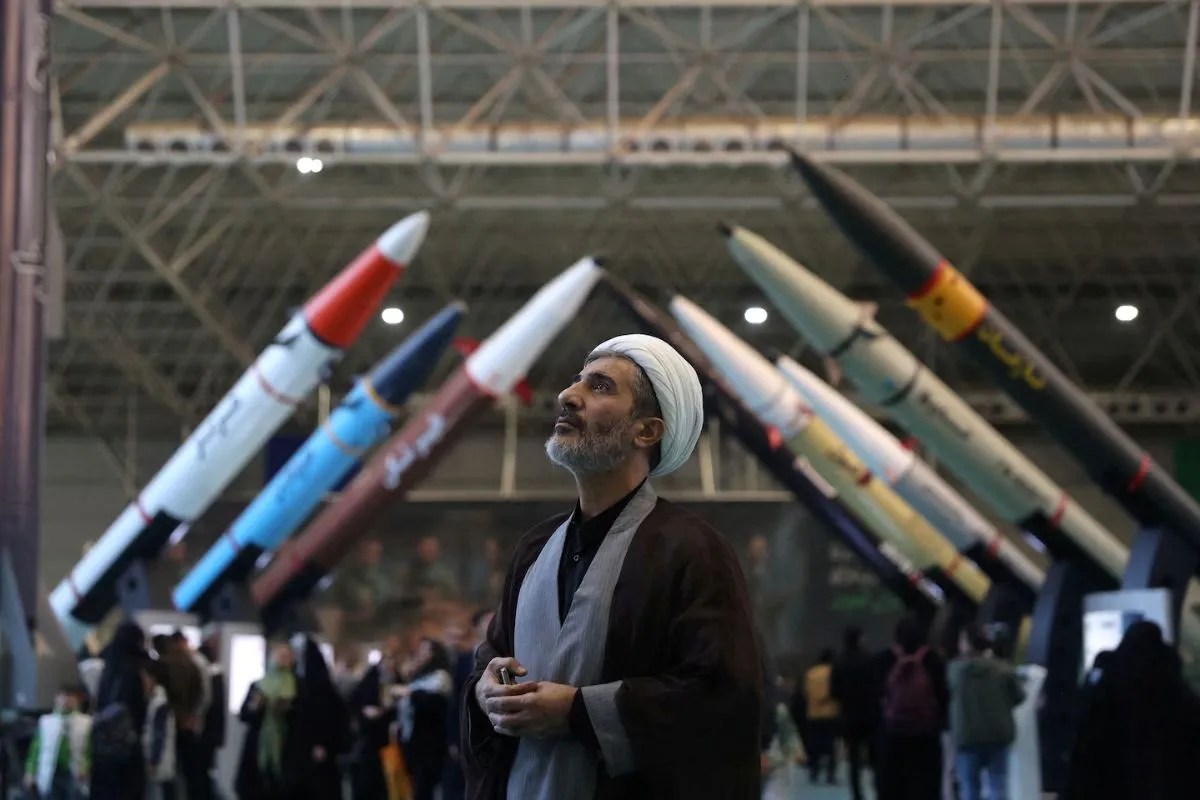
The earth behaves differently when it is packed fifty meters deep. Up on the surface, the desert wind carries the scent of dry salt and aviation fuel, a bitter mixture that sticks to the back of the throat. But down here, beneath layers of reinforced concrete and solid mountain stone, the air is perfectly still, chilled by massive ventilation systems, and entirely devoid of weather.
Imagine a young technician, let us call him Javad, standing under the harsh fluorescent hum of an underground facility hidden beneath the Zagros Mountains. He is not a politician. He is a father, an engineer, someone who studied fluid dynamics at a university in Tehran. His fingers, slightly stained with industrial grease, rest on a console that monitors hydraulic pressures. For months, this corridor was quiet, a subterranean vault holding technology that was supposed to remain dormant under the watchful eyes of international treaties.
Then came the flash across the Persian Gulf.
News travels fast, even through meters of granite. A US strike, sudden and precise, shattered the fragile status quo on the surface. Within hours, the orders came down. The heavy blast doors, thick enough to withstand a tactical nuclear strike, groaned on their massive hinges. Fifty underground missile silos, long kept in a state of suspended animation, breathed back to life.
This is not just a story about geopolitics or the chess moves of superpowers. It is about what happens to humanity when the architecture of war moves entirely out of sight, and why the sudden reopening of these subterranean fortresses changes the very nature of global dread.
The Invisible Arsenal Beneath the Salt Flats
For decades, military strategy was something you could see from space. Satellite photography tracked the movement of tanks, the construction of runways, and the gray hulls of aircraft carriers cutting through the ocean. But the rules changed when the sky became too dangerous.
Iran realized long ago that it could not match the sheer aerial supremacy of its adversaries. The solution was simple, brutal, and incredibly effective: dig. They hollowed out mountains, poured millions of tons of high-grade concrete, and created what the military establishment calls "missile cities."
These are not mere holes in the ground. They are sprawling, interconnected complexes where thousands of soldiers and engineers live and work without ever seeing the sun. Missiles are moved on automated rail systems, shifting from deep storage bays to launch tubes in a matter of minutes.
When the US executed its recent strike, the immediate calculation on the surface was one of deterrence. The logic of modern warfare often dictates that a display of overwhelming force will make an opponent back down. But pressure works differently underground. Instead of retreating, the Iranian leadership turned the key on an entire hidden ecosystem.
Consider the sheer scale of fifty active underground sites. Each one represents a chambered round in a pistol that is permanently pointed at the straits through which a third of the world’s oil flows. By reopening these facilities, the message sent back to the West was not one of compliance, but of deep, subterranean defiance.
The Geometry of Detonations
To understand why this matters to someone sitting thousands of miles away, one must look at the technology of modern bunker-busting munitions. The physics are terrifyingly beautiful and tragic. A standard bomb explodes on impact, scattering shrapnel across a wide area. A penetration bomb, like the American GBU-57 Massive Ordnance Penetrator, does not explode when it hits the ground.
It waits.
It uses its immense weight and a hardened nose cone to punch through thirty feet of reinforced concrete, or two hundred feet of earth, tumbling downward like a kinetic spear. Only when its internal sensors detect that its forward momentum has stopped does the fuse ignite. The resulting explosion creates a shockwave that turns solid rock into a liquid-like plasma, crushing everything inside the mountain chamber through sheer overpressure.
But the Iranians did not build these fifty sites in ignorance of this technology. They built them deeper. They separated the command modules from the launch tubes using long, winding tunnels designed to dissipate shockwaves.
When Javad watches the diagnostic lights turn from amber to green on his console, he knows the mathematical reality. The mountain above him is a shield, but it is also a potential tomb. If a strike comes, the mountain will absorb the blow, but the pressure waves inside the tunnels can liquefy a man’s lungs without even scorching his clothes.
Yet, the work continues. The missiles are fueled. The guidance systems, running on localized networks insulated from Western cyberattacks, are calibrated. The world above argues over oil prices and diplomatic communiqués, while below, the machinery of total retaliation is oiled and ready.
Why the Surface Strategy Failed
There is a profound disconnect between the civilian understanding of war and its psychological reality on the ground. Western analysts often speak of "proportional response" and "escalation ladders," as if conflict were a corporate negotiation conducted with high-explosive ordnance.
The recent American strike was intended to de-escalate by demonstrating consequence. It was a textbook application of modern military theory. But it ignored the cultural memory of a nation that has spent centuries surviving encirclement. When the bombs fell on the surface assets, it did not create fear; it validated the existence of the tunnels. It proved to every engineer down in the dark that their isolation was the only thing keeping them alive.
The reopening of the fifty sites is an admission that the diplomatic guardrails have completely failed. For years, these tunnels were bargaining chips, symbols of a capability held in reserve while diplomats argued in Vienna hotels. Now, the diplomats have left the room, and the engineers have taken their place.
The stakes are no longer abstract. A single miscalculation by a drone operator in Nevada, or a nervous radar technician in Bandar Abbas, can trigger a sequence of events that cannot be stopped by a phone call. The automated nature of these underground launch systems means that once the command is given, the response is algorithmic. The doors open, the fire is lit, and the sky becomes a ceiling of metal.
The Resonance of the Unseen
We live in an era where we believe everything is visible. We have maps on our phones that can zoom in on a backyard barbecue in Ohio, and satellites that can track the wake of a fishing boat in the South China Sea. This creates a false sense of security, a belief that because we can see the world, we can control it.
The fifty underground bases of Iran are a stark reminder of the limits of our vision. They exist in the blind spots of the modern empire. They are a physical manifestation of the unknown, operating under a different set of physical and psychological laws than the world of daylight.
Back in the tunnel, the air conditioning hums its monotonous tune. Javad adjusts a valve, checks a digital readout, and thinks of his family in Shiraz, where the orange blossoms are currently in bloom. He knows the beauty of the surface, but his reality is this gray, unyielding concrete. He is a small cog in a machine designed for the end of the world, waiting for a signal that may come from a sky he cannot see.
The world watches the headlines, waiting to see if the rhetoric will cool or if the economic sanctions will tighten. But the real metric of danger is not found in the speeches at the United Nations. It is measured in the depth of the earth, in the quiet pressure of hydraulic fluid, and in the slow, deliberate unlocking of fifty doors hidden deep beneath the stone.