Stand at the edge of the Potomac River on a damp November morning and you can feel the water working. It does not crash like the ocean. It gnaws. Every tide slips against the cracked stone banks of Hains Point, pulling silt away from the roots of aging cherry trees and nudging the crumbling masonry an inch closer to collapse.
Across the grass, just a few hundred yards from the waterline, sits East Potomac Golf Links.
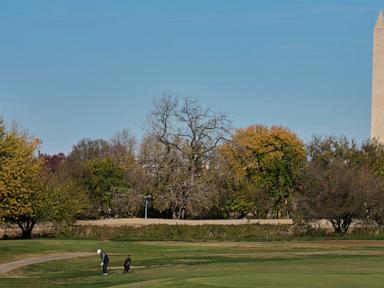
To a casual passerby, it looks like any other urban municipal course—a patchwork of dormant Bermuda grass, scuffed tee markers, and early-morning regulars pulling pushcarts through the mist. To the federal government, however, this peninsula in the heart of Washington, D.C., has become a quiet battleground over who owns public space, how historic landmarks should be modernized, and what happens when executive power collides with a stalled legal fight.
The Trump administration has signaled a plan to move forward with major seawall reconstruction work along the river’s edge at the historic Washington golf course, even as a protracted courtroom battle over the site’s management and redevelopment continues to drag on without resolution. On paper, it reads like a routine infrastructure filing—concrete, riprap, and hydraulic engineering. In reality, it is a high-stakes test of whether an administration can reshape the physical foundation of a contested public asset while the lawyers are still arguing over who holds the keys.
A Century of Mud and Democracy
To understand why a crumbling river wall in the nation’s capital carries so much emotional weight, you have to step back to the early twentieth century.
Hains Point is not natural land. It is dredged river mud, pumped out of the Potomac channel by the Army Corps of Engineers in the late 1800s to keep shipping lanes open and protect the low-lying monuments from seasonal floods. When East Potomac Golf Links opened in 1920, it was built on a radical premise for its era: that golf should not belong exclusively to the wealthy behind private club gates.
Anyone could pay a modest greens fee and walk the fairways.
Over the next hundred years, the course became a rare democratic commons in a city defined by hierarchy. Consider a hypothetical regular—let’s call him Arthur, a retired postal worker from Southeast D.C. who has walked the Blue Course every Tuesday for thirty years. Arthur does not care about architectural pedigrees or federal procurement statutes. He cares that the greens fee stays under forty dollars, that the geese do not completely take over the fourth fairway, and that the river stays on its side of the path.
When the seawall began failing in earnest over the last decade, Arthur noticed it first not in engineering reports, but in puddles. High tides combined with heavy upstream rains pushed brackish water over the deteriorating perimeter wall, flooding low-lying holes and leaving behind slick layers of river mud.
The wall was built nearly a century ago. The mortar has leached out. Huge granite blocks have shifted and tilted like crooked teeth. Behind them, the soil has washed away, creating hidden sinkholes beneath the perimeter walking path where joggers and cyclists pass every day.
Everyone agrees the wall is failing. The fight is over what comes with the repair.
The Collision of Infrastructure and Control
In 2020, the National Park Service—which oversees the National Mall and Memorial Parks, including East Potomac—signed a long-term lease with the National Links Trust, a nonprofit organization dedicated to preserving affordable, accessible municipal golf. The vision was restorative rather than exclusive: rebuild the historic Walter Travis-designed course, keep prices accessible for working-class Washingtonians, and respect the site’s listing on the National Register of Historic Places.
Then came the friction.
Disputes over lease compliance, capital improvement timelines, and the scope of federal oversight escalated into litigation, locking the future of the course in legal amber. While motions piled up on dockets and attorneys parsed the fine print of historic preservation covenants and concessionaire obligations, the Potomac River kept rising.
Water does not wait for summary judgment.
By signaling its intent to advance seawall work at the Washington golf course, the Trump administration has introduced a decisive new variable into the standoff. Under federal jurisdiction, shoreline stabilization along Hains Point is more than a cosmetic upgrade for golfers; it is flood-control infrastructure protecting East Potomac Park and the adjacent Washington Channel. Yet in the middle of an active legal fight over who controls the renovation of the course itself, the move carries unmistakable strategic weight.
Think of it like a landlord who is locked in an eviction and renovation dispute with a tenant, and suddenly announces a massive structural overhaul of the building’s foundation. The foundation genuinely needs fixing. Nobody disputes the cracks in the basement. But whoever controls the blueprints for the foundation also dictates what kind of house can sit on top of it for the next fifty years.
What the River Actually Does to a Seawall
It is easy to talk about seawalls as if they are simple stone fences. Having walked coastal and tidal infrastructure projects for years, I can tell you the reality is far messier—and far less forgiving.
A tidal river wall does not just hold water back; it manages pressure from both sides. When the Potomac surges during a storm, water pushes inward against the stone. When the tide drops rapidly, water trapped in the saturated soil behind the wall pushes outward, trying to blow the stones into the channel. If the drainage fabric behind the wall clogs, or if the joints open up, every tidal cycle acts like a hydraulic pump, sucking fine soil out from under the grass.
Once that soil is gone, the ground collapses from the bottom up.
Fixing that along Hains Point requires heavy marine construction: barges moored in the channel, pile drivers hammering steel sheet piling into the riverbed, cranes lifting multi-ton stone blocks, and temporary cofferdams that close off sections of the shoreline for months at a time.
For a golf course, that kind of heavy engineering is transformative. Haul roads must be cut across turf. Staging areas require acres of flat ground for gravel, steel, and concrete. Elevation grades along the perimeter often have to be raised to meet modern flood-resilience standards, which alters sightlines, drainage patterns, and the layout of holes bordering the water.
When an administration signals that seawall work is moving ahead while control of the golf course remains contested in court, the physical footprint of that construction inevitably intersects with the future design of the links.
The Invisible Stakes for Public Golf
Why does a legal fight over one municipal golf course in Washington draw national scrutiny? Because East Potomac is a bellwether for the soul of American public recreation.
Across the country, municipal golf courses sit on some of the most valuable urban real estate imaginable. For decades, cash-strapped cities and federal agencies viewed them as maintenance headaches—aging facilities with leaking irrigation pipes, outdated clubhouses, and deferred repairs. The standard playbook was predictable: hand the land over to high-end private developers who would pour millions into luxury renovations, raise greens fees to triple digits, and price out the very residents the courses were built to serve.
The National Links Trust model was designed to prove there was another way—that you could restore architectural pedigree and fix crumbling infrastructure without turning a public park into a country club.
That is why the ongoing legal battle feels so personal to the people who play there. On any given afternoon at East Potomac, you will see Capitol Hill interns sharing a tee time with retired federal clerks, high school kids from the First Tee program learning how to grip a seven-iron, and tourists marveling at the sight of the Washington Monument rising directly behind the flagstick on the par-three tenth.
If the legal fight drags on indefinitely, the course risks death by delay—caught between stalled restoration plans and mounting physical decay. Conversely, if federal seawall work proceeds independently of a settled vision for the course, golfers and preservationists worry that critical design decisions about how the land meets the water will be locked in without public consensus.
Confusion in the Gray Zone
Let us be honest about something that often gets lost in coverage of Washington disputes: from the outside, the jurisdictional overlap at Hains Point is deeply confusing.
The land belongs to the federal government, managed by the National Park Service. The river channel falls under the regulatory domain of the U.S. Army Corps of Engineers. The historic status of the course triggers review under federal preservation laws. And the day-to-day operation and capital improvements sit at the center of a contested lease dispute in federal court.
Even seasoned policy watchers struggle to untangle where routine flood-mitigation authority ends and disputed lease management begins.
That ambiguity is precisely where executive signaling thrives. By framing the seawall project around necessary shoreline stabilization and infrastructure resilience, the administration can advance tangible physical work on the peninsula without waiting for a judge to untangle the broader contractual knot. Supporters of aggressive federal intervention argue that waiting years for litigation to conclude while the Potomac erodes parkland is irresponsible stewardship. Critics counter that piecemeal construction during an unresolved legal battle undermines the coherent, preservation-minded restoration the public was promised.
Both arguments carry a grain of truth. That is what makes the standoff so stubborn.
The Sound of Heavy Machinery on Quiet Grass
Picture what happens when the barges finally arrive at Hains Point.
Imagine—as a concrete illustration of what this kind of marine engineering looks like on the ground—a Tuesday morning six months from now. Instead of the quiet click of golf balls off wooden tees, the air along the river vibrates with the metallic clang of a diesel pile driver. Orange safety fencing snakes across the perimeter path, separating the walkers from excavators trenching behind the failing stone wall.
The river will be held back. The sinkholes will be filled. The immediate threat of tidal flooding washing across the fairways will recede behind fresh steel and stone.
Yet when the fences eventually come down and the barges pull away into the channel, the deeper question will still be waiting on the grass. A seawall can protect the land from the river, but it cannot decide who the land is for.
Down by the water’s edge, the tide turns twice a day, indifferent to court dockets, executive directives, and the quiet hopes of regulars who just want to walk eighteen holes before noon.