Cold rain in Belgrade smells like wet limestone, diesel exhaust, and roasting chestnuts. Stand on Terazije Square at seven in the evening in late autumn, and you can feel the vibration of the city through the soles of your boots before you hear a single voice. First comes a low, rhythmic thud—thousands of sneakers hitting asphalt in unison. Then comes the shrill, piercing shriek of plastic whistles cutting through the damp air.
Wait. For a different perspective, consider: this related article.
Listen closer to what is actually happening in the streets of Serbia's capital, and you realize this is not another routine Balkan political squabble.
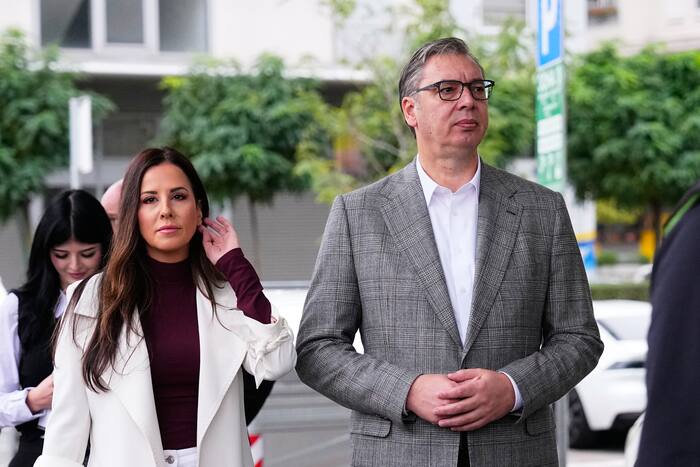
According to international news agencies, including Reuters and the Associated Press, Serbia is holding a high-stakes parliamentary election against the backdrop of sustained, student-led demonstrations challenging President Aleksandar Vučić and his ruling Serbian Progressive Party (SNS). On paper, those wire reports read like familiar geopolitical shorthand: a long-serving populist leader tests his mandate at the ballot box while young protesters demand accountability in the streets. Further insight on the subject has been provided by USA Today.
Strip away the diplomatic phrasing, however, and you find a country wrestling with a question that haunts every modern democracy: what happens when the concrete above your head starts to fall, and the people in charge insist the blueprints were flawless?
The Fracture Beneath the Surface
To understand why twenty-year-old architecture and law students are standing in freezing drizzle instead of cramming for midterms, you have to go back to a tragedy that turned grief into civic fuel. In November 2024, the newly renovated concrete canopy at the main railway station in Novi Sad, Serbia’s second-largest city, collapsed in seconds. Fifteen people died beneath the rubble.
Let us pause here, because numbers numb us. Fifteen people is not a statistic. It is a grandfather waiting for a regional train, a young couple holding hands on a bench, a student checking her phone.
In the aftermath, public outrage erupted not merely over the engineering failure itself, but over what critics and opposition figures alleged was a culture of opaque state contracts, rushed infrastructure projects, and systemic impunity. While government officials maintained that the tragedy was an accident subject to judicial investigation and pointed to years of rapid economic modernization under Vučić’s leadership, thousands of citizens refused to accept business as usual.
Picture a hypothetical twenty-one-year-old civil engineering student from Niš—let us call her Milena—sitting in a cramped lecture hall three days after the collapse. Her professor is drawing load-bearing vectors on a whiteboard. Milena looks at the equations, then looks at the news alerts on her phone showing twisted rebar in Novi Sad. For her, structural integrity ceases to be an academic exercise. If a state cannot guarantee that a public train station roof will stay up, what is the point of learning how to calculate stress loads?
That realization is what pushed students out of university amphitheaters and onto major intersections across Belgrade, Novi Sad, Kragujevac, and Niš.
The Anatomy of a Modern Strongman
To call Aleksandar Vučić a "strongman," as Western headlines routinely do, is both accurate and slightly misleading. It conjures images of a nineteenth-century general barking orders from a balcony. The reality of political power in contemporary Serbia is far subtler, and infinitely more durable.
Think of Vučić’s political machine not as a fortress wall, but as a vast, interlocking suspension bridge. One cable anchors into state-employed workers and pensioners who credit the government with macroeconomic stability, rising average wages, and shiny new highways. Another cable stretches into dominant domestic media outlets, where the president appears almost daily, framing himself as the sole guarantor of peace in a volatile neighborhood. Yet another cable ties into delicate geopolitical balancing acts—maintaining warm ties with Moscow and Beijing while simultaneously negotiating European Union accession and signing lithium mining deals with Western partners.
According to election observers from the Organization for Security and Co-operation in Europe (OSCE) and domestic monitoring groups like CRTA, previous Serbian electoral cycles have been marked by an uneven playing field, including blurred lines between state resources and party campaigning, media dominance by the ruling coalition, and allegations of voter pressure. Government representatives, conversely, have consistently rejected accusations of authoritarianism, arguing that their electoral victories reflect genuine popular support earned through tangible economic growth and diplomatic pragmatism.
Both narratives exist simultaneously in the same living rooms across Serbia.
Consider a hypothetical family dinner in a suburb of Belgrade. At one end of the table sits Dragan, a sixty-four-year-old retired factory technician. He remembers the hyperinflation of the 1990s, when a wheelbarrow of dinars bought a loaf of bread. He remembers the NATO bombings of 1999. When Dragan turns on the evening news and sees new factories opening and pensions arriving on time, he sees security. To him, Vučić is the steady hand keeping chaos at bay.
At the other end of the table sits Dragan’s granddaughter, Sara, a university sophomore who has spent the last month blocking university faculties with her classmates. Sara does not remember the 1990s. Her frame of reference is the European Union countries just a few hours’ drive north, where her older cousins have already emigrated because they grew tired of needing party connections to land an entry-level hospital or municipal job. When Sara looks at the government, she does not see stability; she sees stagnation dressed up in fresh asphalt.
Neither Dragan nor Sara is foolish. They are simply reading from two entirely different risk assessments.
Why This Election Is Different
Serbia has held frequent snap parliamentary elections over the past decade—so many, in fact, that calling an early vote became a signature tactical maneuver for the ruling Serbian Progressive Party. Historically, calling an early election served a clear strategic purpose: it caught a fragmented opposition off guard, reset the political clock, and allowed Vučić to consolidate parliamentary majorities whenever street pressure began to mount.
This time, however, the rhythm broke.
Unlike previous protest waves led by career opposition politicians—whom state-aligned media could easily caricature as self-serving elites hungry for power—the student movement deliberately rejected traditional party branding. There were no podiums with familiar political faces. There were no party flags fluttering above the crowds. Instead, students organized through direct-democracy plenums inside occupied university faculties, voting on demands line by line, rotating spokespeople so no single individual could be co-opted or smeared, and broadcasting their message through satirical banners and relentless, disciplined silence.
For fifteen minutes every day at 11:52 a.m.—the exact minute the canopy collapsed in Novi Sad—traffic across major Serbian cities ground to a halt as tens of thousands stood motionless in silence.
Try to imagine the psychological weight of that silence. Noise is easy for a government to dismiss; noise can be labeled as hooliganism or foreign-funded agitation. Silence is different. Silence forces everyone within earshot—the bus driver idling at a crosswalk, the shopkeeper peering through a glass door, the riot policeman leaning against a shield—to confront their own conscience for nine hundred seconds.
The Invisible Stakes Behind the Ballot Box
When voters step behind the cardboard privacy screens in polling stations from Subotica on the Hungarian border to Vranje in the south, they are ostensibly choosing members of the 250-seat National Assembly. Yet the true stakes extend far beyond legislative arithmetic.
First, there is the question of institutional trust. Democracies do not collapse overnight when tanks roll down boulevards; more often, they hollow out slowly when citizens stop believing that courts, prosecutors, and regulatory inspectors operate independently of the ruling party. The student protests struck directly at this nerve by demanding the full publication of all documentation surrounding the Novi Sad railway reconstruction and the prosecution of those responsible for assaults on peaceful demonstrators.
Second, there is the demographic hemorrhage. According to World Bank and United Nations demographic estimates, Serbia faces one of the steepest population declines in Europe, driven by low birth rates and steady emigration of educated young professionals. Every time a young doctor, software engineer, or civil architect packs a suitcase at Nikola Tesla Airport bound for Vienna, Munich, or Zurich, the country loses decades of public investment. For many young protesters, the parliamentary election represents a final referendum on whether building a dignified life at home remains possible.
Third, there is Europe’s quiet dilemma. Brussels, Washington, Berlin, and Paris watch Belgrade with competing priorities. European leaders rely on Serbia for regional stability in the Western Balkans, cooperation on migration routes, and access to critical raw materials like lithium in the Jadar Valley—a massive deposit viewed by European automakers as vital for electric vehicle batteries, though fiercely opposed by Serbian environmental activists who fear ecological devastation. Critics within Serbia often accuse Western diplomats of turning a blind eye to democratic backsliding in exchange for geopolitical predictability.
The Paradox of the Protest Vote
Here is where the story gets messy, and honesty demands admitting that there are no tidy Hollywood endings waiting at the ballot box.
Even when street protests achieve extraordinary moral clarity, translating civic energy into parliamentary seats is notoriously difficult. Protesting requires solidarity; voting requires choosing between imperfect options. Serbia’s opposition spectrum spans everything from pro-European centrist coalitions and green-left movements to conservative nationalists who view the government as too accommodating toward Kosovo and the West. Uniting those factions into a coherent governing alternative has repeatedly proved elusive.
At the same time, the ruling party possesses formidable organizational reach. Over more than a decade in power, the SNS has built a membership roster numbering in the hundreds of thousands, supported by sophisticated voter-mobilization networks that reach into rural villages and municipal enterprises where independent media barely penetrate. For a voter in a small central Serbian town whose livelihood depends on a local state-run utility, the promise of systemic reform in Belgrade can feel abstract compared to the immediate fear of losing a paycheck.
This is the central tension of Serbia’s political moment: a generational awakening colliding head-on with an entrenched patronage architecture.
What Happens When the Whistles Stop
Spend enough time covering political upheavals across Eastern and Southeastern Europe, and you begin to recognize a distinct sensory shift just before an election day. The chants fade into the mandatory pre-election silence period. The wet flyers pasted onto lamp posts begin to peel in the wind. People lower their voices in cafes, trading predictions over tiny cups of thick Turkish coffee.
Regardless of how the seats in the National Assembly are apportioned when the final ballots are counted in the early hours of the morning, something irreversible has already occurred inside Serbian society.
Fear has a half-life. Once a generation discovers that it can stand together in the cold without flinching, that it can demand receipts for public money and accountability for public tragedies, that muscle memory does not disappear when the polling stations close. A government can win a parliamentary majority and still lose the quiet consent of its youngest citizens.
Picture Milena again—the engineering student from Niš—walking past a newly poured concrete retaining wall on her way to cast her ballot. She reaches out, presses her bare palm against the cold, gray surface, and tests its weight before stepping inside the polling station door.