A metal box hangs from a utility pole at the corner of Fourth Street and Union Avenue in downtown Memphis. It is a SkyCop camera, its lens angled down toward the asphalt, capturing the city’s pulse in high-definition video. It saw what happened on a recent Sunday morning. It watched a 31-year-old man run down the pavement. It watched an unmarked vehicle tailing him. Then the camera recorded the flash of gunfire, the sudden collapse of a human body, and the arrival of silence.
But the public has not been allowed to see what that lens recorded.
The man on the pavement was Tyron Johnson. The people who fired the shots were not local police officers, but National Guard soldiers deployed as part of a specialized federal initiative known as the Memphis Safe Task Force. Task force spokespeople claim Johnson turned toward the troops with a handgun. Community organizers who have reviewed unofficial footage state he was empty-handed, simply running for his life. The soldiers themselves were not wearing body cameras. The official narrative remains locked behind a wall of administrative silence, leaving a grieving family to plead for the release of the city's own surveillance tapes.
Johnson was not the first to fall, nor was he the last. Within a span of just two months, four people died in fatal encounters with the task force. Days after Johnson's death, drug enforcement agents operating under the same umbrella shot and killed Alfonso Ivy during a confrontation. Two deaths in four days. Four deaths in eight weeks.
For the neighborhoods bearing the brunt of this enforcement surge, the numbers are not statistics. They are neighbors, cousins, and friends. The tension in Memphis has reached a boiling point, transforming local sanctuaries into arenas for political and spiritual resistance.
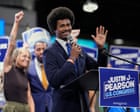
Inside the sanctuary of the New Direction Christian Church in Hickory Hill, more than a thousand citizens packed the pews until the air grew thick and heavy. They did not gather merely to mourn. They came to rally around Justin J. Pearson, the progressive Democratic state representative now running for a seat in Congress. The families of the deceased stood on the stage alongside him, their faces etched with the exhaustion of sudden grief.
Pearson stepped to the microphone. At 31, he possesses the rare, volcanic cadence of a classic Southern orator, a voice forged in the polluted industrial corridors of Southwest Memphis where he first cut his teeth as an environmental activist. He reminded the crowd that the current crisis was entirely predictable. When federal law enforcement surges were ordered into the city, local leaders warned that an influx of heavily armed, outside personnel lacking deep community roots would inevitably lead to tragedy.
Consider the geography of enforcement. The task force does not stage its massive traffic stops in the wealthy, manicured suburbs of Arlington or Collierville. Instead, convoys of state, federal, and local officers regularly assemble in the parking lots of the crumbling shopping malls and public schools right here in Hickory Hill. It is a hyper-targeted approach to policing that residents describe less as public safety and more as an occupying presence.
The political stakes are magnified by the timing of the crisis. Memphis is currently navigating a highly contentious primary election cycle, complicated by a rapid redistricting effort orchestrated by the state’s Republican-controlled General Assembly. The sudden redrawing of lines fractured the historic ninth congressional district, prompting the retirement of longtime Democratic Congressman Steve Cohen and creating a chaotic scramble for succession.
National progressive figures have recognized the broader implications of the Memphis primary. High-profile US Representatives Alexandria Ocasio-Cortez, Ayanna Pressley, and Summer Lee traveled to Tennessee to stand beside Pearson on the altar. They framed the local struggle as part of a continuous, century-long effort to secure basic civil liberties in the American South, explicitly drawing a line from the contemporary police surge back to the final, unfinished work of Dr. Martin Luther King Jr., who was assassinated in this very city nearly sixty years ago.
Yet, the immediate problem confronting local leaders is one of jurisdictional paralysis. Candidates vying for federal office face an agonizing truth: they are running to represent a community subjected to a federal presence they currently have no direct legislative power to halt. Local city council members and county commissioners find themselves writing letters and requesting meetings, while the armored vehicles continue to patrol the avenues.
There was a time when municipal leaders assured the public that National Guard units deployed to assist local police would remain completely unarmed, serving strictly in administrative or logistical support roles. That agreement evaporated quietly. Today, soldiers carry combat-grade firearms through civilian neighborhoods, operating under rules of engagement that remain opaque to the citizens they are ostensibly sent to protect.
A city cannot function when its people view the protectors as a threat, and it cannot heal when the basic facts of a human being's death are treated as a proprietary state secret.
The rally eventually ended, and the crowd spilled back out into the humid July heat of Hickory Hill. But a few miles away, the metal box at Fourth and Union remained fixed to its pole, staring blankly down at the pavement where Tyron Johnson took his final steps, holding a truth that the city is still terrified to look at.