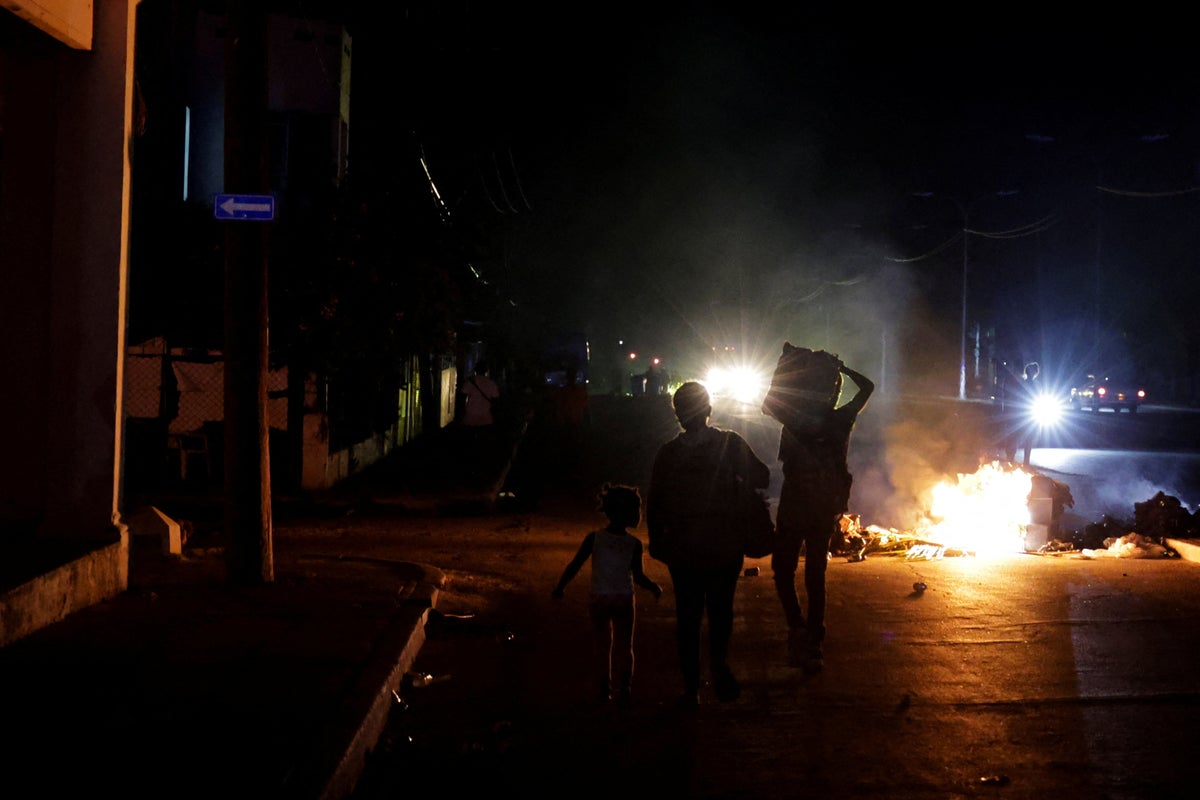
The mainstream press is currently obsessed with a ghost story. They want you to believe that Cuba’s grid is collapsing because Russia got bored and stopped sending tankers. They’ll point to the empty docks at Matanzas, whisper about "the end of the Russian lifeline," and tell you that without a benevolent sugar daddy in Moscow or Caracas, the lights simply have to go out.
They are wrong.
This isn’t a supply chain hiccup. It isn’t a temporary shortage. What we are witnessing is the terminal stage of a deliberate, decades-long refusal to understand the basic physics of energy economics. Cuba isn't "running out" of oil; it has spent forty years building a system designed to fail the moment it wasn't being subsidized by geopolitics.
If you want to understand why Havana is dark, stop looking at the shipping manifests. Start looking at the heat rate of the Guiteras power plant.
The Myth of the Russian Rug-Pull
The "lazy consensus" says Putin is punishing Diaz-Canel, or that Russia’s own war effort has drained their export capacity. This ignores the cold reality of the global oil market. Russia is desperate for buyers. They are selling discounted Urals to anyone with a hull and a pulse.
The problem isn't that Russia won't sell. The problem is that Cuba is broke.
I have watched dozens of emerging markets navigate supply shocks. The ones that survive have a functional internal economy that can absorb price volatility. Cuba has a museum piece for a grid. When the mainstream media laments the "lack of fuel," they ignore the fact that even if you gave the Cuban government a million barrels of light sweet crude today, their thermal plants are so degraded they would likely melt the boilers trying to process it.
The Guiteras Fallacy: Betting on Zombies
The Antonio Guiteras plant in Matanzas is often cited as the "heart" of the Cuban grid. In reality, it is a Frankenstein’s monster of Soviet-era engineering and desperate, duct-tape patches.
The fundamental misunderstanding in most reporting is that "energy" equals "fuel." In the real world, energy equals infrastructure plus efficiency.
- Heat Rate Neglect: Most modern combined-cycle plants operate at efficiencies that would make a Cuban engineer weep. Cuba’s plants are largely inefficient "kettle" style boilers. They require massive amounts of heavy fuel oil (HFO) to produce a fraction of the output of a modern facility.
- The Sulfur Trap: Because Cuba tries to burn its own domestic crude—which is essentially liquid asphalt—they have decimated their own hardware. This domestic oil has a sulfur content so high it eats the insides of the turbines.
- The Maintenance Debt: You cannot "maintain" a plant for 40 years without a capital expenditure budget. You are simply managing its decomposition.
When people ask, "Why can't Cuba just switch to renewables?" they are asking a flawed question. You cannot bolt a 21st-century solar array onto a 1950s transmission backbone that leaks 20% of its load before it even reaches a transformer.
The Sovereign Subsidy Addiction
For half a century, the Cuban energy strategy has been "find a patron."
First, it was the USSR. When that collapsed, they didn't modernize; they just waited for Hugo Chávez. When Venezuela’s production cratered, they looked back to Moscow. This isn't a national energy policy. It’s a panhandling circuit.
The "insider" truth that nobody wants to admit is that the Cuban government needs the energy crisis to be viewed as an external supply problem. If the crisis is caused by "The Embargo" or "Russian Pivot," the regime remains a victim of circumstance. If the crisis is admitted to be a total failure of centralized planning and a refusal to allow private capital into the energy sector, the regime is the architect of its own darkness.
I’ve seen this play out in Lebanon and South Africa. You don't fix a grid by finding a new supplier. You fix it by decentralizing. But decentralization is the one thing a command economy cannot survive. A citizen with their own solar panels and a Tesla Powerwall is a citizen who doesn't need to listen to a government broadcast.
The Real Cost of "Free" Electricity
One of the most destructive forces in Cuba isn't the lack of oil—it's the price of the kilowatt. For decades, the state has subsidized electricity to the point of absurdity. When something is "free," nobody invests in the efficiency of its delivery.
- Consumption without Correction: In a market economy, when supply drops, prices rise, and consumption falls. In Cuba, the price stays fixed until the system literally explodes.
- Zero Incentive for Upgrades: Why would a state-run utility optimize its turbines when there is no profit motive to do so?
The "People Also Ask" sections on search engines are filled with questions like: "Will the US lift the embargo to save the Cuban grid?"
That is the wrong question. The right question is: "Would lifting the embargo actually change anything?" The answer is a brutal no. American companies are not going to ship multi-billion dollar turbines to a country that has no mechanism to pay for them and a track record of nationalizing assets when the mood strikes.
The Floating Power Plant Scam
To stop the bleeding, Cuba has turned to Turkish "powerships"—giant floating generators moored off the coast. The media treats these as a clever temporary fix.
They are an economic disaster.
These ships charge a massive premium. You are paying for the fuel, the rent of the vessel, and the "risk premium" of docking in a country that is effectively insolvent. It is the energy equivalent of a payday loan. It keeps the lights on in Havana for a few more hours while draining the last of the country’s hard currency reserves. It is a transfer of wealth from the Cuban people to foreign corporations, all to avoid the "embarrassment" of a total blackout.
Why Solar Won't Save Them (Yet)
The "Green Consensus" argues that Cuba is a tropical paradise perfectly suited for solar. This is mathematically true but economically illiterate.
To transition a national grid to renewables, you need firming capacity. Since the sun doesn't shine at 9 PM, you need massive battery storage or fast-ramping gas peaker plants. Cuba has neither. Their grid is so unstable that the "frequency" of the electricity fluctuates wildly. If you try to dump massive amounts of intermittent solar power into a brittle, fluctuating grid, you don't get green energy. You get a catastrophic synchronization failure that fries the remaining transformers.
The Path to Sovereign Suicide
The tragedy isn't that Cuba is poor. The tragedy is that the energy crisis is being used as a shield to hide a rotting political structure.
Investors often ask me if there’s an "opening" in Cuba. I tell them the same thing: You don't invest in a house where the owner is currently burning the floorboards to stay warm. The "Russian Oil" narrative is a convenient distraction for both the Cuban government and its critics. It allows everyone to talk about tankers and geopolitics instead of talking about the fact that the Cuban state has failed in its most basic duty: maintaining the physical infrastructure of a functioning society.
Stop waiting for the next tanker. The tankers aren't the solution; they are the morphine for a patient with a terminal infection. Until the Cuban government allows for the private ownership of energy production and creates a transparent, market-based pricing system, the country will continue to flicker out.
The lights aren't going out because of a shortage in the Gulf of Mexico. They are going out because the centralized model has reached its physical limit.
Turn off the news. Watch the satellite imagery. The darkness tells you everything you need to know about the viability of the current regime.