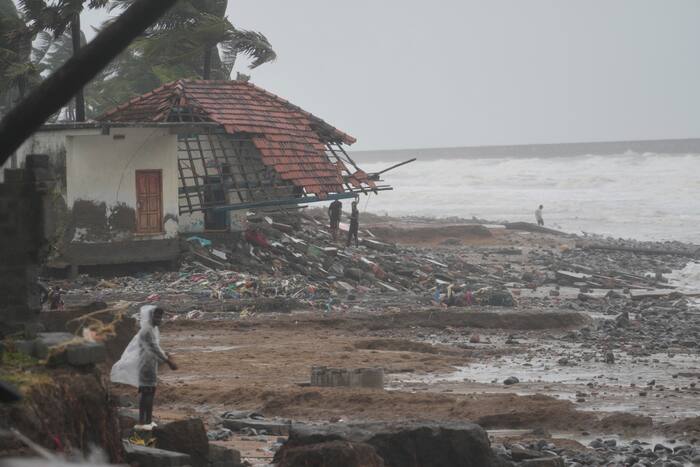
At least three people are dead, thousands of mud-and-thatch houses lie flattened, and acres of standing crops sit underwater after a severe cyclone slammed into eastern India. That headline reads like breaking news, yet if you've followed Bay of Bengal weather systems over the last decade, you've read this exact story before.
The real story isn't just the storm itself. It's why eastern India's coastal belt—stretching from Odisha through West Bengal and into Andhra Pradesh—suffers the exact same pattern of fatal collapses and agricultural wipeouts every single cyclone season, even when the India Meteorological Department (IMD) nails the landfall forecast days in advance.
The Anatomy of Cyclone Damage in Eastern India
When a cyclone makes landfall along the eastern coast, the wind gets all the TV cameras. Roofs flying off tin sheds make dramatic footage.
Wind isn't what kills most people or ruins the economy, though.
Storm surge and inland flooding do the heavy lifting. When low atmospheric pressure pushes a wall of seawater into low-lying river deltas—like the Mahanadi delta in Odisha or the Sundarbans in West Bengal—saltwater breaches earthen embankments within hours. Once those mud embankments give way, seawater pours over flat agricultural land where drainage is almost nonexistent.
In the immediate aftermath of a landfall that kills at least three people and wrecks local infrastructure, the fatalities almost always trace back to three predictable causes:
- Wall and roof collapses: Traditional kutcha houses built from mud, bamboo, and unreinforced brick absorb driving rain until their structural integrity vanishes.
- Falling trees and snapped power lines: Saturated soil loses its grip on shallow-rooted coconut palms and banyan trees, sending them crashing onto roads and tin roofs.
- Drowning in flash floods: Low-lying creeks swell rapidly when heavy rain collides with high tide, trapping residents who waited too long to reach cyclone shelters.
Most wire reports stop right there. They count the dead, list the number of evacuated villagers, and move on to the next news cycle. That leaves out the financial gut punch that lasts for years after the floodwaters recede.
Why Farmland Takes Years to Recover
If you lose a concrete wall, you can rebuild it in a month once the cement dries. If seawater floods your paddy field, your livelihood is dead for up to three crop cycles.
Eastern India is the rice bowl of the region. Farmers in coastal districts rely heavily on the kharif (monsoon) harvest, which sits right in the crosshairs of post-monsoon cyclones between October and December. When a storm hits right before harvest, high winds lodge the stalks flat into the mud. Even freshwater rain causes the submerged grain to rot or germinate prematurely on the stalk.
Salinity makes the problem ten times worse.
When storm surge pushes brackish water inland, sodium chloride binds to the clay particles in the soil. You can't just pump the water out and plant seeds the next week. High soil salinity stunts root growth, blocks nutrient uptake, and turns fertile alluvial soil into a crusted, barren flat. Agricultural extension workers in coastal West Bengal and Odisha routinely advise farmers to flush fields with freshwater—which depends entirely on the next monsoon—and apply heavy doses of gypsum to neutralize the sodium.
For a smallholder farmer operating on less than two acres, waiting a full year for the soil to heal isn't a minor inconvenience. It's an immediate debt trap. Many end up borrowing from informal moneylenders at brutal interest rates just to buy seeds for the next season, only to face another depression forming in the Bay of Bengal twelve months later.
What Early Warnings Still Can't Fix
Give credit where it's due. India's disaster management apparatus has transformed since the 1999 Odisha super cyclone killed roughly 10,000 people. Today, the IMD tracks cyclones with pinpoint accuracy, and the National Disaster Response Force (NDRF) pre-positions teams before the first outer rainbands even touch the coast.
So why do people still die, and why do homes still crumble?
Because evacuation orders only save lives if people actually leave their property—and many refuse until the last possible second. If you're a farmer or a daily-wage laborer, your entire net worth is tied up in two cows, a few goats, and fifty sacks of harvested grain stored in your house. Multipurpose cyclone shelters built across Odisha and West Bengal rarely have enough space for livestock. Leaving your house means gambling that looters or floodwaters won't wipe out everything you own.
Then there's the housing gap. While government schemes have funded thousands of concrete pucca houses along the coast, millions of families still live in semi-permanent structures. Tin sheets nailed onto wooden rafters turn into lethal projectiles in 100 km/h gusts. Unanchored brick walls without reinforced concrete columns buckle under lateral wind pressure.
What Most People Get Wrong About Bay of Bengal Cyclones
There's a common misconception that only "Super Cyclones" with 200 km/h winds cause real devastation. That's completely false.
A slow-moving cyclonic storm with 90 km/h winds can dump 300 millimeters of rain in 24 hours. Slow storms linger over the coast, pounding weakened embankments through two consecutive high tides. In fact, moderate cyclones frequently cause worse agricultural losses than fast-moving severe storms because they stall over river basins and drown standing crops for days.
Another myth is that concrete embankments permanently solve coastal flooding. Hard engineering works until a storm surge overtops the wall—at which point the concrete barrier actually traps the seawater inland, preventing it from draining back into the ocean when the tide drops.
Practical Steps for Coastal Residents and Relief Planners
Surviving the next Bay of Bengal cyclone—and protecting property from turning into another casualty statistic—comes down to practical preparation long before a low-pressure system forms on satellite imagery.
If you live or manage property in a cyclone-prone coastal district, focus on structural weak points first. Retrofitting an existing home doesn't require tearing it down. Anchor roof trusses directly into load-bearing walls using galvanized iron straps rather than relying on gravity and simple nails. Replace loose asbestos or corrugated tin sheets with reinforced concrete slabs wherever budgets allow, or secure metal sheets with heavy-duty J-bolts and rubber washers at every ridge.
For farmers protecting land and livestock, preparation starts before cyclone season peaks:
- Elevate grain storage: Move harvested paddy and seed stock onto raised wooden platforms or sealed plastic drums at least four feet above historical flood levels.
- Adopt salt-tolerant rice varieties: Institutions like the ICAR-National Rice Research Institute (NRRI) in Cuttack have developed flood- and salt-tolerant cultivars like Swarna-Sub1 and Luna Suvarna that survive submergence far better than traditional hybrids.
- Pre-register livestock with local panchayats: Identify higher-ground community shelters that accept cattle before a storm warning hits, so you aren't making life-or-death decisions in 80 km/h winds.
When the IMD issues a red alert for your district, pack waterproof bags with identification papers, land deeds, essential medicines, and dry rations at least 24 hours before projected landfall. Disconnect main electrical breakers and turn off LPG cylinders before walking out the door. Once the eye of the storm passes, stay inside—the calm lasts anywhere from ten minutes to an hour before the eyewall hits from the exact opposite direction with full force.


