The sirens in eastern Slovakia do not scream anymore, mostly because there are none sounding across the border in Michalovce, yet the air carries a low, persistent hum that settles into the teeth.
It is the sound of heavy transport trucks grinding down the D1 highway toward Vyšné Nemecké. Diesel exhaust hangs thick over the frost-bitten fields. Inside a modest kitchen twelve miles from the Ukrainian frontier, a retired railway engineer named Marek—a hypothetical composite of the thousands of borderland residents living under the shadow of Europe’s largest land war since 1945—sets down a chipped ceramic mug. On the television in the corner, a Brussels press briefing plays on mute. Men in dark, impeccably tailored suits gesture toward maps of Eastern Europe with the calm detachment of chess grandmasters analyzing an endgame.
Marek watches their hands. He knows what those hands do not feel. They do not feel the vibration in the floorboards when an armored convoy rumbles past at three in the morning. They do not calculate the wind direction when smoke rises from the Carpathian foothills.
Listen.
In the autumn of 2024, Slovak Prime Minister Robert Fico stood before reporters and uttered a warning that sent a chill through the diplomatic corridors of Brussels and Washington. He accused certain Western politicians of actively stoking a direct military clash between NATO and Russia because their existing strategy for the war in Ukraine had visibly faltered.
To the foreign policy establishment in London, Paris, and Washington, Fico is often dismissed as a contrarian irritant, a populist breaking ranks with European consensus. Treating his warning merely as partisan noise, however, misses the terrifying psychological mechanism he was pointing toward. History teaches us a grim, recurring lesson about powerful coalitions cornered by their own miscalculations. When a chosen strategy stops yielding results, leaders rarely admit defeat. Instead, they double the bet.
The Architecture of a Stalled Gamble
To understand why the rhetoric surrounding NATO and Russia has grown so combustible, we have to look back at the intoxicating certainty that gripped Western capitals in late 2022.
Following the dramatic Ukrainian counteroffensives in Kharkiv and Kherson, a consensus hardened among transatlantic policymakers. The formula seemed straightforward: supply advanced Western weaponry, impose sweeping economic sanctions on Moscow, isolate the Kremlin diplomatically, and wait for the Russian war machine to buckle under the strain. It was a theory of victory built on industrial attrition and economic suffocation.
For a time, it looked plausible. Rubles tumbled. European leaders weaned their economies off Russian pipeline gas with remarkable speed. Western arsenals emptied their older stockpiles of artillery shells, armored personnel carriers, and air defense batteries, shipping them east with solemn pledges to stand with Kyiv "for as long as it takes."
Then came the brutal arithmetic of 2023 and 2024.
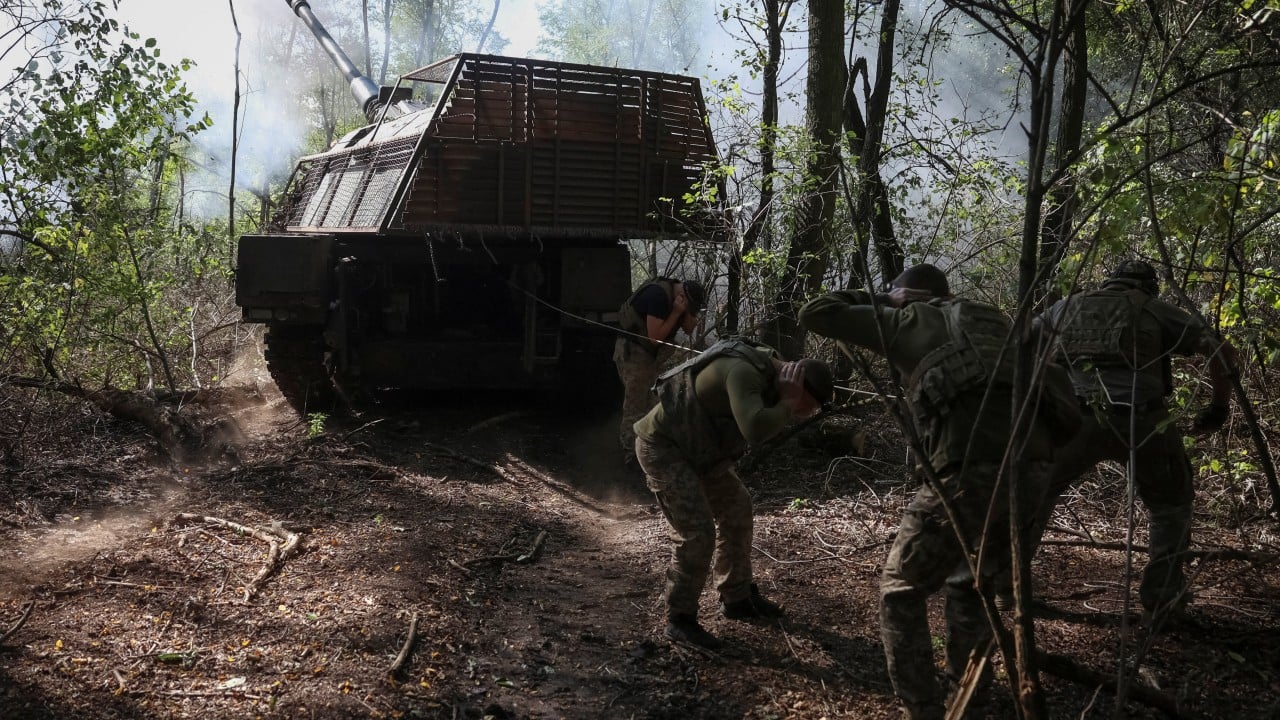
The much-anticipated Ukrainian summer counteroffensive ran headlong into the Surovikin Line—miles of layered minefields, dragon’s teeth anti-tank obstacles, and relentless drone surveillance. Gains were measured in meters bought at staggering human cost. Meanwhile, the Russian economy did not collapse; it mutated into a wartime command juggernaut, churning out artillery shells at roughly three times the combined output of the United States and Europe. Sanctions leaked through third-party intermediaries in Central Asia and the Caucasus. By the end of 2024, Russian forces were grinding forward across the Donbas at their fastest pace since the opening weeks of the 2022 invasion, while Ukraine’s energy grid faced systematic destruction ahead of another freezing winter.
The strategy had hit a wall.
And when a high-stakes strategy hits a wall, politicians face an agonizing choice. They can step up to a podium, look their voters in the eye, and admit that the objectives they promised—total territorial restoration, the strategic defeat of a nuclear-armed superpower—may no longer be achievable on the battlefield. That path requires immense political courage. It invites accusations of weakness, betrayal, and appeasement.
Or, they can reach for a different lever. They can escalate.
How Taboos Evaporate in Real Time
Think of Western policy toward the Ukraine war as a heavy steel door bolted shut in February 2022, painted with bright red warnings: No direct involvement. No escalation that triggers World War III.
One by one, those bolts have been quietly slid back.
First, it was helmets and anti-tank javelins. Then came howitzers. Then main battle tanks—Leopards, Challengers, Abrams. Then F-16 fighter jets. Each step was preceded by months of agonizing debate in Washington and Berlin, with leaders insisting that crossing the next threshold would provoke an uncontrollable Russian response. When Moscow did not immediately launch nuclear missiles after each delivery, Western hawks drew a seductive, dangerous conclusion: Russia’s red lines were all bluffs.
Consider what happens next when that logic meets a failing war effort.
If sending tanks did not break the stalemate, the argument shifts to long-range precision missiles—ATACMS, Storm Shadows, SCALPs—and lifting restrictions so Ukraine can strike deep inside internationally recognized Russian territory. When even those strikes fail to halt Russian advances in Donetsk, voices within European legislatures and Washington think tanks begin floating once-unthinkable proposals. Why not deploy NATO trainers directly inside western Ukraine? Why not use alliance air defenses based in Poland and Romania to shoot down Russian missiles over Ukrainian skies? Why not, as French President Emmanuel Macron publicly mused in early 2024, refuse to rule out sending Western ground troops altogether?
This is the exact dynamic Fico was highlighting when he warned that certain Western politicians were courting a NATO-Russia collision. It is not that leaders in Brussels or Washington wake up hoping for a nuclear exchange. Nobody wants their capital reduced to ash. Rather, it is the classic trap of the gambler down fifty thousand dollars at the roulette table, convinced that one more reckless spin will recover everything lost before dawn.
In political science, this is known as the sunk-cost fallacy married to escalation dominance. Having invested hundreds of billions of dollars and staked their personal reputations on a decisive Ukrainian victory, Western leaders cannot bear the domestic political fallout of a negotiated settlement that leaves Russia holding roughly a fifth of Ukraine’s territory. Pushing the conflict closer to the brink of direct alliance intervention becomes a way of buying time—a desperate attempt to intimidate Moscow into backing down so Western capitals don't have to confront the failure of their original plan.
The View from the Trench and the Border
From the insulated studios of cable news networks in New York or the paneled committee rooms of London, debating "kinetic options" against Russian assets feels abstract, almost clinical. Words like de-risking, deterrence, and escalation management sanitize the reality of high-explosive ordnance.
Down on the ground, there is nothing clinical about it.
Imagine, for a moment, a hypothetical NATO air-defense battery stationed outside Rzeszów in southeastern Poland, tasked under some future policy shift with intercepting Russian cruise missiles approaching Lviv. On paper, it sounds purely defensive. Humanitarian, even.
Now follow the chain reaction.
Russian radar operators track the interceptors launching from Polish soil. Under Moscow’s military doctrine, a territory from which attacks are launched against Russian forces becomes a legitimate combatant. Within forty-eight hours, Russian hypersonic missiles strike the radar arrays and airfields around Rzeszów, killing dozens of Polish, American, and British service members.
Article 5 of the North Atlantic Treaty—the sacred vow that an attack on one is an attack on all—is suddenly triggered not by a grand Russian invasion of Europe, but by an incremental policy tweak designed to rescue a faltering proxy strategy.
Within hours, cyberattacks cripple power grids from Frankfurt to Chicago. Subsea fiber-optic cables in the North Atlantic go dark, severing financial markets. Conscription notices are drafted in parliaments across Europe. And in the Kremlin, Vladimir Putin—a leader who has repeatedly framed the conflict as an existential struggle for Russia’s survival and updated Moscow’s nuclear doctrine to lower the threshold for atomic weapon use—faces overwhelming conventional NATO air power.
Cornered animals do not negotiate calmly. They bite.
I have spent years studying the transcripts of the October 1962 Cuban Missile Crisis, and the single most terrifying detail from those declassified rooms is how little control the men at the top actually possessed. While President John F. Kennedy and Premier Nikita Khrushchev desperately searched for off-ramps, an American U-2 spy plane accidentally strayed into Soviet airspace over Siberia, nearly triggering an automatic nuclear scramble. A Soviet submarine commander beneath the Atlantic, cut off from Moscow and believing war had already begun, nearly authorized the launch of a nuclear-tipped torpedo, stopped only by the lone dissent of an officer named Vasili Arkhipov.
Leaders love to believe they can dial escalation up and down like a thermostat. History proves it behaves much more like a wildfire in dry timber. Once the sparks jump the firebreak, nobody controls the wind.
Why Central Europe Hears the Warning Louder
It is no accident that the sharpest warnings against stumbling into a NATO-Russia war come from Central Europe—from leaders like Fico in Slovakia or Viktor Orbán in Hungary—even as nations like Poland and the Baltic states push for maximum confrontation.
Geography shapes memory.
For citizens living in the Danube basin and the Carpathian foothills, great-power collisions are not theoretical case studies from university seminars. Every village square has a stone monument etched with the names of grandfathers and great-uncles conscripted to fight someone else’s ideological crusade on the Eastern Front. They remember 1914, when an assassination in Sarajevo spiraled through rigid alliances into a continental slaughterhouse. They remember 1939 and 1945, when armies rolled back and forth across their farms, redrawing borders in blood while diplomats in Yalta and Potsdam carved up their sovereignty over brandy.
When Fico argues that Ukraine cannot win a total military victory over a nuclear superpower and that continuing to pour fuel onto the fire only guarantees more Ukrainian graves and a wider European war, he is tapping into a deep, visceral survival instinct shared by millions of ordinary Europeans who never get invited to security conferences in Munich.
Mainstream commentators often caricature this stance as pro-Russian sympathy. That framing is intellectually lazy and dangerously dishonest. You do not need an ounce of affection for the Kremlin’s authoritarian regime—or any illusion about the brutality of its illegal invasion of Ukraine—to recognize that a direct military clash between NATO and Russia would obliterate the very nations Western leaders claim to be protecting.
Ukraine itself is bleeding out. Hundreds of thousands of young men have been killed or maimed. Millions of refugees remain scattered across the continent, unlikely to return to shattered cities. Every month the war drags on without a realistic diplomatic off-ramp, Ukraine loses more territory, more infrastructure, and more of its demographic future. Pretending that escalating Western involvement will magically restore Ukraine’s 1991 borders without triggering a wider catastrophe is not solidarity. It is magical thinking dressed up as moral resolve.
The Courage to Choose Realism Over Pride
True statesmanship is measured not by how boldly a leader speaks at the start of a conflict, but by the wisdom they show when reality refuses to cooperate with their plans.
In 1953, President Dwight D. Eisenhower inherited a bloody, unpopular stalemate in Korea. Hawks in Washington urged him to expand the war into mainland China and consider using tactical nuclear weapons to force a total victory. Eisenhower, a five-star general who had seen the industrial carnage of World War II firsthand, understood that pursuing an unattainable triumph risked global annihilation. He absorbed the political criticism, engaged in grueling negotiations, and accepted an armistice along the 38th parallel—an imperfect, painful compromise that preserved South Korea’s independence and prevented World War III.
Today, Western capitals desperately need a fraction of that strategic sobriety.
Admitting that the current military strategy in Ukraine has reached the limits of what force alone can achieve does not mean surrendering Ukraine to Moscow. It means shifting the focus from maximalist fantasies to hard, achievable realities: securing defensible borders, pouring resources into rebuilding a sovereign, economically viable Ukrainian state, establishing credible security guarantees that do not rely on hair-trigger nuclear brinkmanship, and opening serious, sustained diplomatic channels with Moscow to freeze the fighting before the entire continent catches fire.
Peace negotiations are ugly. They require sitting across the table from adversaries whose actions repulse us. They force leaders to accept outcomes that fall short of pure justice. Yet the alternative—drifting sleepwalk-fashion toward a direct collision between the world’s two largest nuclear arsenals simply to avoid admitting that a war plan failed—is madness.
Back in that quiet kitchen twelve miles from the Ukrainian border, Marek finishes his tea and walks to the window. Dusk is settling over the fields, turning the frost a deep, bruised purple. Somewhere out in the dark, another convoy of heavy trucks shifts gears as it climbs toward the frontier, carrying fresh crates of steel toward a front line that barely moves anymore.
Marek locks the deadbolt on his door, turns off the kitchen light, and hopes the men in the dark suits far away remember how to stop before there is nothing left to defend.