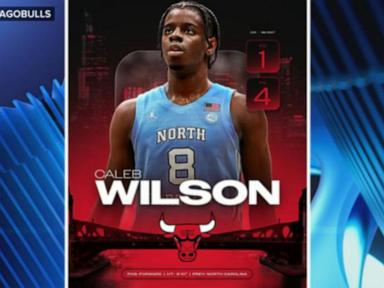
When Caleb Wilson stood at the podium after the Chicago Bulls selected him fourth overall in the 2026 NBA Draft, he did not just embrace the franchise history. He challenged it. By telling reporters he intends to be the greatest player of all time and openly referencing Michael Jordan, the nineteen-year-old forward from North Carolina chose the heaviest mantle in professional sports. History shows that claiming the crown in Chicago is a psychological trap. While sports media ran with the soundbite as an internet-ready video clip, the structural reality facing Wilson and the Bulls requires a far more clinical evaluation.
Ambition is a cheap commodity on draft night. The reality that follows is expensive. Wilson is stepping into an organization undergoing an existential overhaul under a new front office led by Bryson Graham and a first-year head coach in Tiago Splitter. The franchise is attempting a complete retooling after a series of desperate trade deadline deals. To believe that a lone teenager can heal decades of institutional stagnation simply through competitive fire is to ignore how modern basketball franchises succeed or fail.
The Haunting Ground of United Center
Every lottery pick drafted by Chicago walks past a nine and a half foot bronze statue of Jordan before they ever check into a game. The shadow has warped the franchise for thirty years. It creates an environment where incremental progress is treated as failure and grand declarations are required to appease a cynical fanbase.
Look at what happened to the players who came before him. Elton Brand was shipped out despite averaging twenty points and ten rebounds. Derrick Rose carried the burden until his knees collapsed under the structural weight of an entire city's expectations. Even recent stars like Zach LaVine found that scoring efficiency means little when the surrounding roster is a poorly constructed patchwork. The city does not want good players. It demands a savior.
Wilson is uniquely suited to feed this hunger because of his pedigree. He is the third Tar Heel selected by the Bulls in the first round, following Jordan in 1984 and Coby White in 2019. The superficial connections are obvious, but the differences in their respective eras are vast. Jordan arrived at a time when an individual force could alter the entire competitive framework of the league through sheer scoring volume. The modern game does not work that way. A modern forward requires elite spacing, a functional playmaking apparatus, and a front office capable of managing the salary cap with surgical precision.
The Medical Reality Behind the Hype
Scouts are enamored with Wilson's physical profile. At six feet ten inches and 215 pounds, he possesses the length of a traditional center and the defensive agility of a wing. His lone season in Chapel Hill yielded stellar raw numbers, with averages of 19.8 points, 9.4 rebounds, 1.5 steals, and 1.4 blocks per game. He led the college basketball ranks with 66 dunks.
A closer look at his freshman season reveals a significant red flag. His year ended prematurely due to two separate skeletal injuries.
He suffered a fractured left hand during a game against Miami in February. While attempting to work his way back for the regular-season finale against Duke, he suffered a fractured right thumb during a non-contact dunking drill in practice. Two hand fractures on separate limbs within a two-month span suggest a physical vulnerability that cannot be ignored. The team claims these are freak, non-contact or impact occurrences that will not impact his NBA debut, but hand strength and skeletal durability are essential for a player whose game relies entirely on aggressive finishing and defensive paint disruption.
The physical transition to the professional level will test his durability immediately. The professional regular season is an eighty-two-game grind against fully matured athletes. If Wilson's aggressive, physical style remains unrefined, his tendency to seek out violent contact at the rim could turn him into a frequent occupant of the injury report rather than an MVP candidate.
The Roster Fit and the Spacing Problem
The front office has spent the last several months assembling an eclectic group of young talent, but the pieces do not fit together like a finished puzzle. They resemble an experimental laboratory.
Wilson joins a young core that includes forward Matas Buzelis, point guard Josh Giddey, and last year's lottery selection, Noa Essengue. To protect the rim, Chicago secured a commitment from veteran center Nic Claxton. On paper, this is an athletic, switchable, and lengthy defensive unit. In execution, the half-court offense could look like a crowded train car.
Consider the shooting limitations. Wilson shot 57.8% from the field at North Carolina, but his production was heavily concentrated around the restricted area. His jump shot remains an unpolished work in progress. Josh Giddey is a brilliant passer whose perimeter shot remains a liability that defenses routinely exploit by sagging into the lane. Nic Claxton offers virtually zero offensive utility outside of five feet from the basket.
If Splitter deploys a lineup featuring Giddey, Wilson, and Claxton simultaneously, opposing defenses will compress the floor. They will dare the Bulls to shoot from the perimeter. This creates a statistical paradox. Wilson needs an open runway to utilize his elite athleticism and finishing ability, yet the current roster construction threatens to clog the exact lanes he must occupy to thrive.
The success of this rebuild hinges entirely on player development rather than draft day hype. If Wilson cannot develop a reliable catch-and-shoot game from the corners, or if the coaching staff cannot extract league-average perimeter shooting from Buzelis and Giddey, this offense will stall in the half-court. High-end journalism requires acknowledging that intent does not create space on a basketball court. Arithmetic does.
The Cult of the Violent Competitor
Those who believe Wilson will succeed point to his emotional baseline. He is not a passive prospect content to collect a rookie-scale paycheck. He plays with an edge that scouts describe as combative. He plays to humiliate his matchup, using emphatic blocks and transition finishes to dictate the emotional tone of the game.
The Bulls have lacked this internal friction for years. They have fielded talented rosters that dissolved under pressure because they lacked a vocal leader willing to hold teammates accountable. Wilson has the personality to fill that void. He invited his former college coach, Hubert Davis, to sit with him in the green room on draft night, a gesture that spoke to a deep sense of loyalty and coachability despite his brash public persona.
This hyper-aggressive mindset can cut both ways in professional sports. In college, a 6-foot-10 athlete can recover from an out-of-position gamble through pure athletic superiority. In the professional ranks, elite guards will use that aggression against him. They will use pump fakes, heavy hesitation moves, and sophisticated pick-and-roll designs to draw him into early foul trouble. Wilson must learn the difference between controlled intensity and reckless abandon.
The Broken Blueprint of Modern Rebuilds
The modern sports media landscape thrives on the narrative of the singular star. It is an easy story to sell. It builds engagement, sells jerseys, and fills arenas. The truth of team building is far more tedious.
The franchises that have won titles over the last decade did not do so because a single lottery pick arrived and willed them to victory. They succeeded because they spent years accumulating draft capital, identifying undervalued role players, and maintaining maximum financial flexibility. The Oklahoma City Thunder and Boston Celtics did not draft a savior; they built an infrastructure.
Chicago has historically struggled with infrastructure. The previous front office regime repeatedly traded future draft assets for veteran players who raised the team's floor to mediocrity while lowering its ceiling to a first-round exit. The current management group has corrected course by embracing a youth movement, but they are starting from a deficit. They do not have a surplus of future first-round picks to weaponize in trades. They must hit on every single development project.
Wilson is a high-ceiling prospect, but he is entering an environment where the margin for error is razor-thin. If he is forced to carry an offensive load that he is not yet skilled enough to handle, his efficiency will crater. His confidence could turn into frustration. The greatest danger facing the Bulls is that they treat Wilson as a finished product rather than a developmental project who needs to learn how to read secondary defensive rotations and execute weak-side help principles.
The Work That Remains
The draft night video will fade from the news cycle within forty-eight hours. The Summer League games in Las Vegas will offer a brief, distorted glimpse of his capabilities against fringe professional talent. The real work begins in October when the lights turn on at the United Center and the ghost in the rafters watches another young man try to recreate a past that is never coming back.
Caleb Wilson has the physical tools to be an exceptional professional basketball player. He has the length, the instinct, and the motor to become an All-Defensive team regular and a dynamic transition scorer. But he is not Michael Jordan, and he will not save the Chicago Bulls by pretending to be. The franchise will only return to relevance when it stops looking for another version of No. 23 and starts building a basketball team designed for the decade ahead. Wilson needs to stop looking up at the banners and start looking down at the defensive tape. That is where greatness is actually constructed.