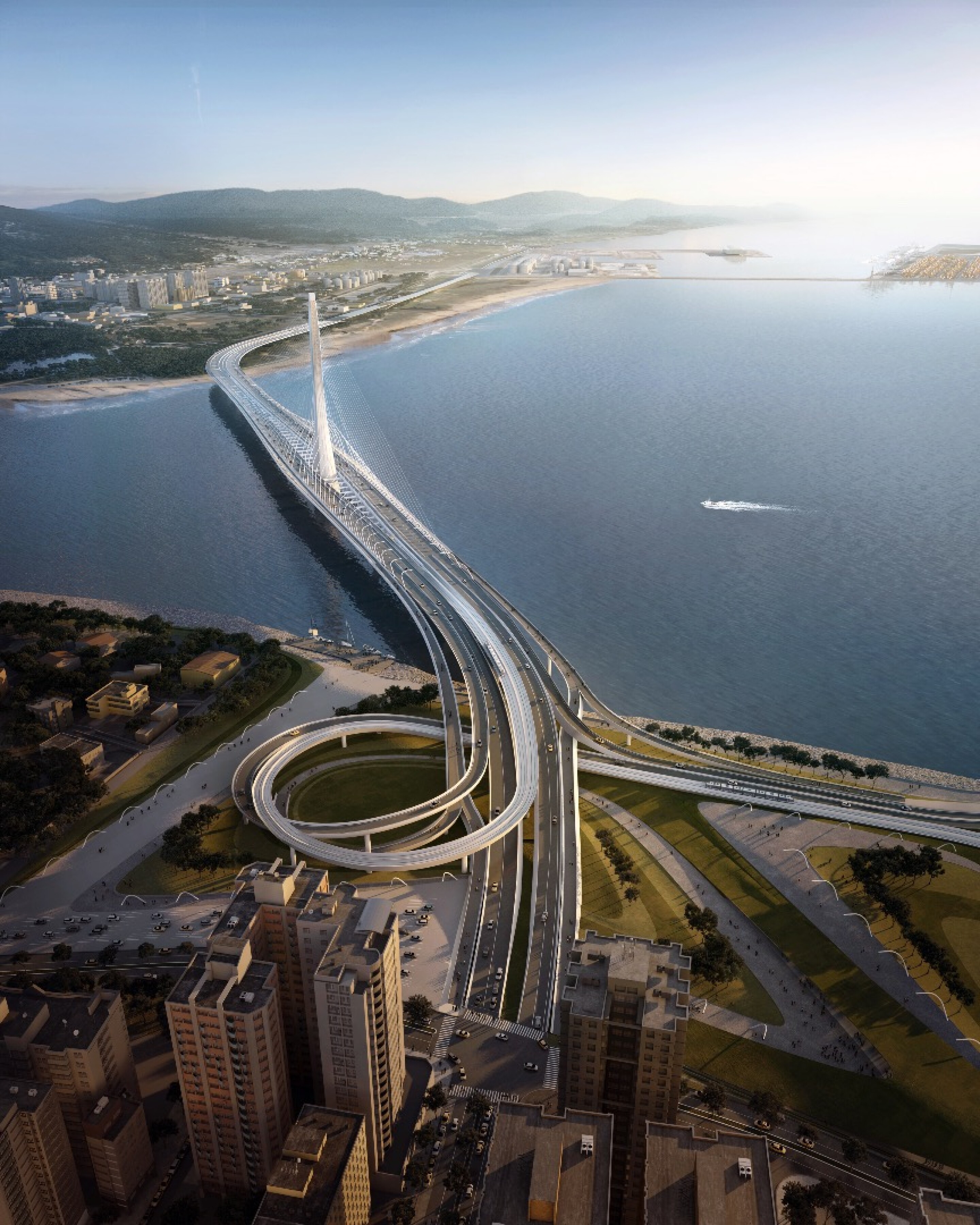
Civil engineers are currently swooning over Zaha Hadid Architects’ latest marvel in Taiwan. The headlines scream about the Danjiang Bridge being the world’s longest single-mast, asymmetric cable-stayed bridge. They celebrate the $1.1 billion price tag and the sleek, flowing curves that mimic the movement of the Tamsui River.
They are celebrating a monument to inefficiency. Recently making headlines lately: The Ghost in the Cockpit and the Long Wait for the Perfect Strike.
While the architectural community pats itself on the back for "minimizing visual impact" and "preserving the sunset," the reality of massive infrastructure is much uglier. We have entered an era where we prioritize aesthetic gymnastics over logistical utility. The Danjiang Bridge is a textbook example of solving a simple problem with the most expensive, complex geometry possible just to win an award.
The Asymmetry Trap
Most cable-stayed bridges use two pylons for a reason. Physics likes symmetry. Gravity is predictable. When you choose an asymmetric, single-mast design, you aren't just making a "bold statement." You are intentionally fighting the fundamental forces of tension and compression. Further insights into this topic are detailed by Ars Technica.
By anchoring the entire 920-meter span to a single 200-meter-tall mast, the engineering team had to compensate for massive torsional forces. To keep that single pylon from buckling under the lopsided weight of the deck, they had to pump in staggering amounts of reinforced concrete and high-tensile steel.
In bridge building, complexity equals risk. I have seen projects where "innovative" cable configurations led to maintenance nightmares within a decade. The more you deviate from a balanced design, the more you rely on active dampening and hyper-specific tensioning that requires constant, specialized monitoring. We aren't building a bridge; we are building a high-maintenance sculpture that happens to carry cars.
The Sunset Fallacy
The primary justification for the single-mast design was to protect the "famous Tamsui sunset." Proponents argued that a traditional multi-pylon bridge would block the view for tourists on the shore.
Think about that for a second. We spent hundreds of millions in additional engineering costs and material waste so that a few thousand people a year wouldn't have to look at a thin concrete pillar through their camera lenses.
This is what I call "The Boutique Infrastructure Crisis." When aesthetic preservation dictates the structural DNA of a transit project, taxpayers lose. A standard suspension bridge or a dual-pylon cable-stayed bridge would have been faster to build, cheaper to maintain, and arguably just as functional. Instead, Taiwan chose a design that forces the cables to fan out in a way that creates a massive "wall" of steel when viewed from certain angles—actually obstructing more of the horizon than two simple, vertical pillars ever would.
Logistics vs. Optics
The Danjiang Bridge is supposed to "link" the Bali and Tamsui districts, cutting travel time by 25 minutes. On paper, that sounds great. In practice, the bridge is a band-aid on a hemorrhaging wound.
Traffic congestion in Northern Taiwan isn't caused by a lack of bridges; it’s caused by a failure in urban density management. By building a massive six-lane highway across the river, we are simply inviting more cars into the bottleneck. This is Induced Demand 101.
If we were serious about regional connectivity, that $1.1 billion would have gone into expanding the Danhai Light Rail or creating high-frequency autonomous transit corridors. Instead, we built a shiny new funnel. We are using 21st-century architectural software to solve a 20th-century problem that we already know shouldn't be solved with more asphalt.
The True Cost of "World Firsts"
The "world's longest" tag is a marketing gimmick. It serves the ego of the designers and the political standing of the administration, but it does nothing for the structural integrity or the commuter's experience.
When you aim for a "world first" in bridge length for a specific sub-category (like "asymmetric single-mast"), you are essentially looking for the most difficult way to cross a river. The engineering required for the $L_{span}$ to reach its 450-meter main section without a second support pylon involves a massive structural depth in the deck itself.
$$T = \frac{mg}{2\sin(\theta)}$$
As the angle $\theta$ of the stay cables decreases to reach those long spans from a single point, the tension $T$ increases exponentially. This necessitates thicker cables, heavier anchors, and a deeper pylon foundation. We are paying a "complexity tax" on every single bolt and cable.
Maintenance is the Silent Killer
The industry never talks about the "legacy debt" of these bridges.
- Cable Vibration: Single-mast bridges are notoriously sensitive to wind-induced vibrations.
- Structural Creep: The asymmetric loading means the pylon will experience uneven "creep" over fifty years, requiring incredibly precise (and expensive) adjustments to the cable tension.
- Corrosion: The more complex the cable junctions, the harder it is to inspect for the micro-cracks that lead to catastrophic failure.
I’ve sat in meetings where the O&M (Operations and Maintenance) teams are told to "figure it out later" while the architects celebrate the groundbreaking ceremony. We are leaving a multi-billion dollar bill for the next generation, all because we wanted a bridge that looks like a "gliding bird."
The Wrong Question
People ask: "Is the Danjiang Bridge a feat of engineering?"
The answer is yes. It is a miracle that it stands at all.
But the question they should be asking is: "Why are we still using bridges as trophies?"
We need boring infrastructure. We need bridges that are invisible because they are so efficient and cost-effective that the leftover budget can be used to actually fix the schools and hospitals on either side of the river.
The Danjiang Bridge is a beautiful, expensive mistake. It proves we can bend steel and concrete to our will, but it also proves we have no idea how to prioritize utility over vanity. Stop applauding the complexity. Start demanding the sensible.
Build the bridge. Save the billion dollars. Move on.