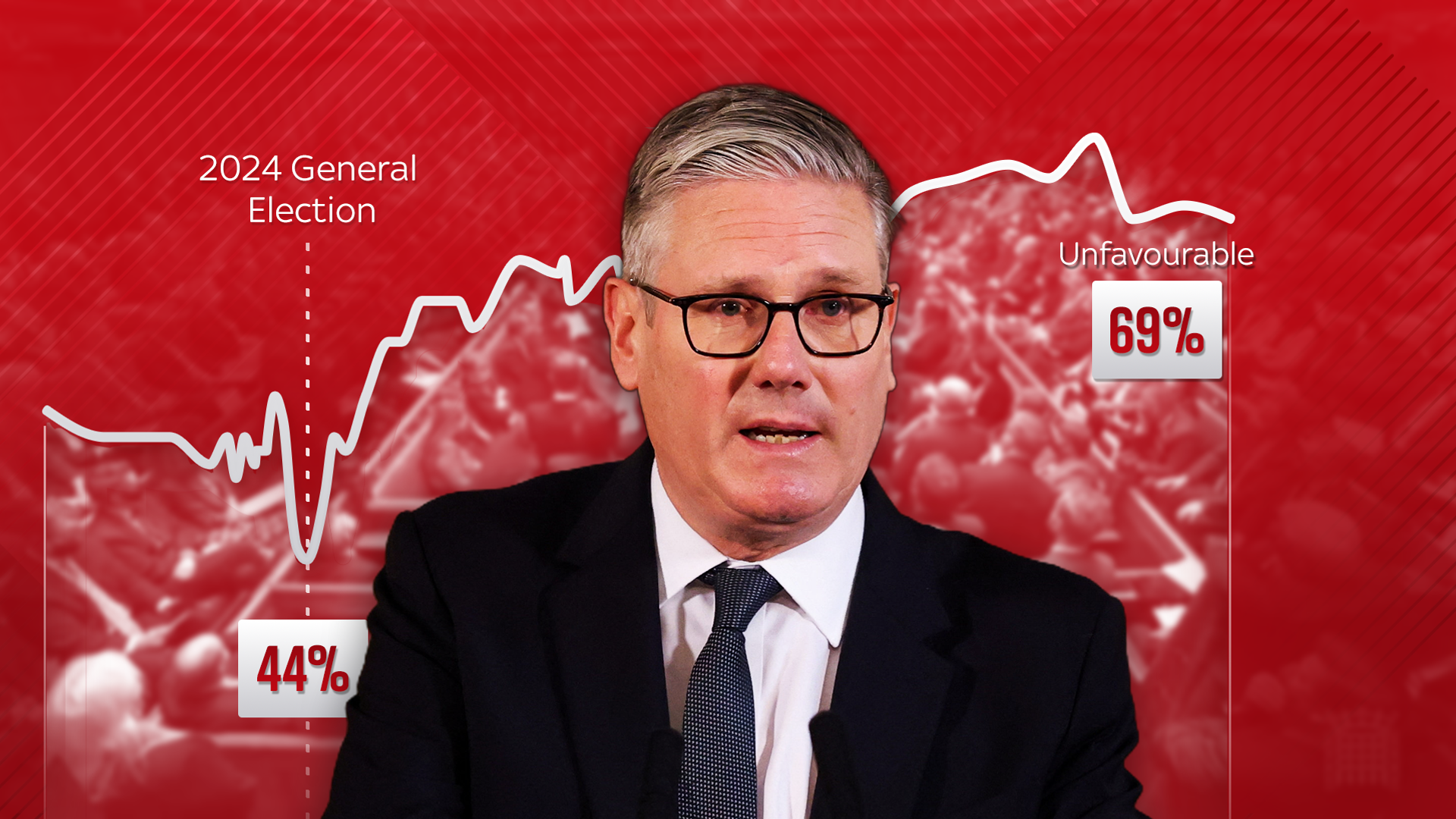
Keir Starmer isn't just fighting a political battle; he's fighting a mathematical one. If you look at the raw numbers coming out of the polling firms and government departments this week, it's clear why the whispers of a leadership challenge have turned into a roar. Voters feel let down. The "change" promised on the campaign trail has, for many, shifted into a sense of stagnation. When you strip away the spin from Number 10, the data reveals a government that has lost its honeymoon period faster than almost any in modern British history.
The pressure isn't coming from a single scandal. It’s a cumulative weight. We’re seeing a synchronized drop across economic confidence, NHS performance metrics, and personal trust. People don't just think the government is doing a bad job; they think it’s doing the same job as the last one, and that’s a death knell for a party that ran on being different.
The polling collapse that should terrify Labour
Looking at the latest YouGov and Ipsos trackers, the trend line for Starmer’s personal approval rating looks like a ski slope. In the immediate aftermath of the election, he enjoyed a net positive rating that suggested the public was willing to give him time. That grace period is over. As of mid-May 2026, his net approval has plummeted into the negative thirties. To put that in perspective, he's now polling worse than some of his predecessors did during their most chaotic months.
It isn't just that people dislike him. It's who dislikes him. The data shows a significant "voter's remorse" among those who switched from Conservative to Labour. These "hero voters" are the ones who decide elections. According to recent demographic breakdowns, over 40% of those who switched to Labour in 2024 now say they would vote for a different party—or not vote at all—if an election were held tomorrow.
The rise of Reform UK and a stabilized Conservative opposition means the "efficiency" of the Labour vote is evaporating. Starmer is being squeezed from both sides. On the left, there's frustration over the refusal to scrap the two-child benefit cap. On the right, the perceived failure to "stop the boats" or secure the borders is driving former supporters back toward Nigel Farage’s camp. The math doesn't lie: Starmer’s coalition is fracturing.
Why the economic data is hurting the Prime Minister
The Treasury keeps talking about "long-term foundations," but the public lives in the short term. Real wages have struggled to keep pace with the lingering effects of the previous years' inflation. While the official inflation rate might look stable on a spreadsheet, the "misery index"—a combination of unemployment and the cost of living—remains stubbornly high for the average household.
Consumer confidence has dipped for four consecutive months. People are scared to spend. Retail data shows a sharp contraction in discretionary income. When people feel poorer, they blame the person at the top. The government's decision to maintain tight fiscal rules has been characterized by critics as "austerity 2.0." Whether that’s fair or not doesn't matter to the voter who can't afford their mortgage renewal.
The mortgage time bomb keeps ticking
Interest rates haven't fallen as quickly as the Bank of England initially hinted. For the hundreds of thousands of homeowners coming off fixed-rate deals this quarter, the "Starmer Premium" is a very real, very painful experience. Data from UK Finance suggests that the average household renewing their mortgage this year is seeing a monthly increase of over £200. That’s money straight out of the local economy and into the hands of lenders. It’s a political nightmare.
The NHS waiting list failure
Labour staked its reputation on "fixing" the NHS. The data tells a different story. While there was a slight dip in the overall waiting list numbers earlier this year, that trend has reversed. The total number of people waiting for elective care is still hovering near record highs. More importantly, the "trolley wait" times in A&E departments haven't hit the targets promised in the manifesto.
If you look at the performance of the 18-week referral-to-treatment target, it’s still lagging far behind the pre-pandemic levels. Staffing levels are another grim data point. Despite promises of more GPs and nurses, the "leaky bucket" of NHS retention means that for every new recruit, someone else is leaving for the private sector or moving abroad. The public sees the billions being pumped in and wonders where it's going. The disconnect between spending and outcomes is the primary driver of the current resignation calls.
Trust and the "Freebie-Gate" impact
Data on "integrity" and "honesty" used to be Starmer’s strongest suit. Not anymore. Following the series of disclosures regarding donations, clothes, and hospitality, the "trust" metric has cratered. In focus groups conducted across the North of England, the word most associated with the Prime Minister has shifted from "competent" to "hypocritical."
This isn't just about optics; it’s about the "purity" brand that Labour sold. When you compare the frequency of these stories to the frequency of policy wins, the ratio is heavily skewed toward the negative. The data on media mentions shows that for every minute spent discussing the government’s green energy plans, five minutes are spent discussing internal party rows or donor scandals.
The Reform UK surge is a statistical reality
The most dangerous data point for Starmer isn't coming from the Tories. It's coming from Reform UK. In recent local by-elections and national polls, Reform has consistently hit the 18-20% mark. They are cannibalizing the working-class vote that Labour reclaimed in 2024.
Analysis of the "red wall" seats suggests that if a general election were held today, dozens of Labour MPs would be at risk not because the Tories are popular, but because the right-wing vote is no longer split in a way that favors Labour. The data suggests that the "anti-establishment" sentiment that fueled Brexit is now being directed at Starmer. He is seen as the ultimate establishment figure at a time when the public wants an iconoclast.
What needs to change right now
If Starmer wants to stop the bleeding, he can't rely on speeches. He needs a "data win." This means a tangible, measurable improvement in a metric that people actually feel.
- Focus on the "small wins" in the NHS. The government needs to stop talking about 10-year plans and start showing a week-on-week reduction in the longest waits.
- Aggressive movement on housing. The planning reforms need to turn into "spades in the ground" data. If the public sees houses being built, they might believe the growth story.
- A pivot on the cost of living. Whether it's a direct intervention in energy bills or a targeted tax cut for middle-earners, the "economic pain" data needs to be addressed before the autumn budget.
The reality is simple. You can't argue with a bank statement or a waiting list. Starmer’s crisis is a crisis of delivery. Until the charts start pointing up, the calls for him to step aside will only get louder. If you're looking for signs of a recovery, watch the "Right Direction / Wrong Direction" polling. Currently, "Wrong Direction" is winning by a landslide. That has to flip, or the Prime Minister's days in Downing Street are numbered.