The air on Pensacola Beach always tastes of salt, coconut oil, and expectation. On a hot mid-July morning, the sugar-white sand of the Florida Panhandle acts like a giant mirror, reflecting a blinding sun that forces squinted eyes and heavy sighs. Thousands of people sit shoulder-to-shoulder, their toes dug into the cool dampness just beneath the surface heat.
They are waiting for a sound.
Every year, the locals and the travelers gather for a ritual. It is called "Breakfast with the Blues," an early-morning prelude to the weekend's massive air show. Parents adjust cheap plastic sunglasses on the noses of toddlers. Couples share lukewarm coffee from thermoses. It is a slow, sleepy scene of classic Americana. People are quiet. The Gulf of Mexico is flat as glass.
Then, the world tears open.
To understand what happened next, you must first understand the physics of silence. A fighter jet traveling close to the speed of sound does not announce its arrival. It does not rumble in the distance like a gathering storm. It stalks. It slips through the sky ahead of its own voice.
One moment, a family of four is sitting under a blue-and-white striped umbrella, debating whether to go into the water. The next, the horizon warps.
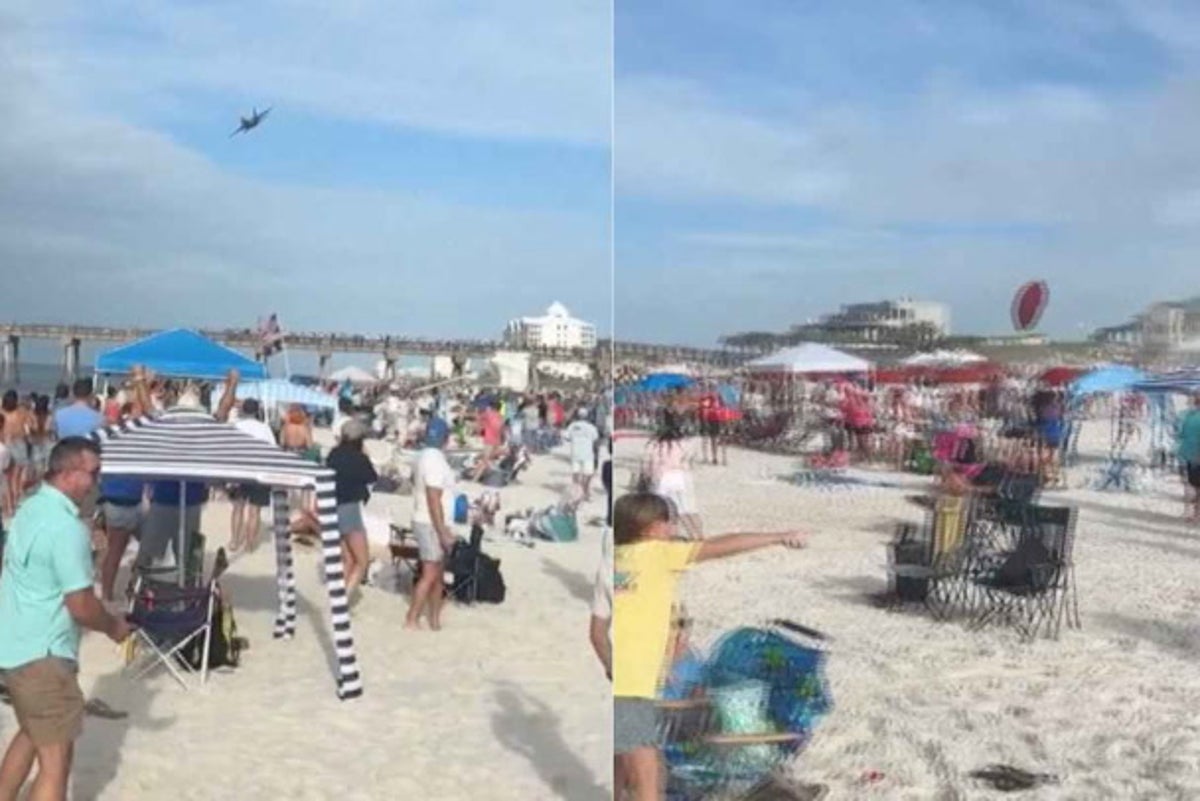
A single F/A-18 Super Hornet, painted in the unmistakable deep navy and gold of the U.S. Navy Blue Angels, drops from the sky. It is not high. It is low. Impossibly low.
The Shockwave on the Sand
Imagine the sheer displacement of atmosphere when twenty tons of metal, titanium, and jet fuel tears through the air at hundreds of miles per hour, mere feet above the water.
It starts with a shadow. A dark dart slicing across the turquoise water, moving faster than human eyes can track. Before the brain can process the shape, the pressure wave hits.
It is a physical wall of air. It slams into the beach like an invisible hand.
Then comes the roar. It is not a noise you hear with your ears; it is a vibration that rattles your ribcage, vibrates your teeth, and empties your lungs. The raw, screaming power of the twin General Electric turbofan engines obliterates every other sensory input.
In an instant, the peaceful beach scene turns into a beautiful, chaotic explosion of summer gear.
The jet sweeps over the shoreline, banking sharply to the side. Behind it, a wake of turbulent air grabs hold of the beach. Heavy canvas umbrellas, secured deep in the sand, are yanked free like weeds. Green, red, and blue fabrics bloom into the sky, spinning violently in the jet wash. Lightweight beach chairs lift off, tumbling over the sand like tumbleweeds in a high-speed wind tunnel. Pop-up tents collapse and roll.
For three seconds, it is utter pandemonium.
People scream. Some duck flat onto the sand, burying their faces in their arms, convinced for a fleeting fraction of a second that the sky is falling. Others leap to their feet, chasing runaway coolers and flying shade structures that have suddenly become airborne projectiles.
And then, just as quickly as it began, the jet is gone. It climbs into the blue, leaving behind a sky stained with white smoke and a beach that looks like a hurricane hit it inside of five seconds.
But nobody is angry.
Instead, a collective, breathless roar rises from the crowd. It starts as a few scattered gasps, then erupts into wild, adrenaline-fueled cheering. People are laughing, shaking the sand out of their hair, clutching their chests.
Ashley Korn, a beachgoer who had been visiting the Pensacola shores for a decade, tried to find the words for what she had just experienced. She had seen the jets before. Everyone here had. But this was different.
"I literally thought we were going to be taken out by Blue Angels," she said later, her voice still carrying the tremor of excitement. "But it was amazing."
The Fine Line of Flight
Behind the wild thrill of the crowd lies a highly disciplined, deeply scrutinized world where inches matter. The Blue Angels are the gold standard of military flight demonstration. They do not make mistakes.
Except when they do.
Navy officials quickly recognized that the spectacular moment was actually a miscalculation. The squadron released a statement admitting that during an arrival maneuver, an aircraft flew lower than standard profiles. They called it a "disturbance on the beach."
To the military, it was an operational deviation. To the tourists, it was the memory of a lifetime.
The military runs on margins. Every maneuver, every bank, every pass over a crowd is calculated to the foot. The standard profile keeps these massive machines at a safe distance from civilians, ensuring that the immense power of their jet wash does not cause harm. When an aircraft dips below that threshold, the physical consequences are immediate.
Consider what happens when a jet of that size goes too low. The air displaced by the wings and the hot exhaust from the engines create a localized low-pressure zone, followed instantly by a high-pressure blast. It is a mini-meteorological event.
If that jet had been just a few feet lower, those flying umbrellas—which can be incredibly sharp when airborne—could have caused serious injuries. It was a thrilling spectacle, but it was also a stark reminder of the immense power these pilots command.
A Cultural Lightning Rod
The video of the low pass exploded across the internet. Within hours, millions of people had watched the colorful umbrellas take flight like startled birds.
As with anything in the modern age, the reaction was polarized.
Some viewers were outraged. They pointed out the danger of flying beach equipment, noting that heavy umbrellas can easily injure or kill unsuspecting beachgoers. They demanded accountability. They questioned why such a dangerous maneuver was permitted so close to a civilian crowd.
Others viewed the outrage as a symptom of a fragile culture. To them, the flyover was a display of pure, unadulterated American power. They argued that anyone sitting on a beach during an air show rehearsal should expect a little noise and a lot of wind.
Inside the Pentagon, the incident sparked a different kind of conversation. In military aviation, a "low pass" is a delicate subject. While pilots are trained to push their aircraft to the absolute limit, they are also bound by strict safety protocols. Over the years, several military flyovers have drawn scrutiny, leading to pilot suspensions and investigations.
Yet, there is a legendary, almost mythical status associated with the pilot who flies just a little too low, who gives the crowd a little more than they bargained for. It is the spirit of Maverick, grounded in the reality of high-stakes military discipline.
The Navy confirmed that leadership was reviewing the circumstances surrounding the flight. It was a routine safety review, the kind designed to ensure that the line between a breathtaking show and a tragedy is never crossed.
The Quiet After the Roar
By afternoon, the wind had died down. The flying umbrellas had been retrieved, some with bent metal ribs, others missing their canopies. The tents were restaked, anchored deeper into the white Florida sand this time.
The Gulf returned to its quiet, rhythmic lapping against the shore.
The children went back to building sandcastles. The adults went back to sipping their drinks, though every few minutes, someone would look up at the empty blue sky, half-expecting the horizon to warp once more.
We live in a world where almost everything is sanitized, scheduled, and safe. We watch life through screens, insulated from the raw force of nature and machine. But for a few seconds on a Wednesday morning, thousands of people on a strip of Florida sand felt the raw, terrifying, beautiful edge of human capability.
They felt the heat of the engines. They tasted the kicked-up sand. They watched their summer afternoons lift off and fly away.
No one on that beach will ever look at a clear blue sky the same way again. They will always be listening for the silence that comes before the roar.