The air in a television broadcast gallery is usually a mix of ozone, cold air conditioning, and the frantic, whispered profanity of producers. It is a place of controlled chaos. But on that morning in Tehran, the silence was different. It wasn't the silence of a technical glitch or a missed cue. It was the heavy, suffocating weight of a history book slamming shut.
The red light on the camera didn't just signal a broadcast. It signaled the end of an epoch.
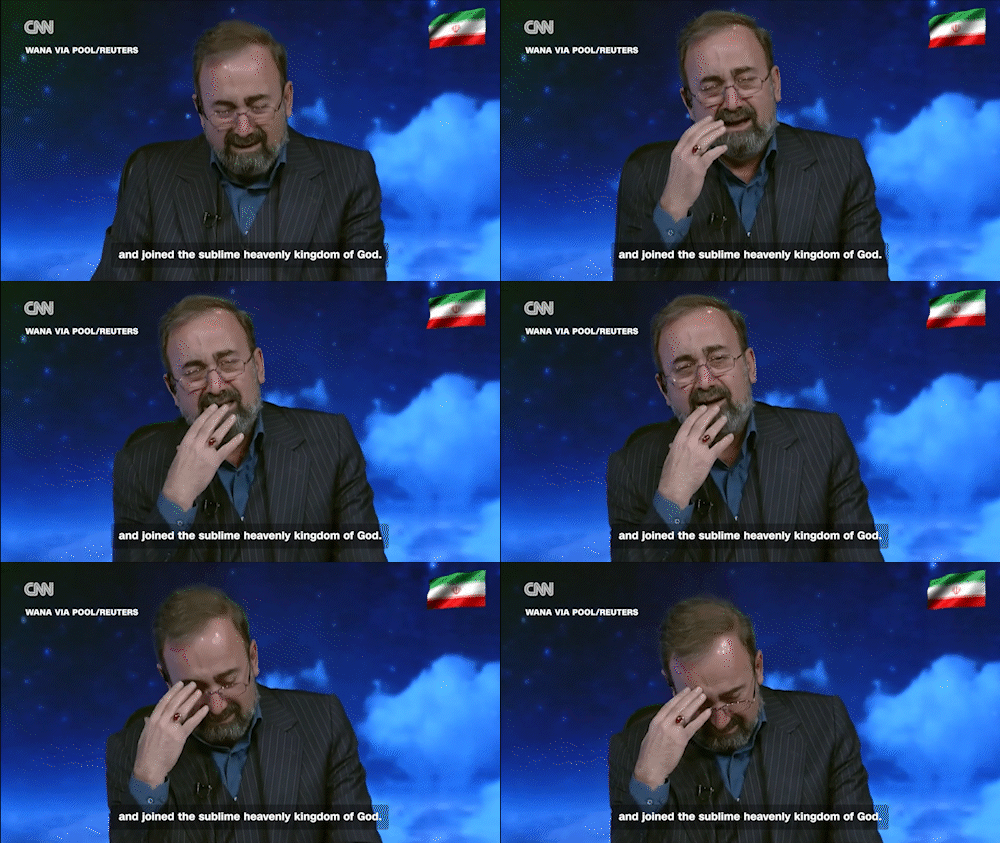
We often think of power as something abstract—a series of laws, a military parade, or a signature on a decree. We forget that power is ultimately channeled through the vocal cords of a human being. On this day, those vocal cords failed. The presenter, a man whose career was built on the steady, unshakeable delivery of the state’s truth, sat before the lens. His job was simple: read the script. Announce that the Supreme Leader of the Islamic Republic of Iran was dead.
He couldn't get the words out.
The Cracked Mask of Authority
To understand why a grown man, a seasoned professional, would collapse into tears on international television, you have to understand the architecture of the world he lived in. In a state where the leader is not just a political figure but a spiritual cornerstone, his passing is not merely a change in administration. It is an existential earthquake.
For decades, the image of the Supreme Leader was the one constant in a volatile region. His face was on the currency. His voice guided the Friday prayers. His decisions moved oil markets and shifted the shadow wars of the Middle East. For the presenter, the man behind the desk, this wasn't just a news item. It was the vanishing of the sun.
He began to read. The first few syllables were standard—the formal, honorific titles that precede any mention of the high office. Then, the glitch. His breath hitched. A sob, sharp and jagged, tore through the professional veneer.
Imagine, for a moment, a hypothetical viewer named Karim. Karim is sitting in a small apartment in Isfahan, the blue tiles of the mosque visible through his window. He has lived his entire life under this one shadow. He hears the anchor’s voice break. In that moment, Karim doesn't just hear news; he feels the floor of his reality tilt. When the person paid to be the voice of the state loses their voice, the state itself feels precarious.
The Weight of the Script
The facts of the matter were clinical. The leader had been ill. There had been rumors, whispers in the bazaars, and frantic checks of social media feeds. But rumors are ghosts. A state television announcement is the solid ground of reality.
The presenter clutched the paper. You could see his knuckles whitening. This piece of paper was the most dangerous and significant document he would ever hold. It was the official period at the end of a very long sentence.
Every journalist knows the "Death Watch." It is the grim preparation for the inevitable. Newsrooms keep pre-written obituaries and edited video packages ready to go at the touch of a button. They call them "evergreens." But there is no amount of rehearsal that prepares a human heart for the moment those pre-written words become the truth.
The tears weren't just about grief. They were about the terrifying "what happens now?"
When a central pillar is removed from a building, the other stones don't just sit there. They groan. They shift. They wait to see if the roof is going to hold. The anchor’s weeping was the sound of those stones shifting. It was a visceral, public display of the uncertainty that defines a succession crisis. Who takes the mantle? Does the system hold, or does it fracture? These are the invisible stakes that turn a news report into a historical trauma.
A Language Beyond Words
There is a specific kind of crying that happens when a person realizes they are witnessing the end of their world. It isn't the loud, wailing grief of a funeral. It is a desperate, gasping struggle to maintain dignity while the soul is exiting through the eyes.
Critics might call it theatre. Skeptics might see it as a calculated display of loyalty in a regime where perceived coldness can be a career-ending mistake. But there is a biological limit to artifice. The way his shoulders shook, the way he looked down at the desk because he could no longer face the black eye of the camera—that was real. It was the reaction of a man who knew that the moment he finished that sentence, everything would be different.
The markets would react. The borders would tighten. The proxies in Lebanon, Yemen, and Iraq would pause, waiting for a signal from a dead man's successor.
Consider the logistical gravity. Transition of power in a system built on a single, charismatic, and religious authority is like trying to change the engine of a plane while it is in a steep dive. The anchor wasn't just crying for a leader; he was crying for the peace of the status quo, however flawed it might have been.
The Silence After the Sob
When the broadcast finally cut away to stock footage of the leader—slow-motion shots of him walking through gardens or greeting crowds—the silence in the living rooms across the nation was likely deafening.
The anchor had done his job, technically. The news was out. The supreme leader was gone. But the image that lingered wasn't the leader’s face. It was the anchor’s broken one.
We live in a world of data points. We track the price of Brent Crude. We analyze the rhetoric of the Assembly of Experts. We map the potential movements of the Revolutionary Guard. These are all necessary, but they miss the pulse. They miss the human cost of living in history.
Power is a fragile thing. We dress it up in gold leaf, surround it with guards, and broadcast it in high definition. We try to make it look eternal. But then a man in a cheap suit, sitting in a room full of monitors and wires, breaks down and cries.
In that moment, the gold leaf peels. The guards look around, wondering who is actually in charge. The high definition shows every line of fear on a human face.
The report ended. The screen faded to a somber, static image accompanied by choral chanting. But the ghost of that sob stayed in the room. It was the sound of a country holding its breath, waiting to see if it would ever be allowed to exhale again.
The red light on the camera turned off. The producer likely stepped into the studio and put a hand on the presenter’s shoulder. They probably offered him a glass of water. Outside, the streets of Tehran remained, for the moment, unnervingly quiet. But the world had already moved on from the man who died to the men who remained, and the agonizing, slow-motion struggle to find a new center of gravity in a world that had just lost its North Star.
The ink on the script was dry, but the paper was damp with the salt of a transition that no one was truly ready for.