The chamber is built for war.
If you stand on the floor of the House of Commons, you will notice two red lines running parallel along the carpet. They are spaced exactly two sword-lengths apart plus one inch. For centuries, this physical boundary governed the British state. It was a structural promise that no matter how white-hot the fury became, the combatants could not slice each other open.
Politics here is a blood sport. It requires a specific kind of armor. You must wear a mask of permanent certainty, project a voice that can cut through the jeers of three hundred people, and pretend that your opponent across the aisle is not merely wrong, but actively ruinous to the nation.
Then, every so often, the theater stops. The actors look at each other, realize they are both bleeding, and decide to put the swords down.
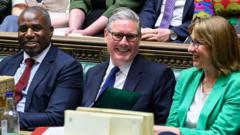
We saw this happen in a quiet, arresting sequence of minutes. It was a moment that defied the gravity of modern political gravity. Keir Starmer stood at the dispatch box, looked across the gap, and offered a remarkably kind, deeply human send-off to his predecessor. To understand why this shook the room, you have to understand the invisible toll of the building itself.
The Weight of the Great Office
To the outside observer, a Prime Minister is an institution. They are a face on a screen, a signature on a bill, or a target for a late-night comedian. We forget that they are also human beings who must somehow sleep, eat, and maintain a family while carrying the psychological weight of millions of lives.
The job of the opposition leader is to systematically dissect that human being every single Wednesday. For years, Starmer and his opponent traded blows. It was a relentless, exhausting routine of point and counter-point, accusation and denial. The air in the chamber during these exchanges is thick. It smells of damp wool, old wood, and collective anxiety. When the cameras zoom in, you see the polished smiles. What you miss are the white knuckles gripping the edge of the dispatch box.
Consider what happens when the music finally stops.
When a leader steps down or prepares to leave the front line, the transition is brutal. In the British system, there is no long, winding sunset. You are in power, and then, in a matter of hours, a removal van parks outside your door. The country watches your humiliation in high definition.
This is the context that made Starmer's gesture so striking. He did not use his time to secure one final political victory. He did not twist the knife. Instead, he spoke directly to the person behind the title.
A Silence of a Different Kind
The House of Commons is rarely quiet. Even during serious debates, there is a constant undercurrent of noise—muttered agreements, sharp intakes of breath, the rustle of order papers.
But when Starmer began to speak about his opponent’s personal decency, the noise died.
He spoke of the immense sacrifices that public service demands, not just from the politician, but from their spouse and their children. He acknowledged the sheer, crushing pressure of leadership. In doing so, he did something rare in modern public life: he validated the pain of his rival.
"We can argue about policy," Starmer's tone seemed to suggest, "but I know the weight of the coat you are taking off. I am wearing it now."
It was a moment of profound empathy. For a few minutes, the partisan dividing lines melted away. The backbenchers on both sides sat in a silence that felt almost reverent. It was the silence of people remembering that beneath the ideological warfare, they all signed up for the same exhausting, terrifying, and often thankless task of trying to run a country.
The Art of the Civilized Exit
In an era defined by political polarization, we have become accustomed to the politics of destruction. We expect our leaders to fight to the bitter end, to delegitimize their opponents, and to treat every transition of power as a stolen victory or a stolen future.
This send-off was an antidote to that poison. It showed that it is possible to fight fiercely for your principles without losing your basic humanity. It demonstrated that dignity is not a sign of weakness, but the ultimate expression of strength.
To the cynic, this was merely political theater of a different kind—a calculated display of magnanimity by a victor. But if you watched the eyes of the people in that room, you saw something different. You saw relief.
We need these moments. Without them, the political system becomes a meat grinder that only attracts the sociopathic and the unfeeling. If we demand that our politicians be entirely devoid of grace, we should not be surprised when we are governed by monsters.
The Echoes in the Corridor
Long after the MPs have filed out of the chamber and the green benches are empty, the memory of that exchange remains. It serves as a quiet reminder of what public life can be.
It tells us that the red lines on the carpet are there to keep us apart, but they do not prevent us from reaching across.
The true test of a democracy is not how it fights, but how it transitions. When the swords are finally sheathed, and the dust settles on the ancient floorboards, the measure of our leaders is not found in the battles they won, but in the decency they preserved when the fighting was done.