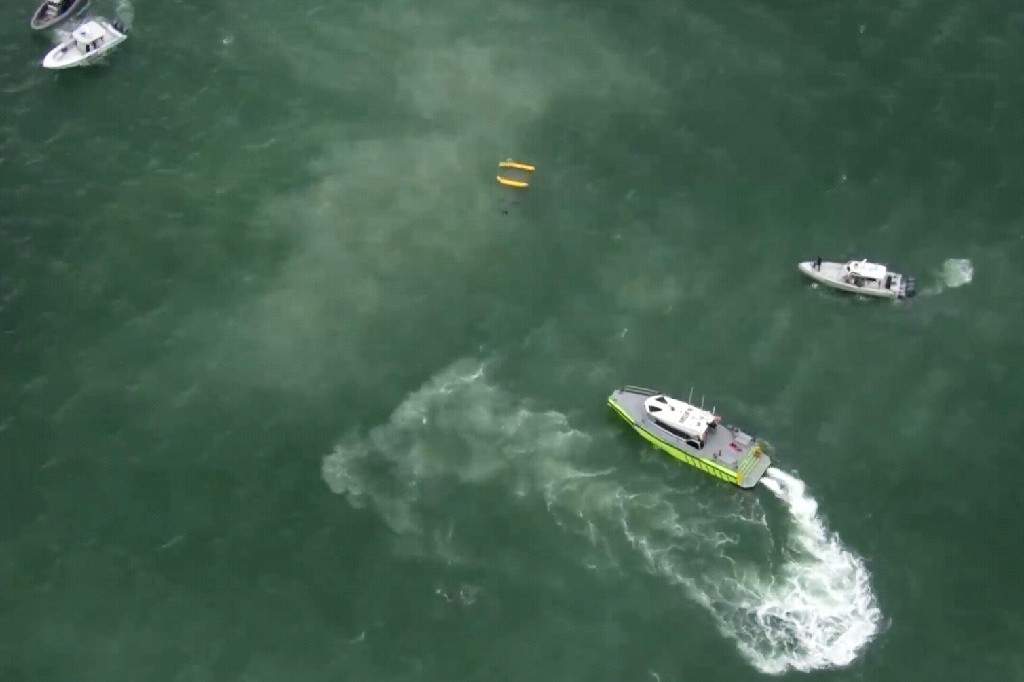
When a helicopter crashes into the waters near Miami leaving one person dead and two others injured, local headlines treat it like a freak accident. It is not. Low-altitude rotorcraft operations over Biscayne Bay and the adjacent coastal corridors represent one of the most unforgiving flight environments in the United States, where congested airspace, sudden maritime microclimates, and thin mechanical margins regularly collide.
Emergency responders pulling survivors from shallow salt water is a grimly familiar scene in South Florida. While federal investigators from the National Transportation Safety Board (NTSB) and the Federal Aviation Administration (FAA) spend months dissecting specific wreckage, the structural realities that turn an airborne emergency into a fatal water impact are already well documented in aviation safety records.
The Anatomy of a Water Impact Near Miami
Water looks soft from a thousand feet up. At eighty knots, it behaves like concrete.
When a helicopter experiences a catastrophic failure over the bay near Miami, the pilot faces a violent sequence of physical forces that leave almost zero margin for error. Unlike fixed-wing aircraft, which can glide for miles if an engine quits, a helicopter relies entirely on the kinetic energy stored in its spinning rotor blades to arrest its descent. This maneuver, known as autorotation, requires split-second precision. The pilot must immediately lower the collective pitch control to allow upward airflow to keep the blades spinning, then flare the aircraft just feet above the surface to trade forward speed for lift.
Over open water, depth perception vanishes. Without stationary visual references like trees, buildings, or pavement textures, a pilot's brain struggles to judge exact height above a flat or rippling bay. Flare too high, and the rotor blades run out of energy twenty feet in the air, dropping the cabin like a stone. Flare too late, and the skids catch the water at high forward speed, causing the aircraft to pitch violently forward and invert.
The Drowning Trap
The impact itself is rarely what kills occupants in coastal helicopter crashes. Dynamic rollover and rapid inversion are the primary culprits. Because a helicopter's heaviest components—the engine, transmission, and main rotor mast—sit directly above the passenger cabin, the aircraft is inherently top-heavy. The moment it hits the water without deploying emergency floatation gear, it flips upside down.
The cabin fills with murky bay water in less than five seconds. Survivors are suddenly disoriented, strapped into four-point harnesses, upside down in the dark, with tangled headset cords and jammed doors. Even experienced military aviators struggle to egress from a submerged, inverted fuselage without specialized underwater escape training. For civilian passengers on a sightseeing tour or private charter, panic sets in before they even locate the door latch.
Why Biscayne Bay Airspace Is Uniquely Hazardous
South Florida is a magnet for rotorcraft traffic. Between Miami International Airport, Opa-locka Executive Airport, Miami Executive Airport, and dozens of private helipads, the sky over Miami-Dade County is a tangled web of overlapping flight paths.
To keep sightseeing helicopters, news choppers, police units, and private charters out of the way of commercial airliners, air traffic control pushes low-altitude traffic into narrow coastal corridors. Pilots routinely fly along the shoreline and across the bay at altitudes between 300 and 1,000 feet.
This creates a dangerous operational paradox. Flying low keeps helicopters safely beneath incoming jumbo jets, yet it destroys the pilot's reaction window when something goes wrong. At 500 feet, an engine failure gives a pilot roughly ten to fifteen seconds to diagnose the problem, pick a landing spot, configure the aircraft, and execute a safe touchdown.
Microclimates and Salt Corrosion
Beyond traffic density, the environment itself actively works against mechanical reliability. South Florida's coastal air is heavy with moisture and suspended salt crystals. That salt settles into turbine compressors, coats electrical connectors, and accelerates intergranular corrosion on critical airframe components.
Operators in coastal regions face significantly higher maintenance burdens than those flying in dry, inland climates. A hairline crack in a tail rotor pitch link or a compromised fuel control unit can escalate from a minor anomaly to total failure in a matter of flight hours.
The weather adds another layer of volatility. Rapidly building convective cells over the Everglades and the Gulf Stream generate sudden wind shear and microbursts. A helicopter cruising smoothly over calm bay waters can fly directly into a localized downdraft that exceeds the aircraft's climb capability, forcing it toward the surface before the pilot can react.
The Regulatory Blind Spot in Sightseeing and Charter Flights
Not all helicopter flights operate under the same safety rules. When a crash occurs near Miami, one of the first questions investigators ask is which section of the Federal Aviation Regulations governed the flight.
Commercial airlines operate under Part 121, the strictest safety framework in the world. Small charter operators generally fly under Part 135, which requires specific pilot training, drug testing, and maintenance oversight. However, a massive loophole exists for local sightseeing flights—often called air tours—that take off and land at the same airport within a 25-mile radius.
Many of these flights operate under Part 91, the same basic rules that govern private recreational pilots flying on weekends. Under Part 91, operators face far less stringent maintenance inspections, looser pilot rest requirements, and fewer mandatory safety equipment rules.
| Regulatory Category | Typical Operations | Maintenance Oversight | Emergency Floatation Gear |
|---|---|---|---|
| Part 91 (Air Tours) | Sightseeing loops within 25 miles | Minimal (Annual/100-hour checks) | Often not required over inland/bay waters |
| Part 135 (Charter) | Point-to-point transport, offshore | Strict FAA-approved programs | Required only beyond gliding distance of land |
| Part 135 (Air Ambulance) | Medical transport | Strict plus specialized equipment | Mandatory for over-water operations |
The Gliding Distance Loophole
Perhaps the most glaring gap in coastal aviation safety involves emergency floatation systems. Skid-mounted pop-out floats prevent a helicopter from immediately sinking or flipping upon water contact, buying occupants precious minutes to exit the cabin.
Under current FAA rules, single-engine helicopters flying over water are generally only required to carry floats if they operate beyond "power-off gliding distance" from shore. Because Biscayne Bay is dotted with barrier islands, causeways, and spoil islands, operators frequently argue that their flight paths remain within gliding distance of dry land.
In theory, the math checks out. In reality, a sudden loss of tail rotor authority, an in-flight fire, or an abrupt bird strike means the pilot cannot glide to the nearest causeway. The aircraft goes straight into the water, and without floats, it turns turtle immediately.
What Actually Happens During an Investigation
When a fatal crash occurs in Miami's waters, public frustration over the lack of immediate answers is understandable. Federal investigations are deliberately slow because aviation wreckage rarely tells a simple story.
Once salvage crews lift the fuselage from the bay floor, investigators immediately rinse the components in fresh water to halt rapid saltwater oxidation, which can destroy microscopic fracture evidence within hours. The wreckage is then transported to a secure facility where engineers conduct a forensic teardown.
- Powerplant Teardown: Engineers disassemble the turbine or piston engine piece by piece to determine if it was producing power at the moment of impact. Rotational scoring on compressor blades indicates the engine was spinning fast; clean breaks suggest it had already seized.
- Flight Control Continuity: Investigators trace every push-pull tube, bellcrank, and hydraulic actuator from the cockpit sticks to the rotor blades to rule out mechanical disconnection prior to impact.
- Avionics and Non-Volatile Memory: Most light helicopters lack traditional black boxes, yet modern GPS units, engine monitoring displays, and even passengers' smartphones often retain fragments of altitude, airspeed, and track data that survive submersion.
- Human Factors and Maintenance Logs: Investigators audit years of mechanic sign-offs, component life limits, and the pilot's recent sleep, flight hours, and toxicology reports.
A preliminary report typically drops within two to three weeks, laying out the basic factual timeline without assigning blame. The final probable cause determination often takes twelve to twenty-four months.
The Uncomfortable Reality for Passengers
Flying in a helicopter offers an unmatched perspective of Miami's coastline, which is precisely why thousands of tourists and executives climb aboard every month. Most arrive safely. Yet the margin between a routine flight and a headline-making tragedy remains thinner than the public realizes.
Single-engine helicopters dominate the urban sightseeing and light charter market because they are vastly cheaper to purchase, fuel, and maintain than twin-engine aircraft. A twin-engine helicopter offers true redundancy—if one engine fails, the other can usually sustain level flight back to an airport. A single-engine machine offers no such luxury. When the lone engine quits over crowded waters, physics takes over immediately.
Passengers stepping onto a tarmac in South Florida rarely ask whether the aircraft is flying under Part 91 or Part 135, whether the pilot has practiced autorotations to water, or whether the skids are equipped with emergency floats. They assume the presence of an FAA certificate guarantees uniform protection. Until regulators close the coastal sightseeing loopholes and mandate floatation gear for all commercial over-water rotorcraft, the waters off Miami will remain an unforgiving test of pilot skill and mechanical luck.