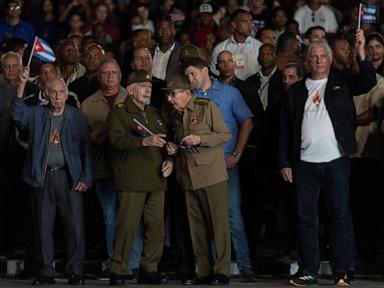
The physical disappearance of the old guard in Havana is almost complete. On June 21, 2026, Ramiro Valdes Menendez died at the age of 94. While current Cuban President Miguel Diaz-Canel lamented the loss on social media, writing that the death hurts deeply like that of a father, the reality of Valdes's passing stretches far beyond official state mourning.
Valdes wasn't just another veteran in green military fatigues. He was the architect of Cuba's internal security apparatus, a founding member of the Cuban Communist Party, and one of the last remaining connections to the original 1959 revolution. With his death, Raul Castro stands as the final titanic figure from the yacht that started it all. If you want to understand how the Cuban government maintained absolute domestic control for over six decades, you have to look at the apparatus Valdes built.
From Rebel Fighter to Chief Architect of G2
Valdes started out young and radical. Born into a poor family in Artemisa on April 28, 1932, he joined Fidel Castro's movement early. He was only 21 when he took part in the bloody, failed assault on the Moncada Barracks in 1953. That attack landed him in prison, followed by exile in Mexico.
When the rebels bought a leaking leisure yacht called the Granma to sail back to Cuba in 1956, Valdes was on board. Of the 82 men who made that trip to launch a guerrilla war against dictator Fulgencio Batista, only 12 survived the brutal initial landing and subsequent military ambush. Valdes was one of them. He went on to serve as second-in-command to Ernesto "Che" Guevara during the mountain campaign.
But fighting in the Sierra Maestra was just the prelude. His real legacy began after the rebels seized power in 1959.
Fidel Castro trusted Valdes with the survival of the new socialist state. As the first Minister of the Interior in the 1960s, Valdes built the G2 state security intelligence service from scratch. He received intelligence training during a 1960 trip to Czechoslovakia, learning Soviet-bloc surveillance methods and adapting them to the Caribbean.
Under his watch, Cuba developed a domestic spy network that successfully neutralized counter-revolutionary groups, many of which were backed by the CIA. Valdes didn't hide his methods. In a rare 2018 interview on Cuban state television, he remarked that there was no one who moved without security knowing it. That absolute surveillance framework became the template for Cuban governance.
Controlling the Wild Colt of Technology
Political life in a communist state is rarely a straight line. Valdes was pushed out of the Ministry of the Interior in 1969, brought back by Fidel in 1978, and removed again in 1985 amidst internal rivalries. Most observers thought his career was done.
Instead, he reinvented himself as the overseer of Cuba's electronics and telecom strategy. He took over Copextel, a tiny electronics project that he grew into a major hub for developing Cuban software, IT, and telecom infrastructure by partnering with companies in China, North Korea, and Japan. By 2006, he was named Minister of Informatics and Communications.
This wasn't about digital freedom. It was about digital control.
Valdes viewed the internet as a double-edged sword. In 2007, he famously labeled the internet as one of the tools for global extermination used by the United States. Yet, he admitted it was necessary for economic development. His philosophy was simple: the wild colt of new technologies can and must be controlled. He applied the same heavy-handed surveillance principles he used in the 1960s to the digital space, ensuring the state monitored what Cubans could see, say, and access online.
What His Absence Means for the Island Right Now
Valdes stayed active in top government roles for an incredible length of time. He served as a Vice President and later as Deputy Prime Minister well into his late 80s and 90s. Though he stepped down from the powerful Central Committee of the Communist Party in April 2021 as part of a broader generational transition, he remained a shadow advisor to Diaz-Canel's administration.
His death removes a massive pillar of historical legitimacy from a government currently struggling with deep economic turmoil, food shortages, and frequent power blackouts. The current leadership can no longer rely on the charisma or the fearsome reputation of the original revolution commanders to keep the public quiet.
If you are tracking geopolitical shifts or analyzing Caribbean political risk, watch how the Cuban government handles security over the next few months. The passing of old-school hardliners like Valdes means the current regime lacks the historical authority to justify its grip on power. This forces them to rely more on raw police presence rather than revolutionary loyalty. Keep a close eye on independent Cuban news outlets like 14ymedio and regional think tanks like the Inter-American Dialogue to see if this transition accelerates internal dissent or prompts unexpected economic reforms to keep the population stable.


