Water is supposed to remember where it came from.
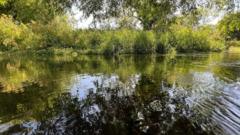
Walk down to the banks of the River Chess on a crisp morning in Hertfordshire, and you might mistake it for a painting from a forgotten century. The water runs impossibly clear over beds of dark green water crowfoot. It winds through ancient meadows, a shallow, murmuring ribbon born from the deep chalk aquifers beneath the Chiltern Hills. There are only about two hundred chalk streams on this entire planet. Most of them are right here in southern England. They are our coral reefs, our ecological equivalents of the Great Barrier Reef, fed by pure rainwater filtered slowly through miles of ancient rock for months, sometimes years, before bubbling up into daylight.
Or at least, that is the myth we tell ourselves.
Step closer to the edge. Look past the surface glare. Notice the stillness where a current should pull. Notice the silt choking the gravel beds where trout should be spawning by the thousands.
Now, look at the recent grading from the Environment Agency. They rated the Chess—touted by Thames Water as a flagship environmental project—as poor.
Poor.
It is a clinical word for a quiet catastrophe. It is a word that sanitizes the slow, suffocating death of an ecosystem. To understand what that rating actually means, you have to look past the bureaucratic spreadsheets and stand where the water meets the pipe.
The Promise and the Pipe
Arthur Pendelton has lived within sight of the Chess for forty years. He remembers when you could see the bottom in five feet of water as clearly as if looking through window glass. He remembers the heavy brown trout resting in the amber shadows of the low-hanging willows.
"They told us it was getting better," Arthur says, leaning heavily on a wooden gate, his knuckles swollen with the quiet arthritis of old age. "Every few years, someone in a high-visibility jacket comes down here with clipboards. They talk about investments. They talk about flagship restorations. Then the summer comes, the rain stops, and the river turns into a stagnant puddle while the treatment plant down the road pumps out whatever the city flushed away this morning."
(Note: Arthur is a composite character representing the lived experiences and testimonies of long-term residents along the Chess valley, gathered from community conservation meetings.)
Thames Water called the Chess a flagship. In naval terms, a flagship is the lead ship in a fleet, the vessel carrying the commander, the pride of the armada. But when a flagship is rated poor, it means the entire fleet is running aground.
How did we get here? How does water that begins its life as pristine rain, filtered through the earth's quiet alchemy, end up classified alongside a polluted drainage ditch?
The answer lies in a toxic marriage of relentless corporate extraction and crumbling Victorian infrastructure that cannot cope with a modern population.
The Thirsty Earth and the Heavy Hand
Imagine baking a sponge cake, letting it dry out completely under a heat lamp, and then trying to squeeze moisture out of it. That is what we are doing to the Chiltern aquifers.
Water companies bore deep into the chalk to supply millions of homes with drinking water. As more houses are built and more concrete seals the earth, less rainwater can soak down to replenish the underground reserves. The water table drops. The springs weaken.
When a chalk stream loses its volume, it loses its velocity. A river needs speed to breathe. It needs fast-flowing water to scour the fine silt away from the flint gravel beds. Without that scouring action, silt settles like gray ash over the spawning grounds of native fish. The river suffocates from the bottom up.
And then, the treatment works step in.
During heavy rains, or sometimes simply because the system is overwhelmed and neglected, storm overflows discharge untreated sewage directly into the watercourses. Phosphorus from household detergents and human waste floods the stream, triggering massive algal blooms. The algae consume the oxygen in the water. The fish gasp. The macroinvertebrates—the mayflies and stoneflies that form the base of the entire aquatic food web—vanish.
What remains is a ghost of a river. It looks wet, but it is dead inside.
The Cost of Looking Away
We have a strange habit in modern life of compartmentalizing our environmental failures. We treat a degraded river like a pothole on a side street—annoying, perhaps, but someone else's job to fix while we drive past with the radio on.
We forget that water is a closed loop.
The water that drains through the chalk valleys, the water that struggles through poor aeration and chemical soups, is the same water we draw back up for our taps after it travels down the catchment. We are swimming in, drinking from, and washing our lives through our own refuse, mediated only by chemical treatments that grow more desperate by the year.
When the Environment Agency grades a flagship chalk stream as poor, it is not just an administrative downgrade. It is an indictment of our priorities. It proves that corporate slogans about sustainability and biodiversity net gains are often little more than PR window dressing designed to pacify a public that still believes in the romance of English waterways.
Consider what happens next if we do nothing. The unique flora of the chalk valleys—plants found almost nowhere else on Earth—will disappear. The brown trout will go the way of the British salmon in urban rivers, remembered only in old photographs and local angling lore. The landscape will flatten into a dull, gray monotony where only the hardiest, pollution-tolerant microbes survive.
The Weight of the Current
There is a moment just before dusk when the light hits the Chess at a sharp, horizontal angle. For a few minutes, the water glows with a fierce, deceptive beauty. The surface catches the amber of the setting sun, masking the murky depths and the choked weed beds below.
It is easy to be seduced by that surface. It is easy to look at a winding stream in the English countryside and assume that nature is resilient enough to absorb whatever we throw at it.
Nature is resilient, yes. But resilience has a breaking point.
When you strip away the corporate press releases, when you ignore the comforting fiction of the word flagship, you are left with the cold, unvarnished reality of a river gasping for air. The poor rating is not a surprise ending. It is a warning shot.
The water keeps flowing, past the treatment plants, past the depleted wells, past the silent gates where old men remember how things used to be. It carries our choices down to the sea, waiting to see if we will finally decide to care before the current stops entirely.