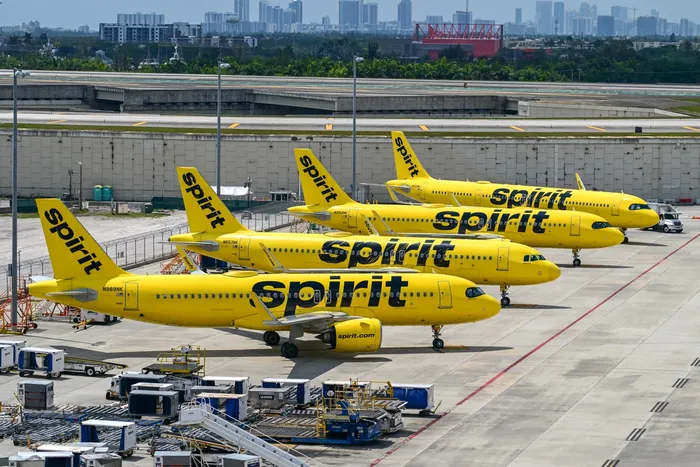
The yellow planes are grounded for good. On May 2, 2026, Spirit Airlines terminated all global operations with a suddenness that left thousands of travelers standing in terminal lines staring at blank monitors. This isn't just a bankruptcy filing or a seasonal route adjustment; it is a total liquidation of the pioneer that forced the rest of the industry to lower its prices. While legacy carriers like Delta, United, and American have rushed to offer "rescue fares" to stranded passengers, the immediate logistical fix masks a much darker reality for the American traveler. The floor of the budget travel market has officially fallen out.
The Midnight Collapse
Spirit’s demise was precipitated by a lethal cocktail of soaring jet fuel prices—driven by intensified conflict in the Middle East—and a failed $500 million federal bailout negotiation with the Trump administration. The airline had already been operating under the shadow of a previous bankruptcy, attempting to restructure its massive $7.4 billion debt load. When fuel costs spiked to roughly $4.51 per gallon this spring, the math simply stopped working.
By Saturday morning, the airline’s customer service counters were abandoned. Signage was being stripped from walls in Houston and Detroit. The airline’s leadership issued a blunt directive: do not come to the airport. For those already mid-journey, the message was even colder. You are on your own.
The Rescue Fare Reality
In a coordinated effort led by Transportation Secretary Sean Duffy, the "Big Four" and several low-cost rivals have implemented a temporary safety net. United and Delta are capping one-way fares for Spirit refugees, while JetBlue has offered $99 seats for those who can prove they held a valid Spirit itinerary.
Current Rescue Fare Caps
| Airline | One-Way Cap (Nonstop) | One-Way Cap (Connecting) |
|---|---|---|
| United | $199 | $299 |
| JetBlue | $99 | N/A |
| Delta | Reduced (Variable) | Reduced (Variable) |
| Southwest | Special Airport Rates | Special Airport Rates |
While these gestures prevent immediate price gouging for the stranded, they are short-term bandages. Most of these rescue fares expire within a week. For the millions of travelers who booked Spirit for summer vacations in June, July, and August, there is no "rescue." Those tickets are now worthless pieces of digital paper.
Why the Merger Block Killed the Carrier
To understand why Spirit is dead, one has to look back at the 2024 federal block of the JetBlue-Spirit merger. The Department of Justice argued at the time that preventing the merger would protect consumers by keeping a low-cost competitor in the sky. It was a catastrophic miscalculation. By denying Spirit a life raft, the government effectively signed its death warrant, leaving it to face a volatile fuel market with no capital reserves.
The irony is thick. The regulatory move meant to preserve competition has resulted in a less competitive landscape. With Spirit gone, the "Spirit effect"—the phenomenon where legacy airlines drop their prices on routes where Spirit competes—evaporates instantly.
The Hidden Logistics of a Liquidation
This isn't just about passengers. Spirit’s 12,000 employees are now part of a massive industry-wide scramble. While American and JetBlue have opened "preferential hiring" portals, the transition for pilots, flight attendants, and mechanics will be anything but smooth. Seniority lists, a cornerstone of airline labor, will be a primary point of friction.
Then there is the metal. Spirit’s fleet, largely comprised of Airbus A320 and A321 aircraft, represents a significant portion of the narrow-body capacity in the U.S. These planes won't stay dark for long. Frontier and Allegiant are already circling the carcass, looking to snap up gates in Fort Lauderdale, Orlando, and Las Vegas. However, re-painting, re-certifying, and re-staffing these aircraft takes months, not days. We are looking at a summer of record-high load factors and even fewer empty seats.
Reclaiming Your Money
If you are holding a Spirit ticket, the window for a clean refund is closing fast. The airline’s cash reserves are being swallowed by secured creditors.
- Credit Card Chargebacks: This is your only reliable lever. Under federal law, if a merchant fails to provide the service purchased, you are entitled to a chargeback. Contact your bank immediately.
- Vouchers and Points: Consider these lost. In a liquidation, unsecured creditors—which includes holders of "Free Spirit" points and travel vouchers—are at the bottom of the priority list.
- Third-Party Bookings: If you used Expedia or Priceline, your contract is with them. Demand they rebook you on a partner carrier, though be prepared for long hold times and significant resistance.
The era of the $39 flight across the country is over. As the industry consolidates further and the protective barrier of the ultra-low-cost model vanishes, travelers will find that the "savings" they enjoyed for three decades were subsidized by an airline running on a financial treadmill that finally hit the emergency stop. The sky just got a lot more expensive.