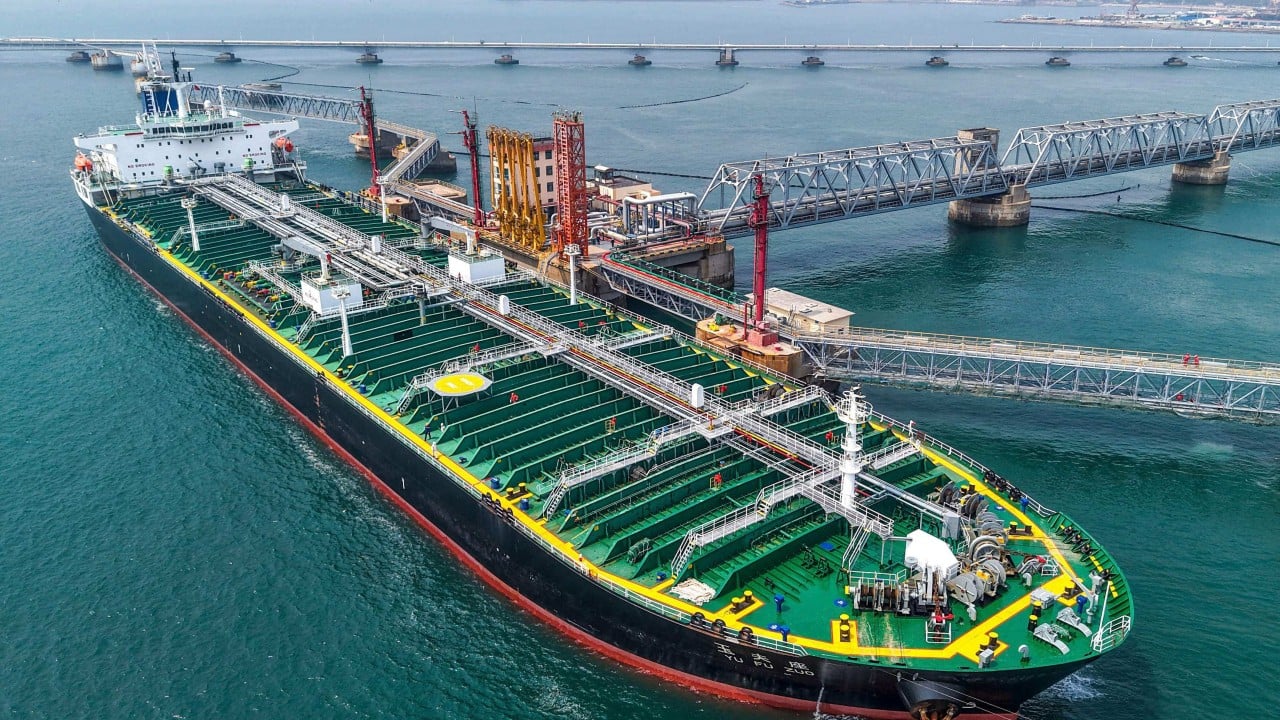
China's structural shift away from liquid transport fuels fundamentally alters global energy geopolitics. The narrative that China remains permanently vulnerable to maritime supply disruptions is being invalidated by the rapid deceleration of its internal combustion engine market. The mitigation of Strait of Hormuz vulnerabilities is not a passive byproduct of economic cooling; it is an intentional macroeconomic hedge executed via grid electrification, industrial reallocation, and alternative transport adoption.
To evaluate the trajectory of global crude markets, analysts must abandon aggregate demand metrics and instead isolate the specific sectors driving Chinese consumption. The structural decoupling of Chinese gross domestic product from crude oil import volumes is governed by three underlying operational mechanisms: transport substitution dynamics, grid-level efficiency gains, and a strategic pivot toward petrochemical feedstocks.
The Transport Substitution Function
The primary driver of historical Chinese crude demand growth—the expansion of the domestic passenger vehicle fleet—has encountered a structural ceiling. The substitution of crude oil by electric and alternative-fuel drivetrains is best understood through a multi-variable displacement function.
Displacement = (EV Fleet Growth * Average Annual VKT * Ice Fuel Intensity) + (LNG Heavy Truck Transition)
Where VKT represents Vehicle Kilometers Traveled. Passenger vehicles consume approximately one-third of China's oil imports. The current penetration rate of New Energy Vehicles (NEVs), which includes battery electric and plug-in hybrid models, has crossed the inflection point necessary to contract the baseline consumption of gasoline.
The mechanics of this displacement operate across distinct asset classes:
- Passenger Fleets: The operational cost parity of electric vehicles in Chinese municipal environments accelerates the retirement of internal combustion engine assets. The efficiency of a battery-electric drivetrain outperforms an internal combustion engine on a well-to-wheel basis, even when accounting for a coal-heavy generation mix. This creates a permanent demand destruction mechanism for refined gasoline.
- Commercial Logistics: The heavy-duty transport sector shows a capital expenditure shift toward Liquefied Natural Gas (LNG) and battery-swapping heavy trucks. For long-haul freight corridors, the price spread between domestic gas and imported diesel incentivizes fleet operators to convert to gas-fired or electrified drivetrains. The commercial logistics sector represents a sticky segment of diesel demand; its erosion permanently lowers the floor of Chinese middle-distillate consumption.
- High-Speed Rail Networks: The expansion of the domestic high-speed rail infrastructure has systematically captured market share from regional aviation and intercity bus routes. This infrastructural substitution dampens the growth curve of jet fuel and kerosene, segments that western oil markets historically relied upon to balance refining margins.
The secondary effect of this transport transition is the compression of domestic refining margins. As demand for gasoline and diesel peaks, state-owned and independent refiners face a structural supply imbalance, forcing run-rate reductions and an export-oriented survival strategy.
The Strait of Hormuz Risk Mitigation Matrix
The geopolitical imperative for China’s energy transition centers on the vulnerability of its maritime supply lines. Approximately half of China’s crude oil imports pass through the Strait of Hormuz, with a secondary chokepoint at the Strait of Malacca. The reduction of crude oil demand serves as a direct strategic defense mechanism against potential naval blockades or regional conflicts in the Middle East.
The mitigation of this risk does not require the complete elimination of oil imports. Instead, it relies on reducing import dependency below a critical threshold where domestic production and alternative pipeline infrastructure can sustain essential state functions.
The strategic insulation architecture relies on three primary supply pathways:
- The Overland Pipeline Network: The Power of Siberia gas pipelines and the Eastern Siberia-Pacific Ocean (ESPO) oil pipeline provide direct, un-blockable continental energy flows from Russia. These assets bypass maritime chokepoints entirely, delivering crude and gas directly into northeastern China.
- Central Asian Transit Corridors: Pipeline infrastructure running through Kazakhstan and Turkmenistan provides a land-based buffer. These supply routes are secured by bilateral state agreements that sit outside the sphere of Western maritime interdiction capabilities.
- Strategic Petroleum Reserve Management: China’s state-controlled storage capacity functions as an economic shock absorber. By maintaining reserves that cover multiple months of net imports, the state can withstand prolonged disruptions at the Strait of Hormuz without triggering immediate domestic industrial contraction.
When transport electrification reduces the total volume of crude required to keep the economy moving, the relative share of secure, overland pipeline crude rises. This structural change alters the geopolitical calculus. A supply disruption at Hormuz, which would historically have triggered an economic crisis in Beijing, becomes a manageable operational disruption.
The Petrochemical Pivot and Demand Asymmetry
A common analytical error is assuming that the decline in transport fuel demand equates to a near-zero crude import model. The reality is a structural reallocation of the barrel. Chinese industrial strategy involves a massive buildout of crude-to-chemicals (COTC) refining capacity.
This shifting allocation transforms crude oil from a primary energy source into an industrial raw material. The growth in oil demand is now concentrated in petrochemical feedstocks—specifically naphtha, liquefied petroleum gas (LPG), and ethane—used to manufacture plastics, synthetic fibers, and advanced electronics components.
This creates a distinct demand asymmetry:
- Cyclical Transport Decline: Gasoline and diesel demand follow a permanent downward trajectory driven by technological substitution.
- Structural Chemical Growth: Petrochemical demand remains tied to global manufacturing output and internal industrial upgrading.
The critical distinction lies in the flexibility of these supply chains. Transport fuels must be distributed continuously across vast domestic retail networks to maintain economic activity. Petrochemical manufacturing, by contrast, can be throttled based on global margin environments, inventory cycles, and raw material availability. Furthermore, chemical feedstocks can be sourced from a wider variety of global producers, including US ethane and propane exporters, reducing the concentrated dependence on Middle Eastern crude grades.
Grid Deflationary Dynamics and Alternative Power Scales
The viability of substituting oil with electricity depends entirely on the scalability and cost structure of the domestic power grid. China’s deployment of utility-scale solar, wind, and nuclear generation capacity creates a deflationary energy loop that permanently undercuts the economics of imported fossil fuels.
The expansion of the ultra-high voltage (UHV) direct current transmission network allows the state to generate massive amounts of renewable power in western inland regions and transmit it with minimal loss to the high-demand industrial centers on the eastern coast. This network acts as the physical foundation for the electrified transport fleet.
The integration of intermittent renewables is supported by several balancing mechanisms:
- Pumped Hydro Storage: The aggressive construction of pumped hydro stations provides large-scale, long-duration energy storage to manage peak load demand without relying on oil or gas-fired peaking plants.
- Coal-Fired Baseline Optimization: While coal remains a significant component of the generation mix, its role is shifting from a primary baseload source to a strategic balancing mechanism. The thermal efficiency of modern ultra-supercritical coal plants minimizes the carbon intensity per kilowatt-hour delivered to the EV fleet compared to localized internal combustion.
- Nuclear Baseload Expansion: The continuous commissioning of domestic generation-III and generation-IV nuclear reactors provides a zero-carbon, non-intermittent baseline that insulates the industrial grid from international fuel price shocks.
This power architecture transforms the energy security problem. Instead of managing a vulnerable global supply chain for liquid crude, the state manages an internal engineering problem: grid balancing and asset optimization.
Strategic Forecast and Market Implications
The convergence of transport electrification, petrochemical realignment, and maritime risk mitigation indicates that Chinese crude demand will reach a definitive plateau before transitioning into a structural decline. This shift will alter the global refining complex and redistribute geopolitical leverage.
The primary structural outcome will be the emergence of a permanent supply overhang in global crude markets. As the world's largest importer reduces its marginal purchase volumes, traditional oil-exporting nations will face intensified competition for market share. The pricing power historically held by the OPEC+ bloc will erode, as producers must compete on cost efficiency and carbon intensity to secure access to a shrinking Chinese import quota.
International refining centers will be forced to restructure. European and Asian merchant refiners that lack integrated petrochemical operations will face unsustainably low cracks for light-ends and middle distillates. The global refining footprint will consolidate around highly integrated complexes capable of maximizing chemical yields while minimizing transport fuel output.
The strategic play for global energy market participants is clear: capital allocation must pivot away from upstream oil exploration aimed at volume growth and toward asset classes aligned with the electrified supply chain. The reliance on the Strait of Hormuz as the central artery of global economic health will diminish, replaced by the geopolitical securing of critical mineral supply chains necessary to sustain the global electrical infrastructure.