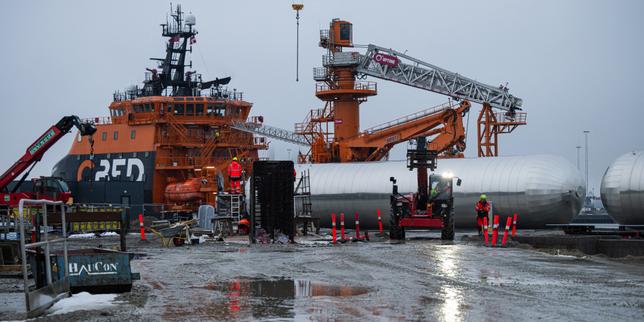
Denmark recently pumped liquefied carbon dioxide nearly two kilometers beneath the seabed of the North Sea, inaugurating a high-profile industrial burial site known as Project Greensand. Led by energy giant INEOS and backed by political fanfare, the milestone marks the first time captured emissions have been transported across borders and permanently sequestered offshore within depleted oil reservoirs. Yet beneath the celebratory rhetoric lies a complex web of economic uncertainty, infrastructural deficits, and unanswered questions regarding whether carbon capture and storage can scale fast enough to matter.
The technical premise is straightforward enough. Industrial emitters capture carbon dioxide at the smokestack, compress it into a liquid state, load it onto specialized vessels, and ship it out to decommissioned extraction platforms. From there, pumps force the gas down steel-lined wells into porous sandstone formations sealed off by impermeable caprock. Nature spent millions of years trapping fossil fuels in these subterranean vaults. Engineers now intend to fill those empty spaces with the very waste products generated by burning them.
For decades, the oil and gas sector treated the North Sea as a cash cow for extraction. Now, politicians in Copenhagen want to rebrand these exhausted basins as environmental salvation zones. The transition sounds poetic on paper. In practice, it represents a massive pivot for an industry searching for a social license to operate while continuing to extract hydrocarbons.
The Subterranean Mechanics
Understanding why Denmark chose the Nini West field requires looking at geology rather than public relations. Depleted oil and gas reservoirs offer proven structural integrity. For decades, geologists mapped these formations down to the individual meter, tracking how fluids move through sandstone under immense pressure. That historical data provides a safety baseline that greenfield storage sites simply cannot match.
When liquid carbon dioxide enters the reservoir, it behaves differently than natural gas or crude oil. Supercritical carbon dioxide—fluid maintained at specific temperatures and pressures where it acts like both a gas and a liquid—is denser than ambient air but lighter than formation brines. Over time, it migrates upward until it hits the thick shale and clay layers acting as a permanent lid. Secondary trapping mechanisms also kick in. Capillary forces trap tiny bubbles of the gas within the pore spaces of the rock, while geochemical reactions slowly dissolve the carbon into the surrounding saltwater, eventually mineralizing into solid stone.
This geochemical conversion is the ultimate goal. Solid rock cannot leak. But the timeline for complete mineralization spans centuries. Until then, engineers rely on seismic monitoring, pressure gauges, and periodic acoustic surveys to ensure the plume stays put. The technology works in controlled environments. Scaling it to handle millions of tons of industrial waste across dozens of weathered wells is an entirely different operational challenge.
Economic Realities and the Subsidy Trap
No discussion of carbon capture is complete without examining the balance sheet. Burying carbon is expensive. Capturing emissions from cement plants, steel mills, or chemical facilities requires energy-intensive chemical separation processes. Compressing, transporting, and injecting that gas adds another layer of cost. Without regulatory penalties or direct financial incentives, emitting carbon remains cheaper than burying it.
The European Union Emissions Trading System provides the primary economic engine for projects like Greensand. As the price of carbon allowances rises, heavy industrial emitters face a stark financial choice: pay millions in compliance taxes or invest in capture infrastructure. Denmark engineered its national strategy around this regulatory pressure, positioning itself as a regional hub for trans-boundary carbon transport.
Yet subsidies remain the invisible scaffolding holding the entire enterprise upright. Taxpayer funds and government grants co-financed the initial phases of Project Greensand. Critics argue that public financing props up corporate business models that should be self-sustaining. Energy companies insist that early-stage capital expenditure is necessary to establish a commercial market. Both arguments hold weight. The danger is that carbon storage becomes an expensive subsidy sink, diverting capital away from genuine emissions reduction at the source.
The Cross-Border Logistics Maze
One overlooked achievement of the Danish project is not geological, but bureaucratic. Carbon dioxide captured in Antwerp, Belgium, traveled across international maritime boundaries before reaching a Danish platform. That journey required navigating a maze of international maritime laws, environmental permits, and liability agreements that were never designed for a multi-nation waste disposal chain.
Under the London Protocol, dumping waste at sea was historically prohibited. Amendments passed years ago carved out an exception for carbon dioxide sequestration, but ratifying those amendments across multiple jurisdictions proved painfully slow. Countries had to sign bilateral agreements explicitly allowing the export and import of greenhouse gases for permanent storage.
This regulatory bottleneck threatens future expansion. If a cement plant in Germany wants to pipe or ship its emissions to a storage well off the coast of Norway or Denmark, the paperwork takes longer than building the capture facility itself. Legal harmonization across Europe remains incomplete. Liability is another thorny issue. If a carbon plume migrates outside the designated concession area or experiences a slow leak decades after the injection wells are capped, determining financial responsibility across corporate successors and government agencies creates a legal quagmire.
The Moral Hazard Argument
Environmental advocates raise a deeper objection that goes beyond economics or engineering. Carbon capture and storage acts as a life support system for fossil fuel combustion. By offering a technical mechanism to scrub emissions at the tailpipe or smokestack, the practice relieves pressure on heavy industries to transition away from fossil fuels entirely.
Oil majors love carbon capture because it preserves their core business model. If a refinery can capture its emissions and bury them underground, management can claim green credentials while continuing to extract petroleum. The moral hazard is real. Billions of dollars spent on injection wells and offshore pipelines cannot simultaneously be invested in green hydrogen, direct air capture innovation, or deep industrial electrification.
Proponents counter that certain sectors cannot be easily electrified. Cement production, for instance, releases carbon dioxide directly from limestone calcination during the chemical reaction itself, independent of the fuel used to heat the kiln. For these hard-to-abate industries, carbon capture is not an excuse to delay transition; it is the only viable pathway to net-zero emissions. Both perspectives are valid, creating an uncomfortable policy tension at the heart of modern climate strategy.
Infrastructure Deficits on the Horizon
Denmark’s North Sea triumph is currently a bespoke operation. Moving from a single demonstration project to a continental waste management network requires an unprecedented infrastructure buildout. Pipelines, onshore terminals, compression stations, and dedicated transport vessels must be manufactured, permitted, and deployed at industrial scale.
Existing natural gas pipelines flow in the opposite direction—from offshore fields to the mainland. Repurposing those pipelines for carbon dioxide transport sounds efficient, but old steel alloys suffer from corrosion risks when exposed to high concentrations of wet carbon dioxide. Impurities like water or hydrogen sulfide react with the gas to form corrosive acids, meaning pipelines must be thoroughly dehydrated or completely replaced with corrosion-resistant materials.
Building new onshore receiving terminals meets fierce local resistance. NIMBYism is not unique to wind turbines and transmission lines; citizens living near coastal towns object to industrial facilities processing pressurized greenhouse gases, regardless of safety assurances. Public consultations drag on for years, delaying the very infrastructure needed to meet regional climate targets.
The Global Replication Race
Denmark is not alone in betting on the seafloor. Norway operates the Sleipner and Snøhvit offshore storage sites, which have injected carbon dioxide into saline aquifers for decades as part of domestic tax compliance strategies. The Netherlands is aggressively developing its own depleted gas fields in the Dutch sector of the North Sea under projects like Porthos.
Outside of Europe, countries from the United States to Australia are fast-tracking class six injection wells to accommodate industrial clusters. Each region faces its own unique combination of geological constraints and regulatory hurdles. The North Sea stands out because of its dense concentration of mature petroleum infrastructure and favorable offshore geography.
Yet enthusiasm must be measured against operational reality. The cumulative capacity of all operational carbon storage projects globally currently handles a fraction of annual global industrial emissions. Scaling up by a factor of one hundred over the next two decades requires capital allocation and engineering execution on a scale historically reserved for wartime mobilization.
Hard Realities of Industrial Transition
Project Greensand deserves credit for turning theory into practice. Pumping millions of tons of liquefied gas into a depleted reservoir beneath stormy seas proves that the engineering is possible. But proving that an industrial process works in a controlled pilot phase is very different from proving it can sustainably anchor a global climate strategy.
The transition from fossil fuels to a low-carbon economy will not be neat or painless. Carbon storage is a diagnostic tool for a sick patient, not a cure for the underlying disease. If society relies on underground vaults to absorb endless streams of industrial waste without addressing the fundamental drivers of consumption and energy production, the North Sea seabed will eventually fill up.
Denmark has opened the door to a subterranean future. Whether the rest of the world follows through wise policy or stumbles into an expensive technological trap depends entirely on the rigorous accounting that happens long after the political ribbon-cutting ceremonies fade into memory.